Cambodia Imported $70 Million Worth of Coffee Last Year. Can Local Growers Win Some of It Back?
Cambodians drink far more coffee than the country grows. That gap is a chance to plant more, process better and build a coffee industry with a Cambodian name on it.
AGRICULTURE & AGRO-PROCESSING | THE BETTER CAMBODIA
Walk down almost any street in Phnom Penh and you’ll pass a coffee shop, often several. What most customers don’t realise is that the beans in their cup very likely came from somewhere else.
The Cambodia Coffee Association (CCA) says the Kingdom imported about 12,000 tonnes of green coffee beans in 2025, at a cost of more than $70 million. That works out to roughly $6,000 a tonne.
That is a lot of money leaving the country for a crop Cambodia can grow itself. If more of those beans were planted, harvested and processed here, more of that value would stay with Cambodian farmers and businesses.
Plenty of demand, not much supply
Coffee has quietly become part of daily life here, whether it’s an iced coffee with condensed milk from a roadside stall or a latte in one of the city’s newer cafés. And demand keeps climbing.
By the CCA’s count, Cambodians aged 20 to 69 drink around 1.5 million cups a day. Over a year, that adds up to about 11,200 tonnes of coffee.
Local farms grow only a fraction of that.
According to the Ministry of Agriculture, Forestry and Fisheries, Cambodia produced 1,333 tonnes of coffee in 2025. Of the 705 hectares planted, 563 were harvested, at an average of 2.36 tonnes per hectare.
Put those numbers side by side and the gap is hard to miss. It leaves plenty of room for new plantations, contract farming with smallholders and more modern growing methods.
Where the coffee grows
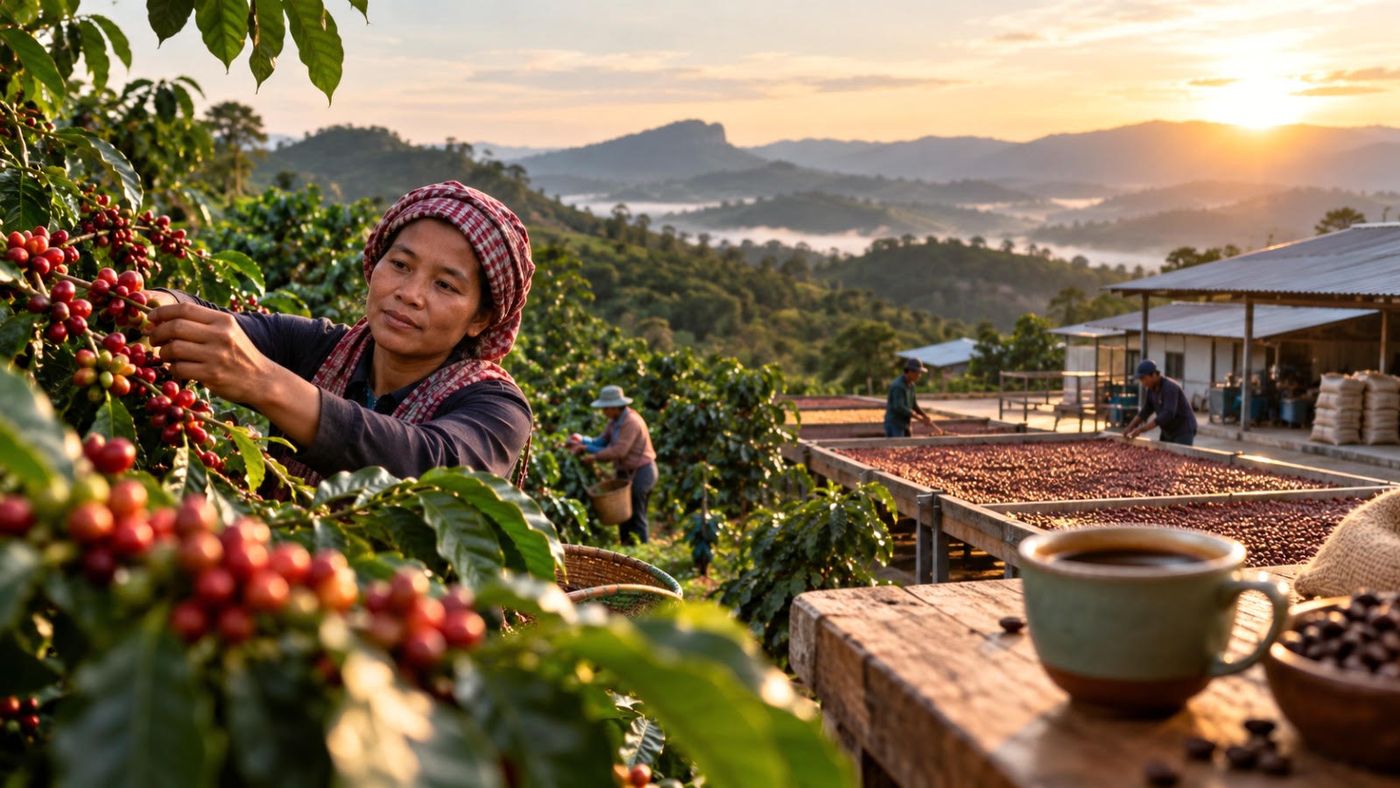
Coffee is already grown in Mondulkiri, Ratanakiri, Pursat, Pailin and Tboung Khmum.
Mondulkiri stands out. Its conditions suit Robusta well, and some of its higher ground may be able to support Arabica too.
The two beans sell into different markets. Robusta goes mostly into traditional blends and instant coffee. Good Arabica, on the other hand, can fetch premium prices from speciality buyers.
Land alone won’t do it, though. Farmers need good seedlings, water, training and, just as important, someone reliable to sell to.
Investors need patience as well. A coffee tree usually takes about three years to produce a commercial crop and around five to reach full yield. Anyone getting into the business has to plan for that wait.
It’s not only about planting
For traders and entrepreneurs, some of the more interesting openings sit further along the chain.
Cambodia still needs collection centres, drying facilities, grading equipment, roasteries, packaging and better distribution.
Then there’s the import trade itself. Roasters, hotels, restaurants and café chains all need a steady supply of green beans, and someone has to provide it.
Vietnam and Thailand already play a big part in Cambodia’s coffee supply. Working with experienced producers from those countries could bring in technology and processing know-how, and help get Cambodian coffee brands off the ground.
Growing more at home doesn’t have to mean shutting out foreign suppliers. In practice, it could mean blending local beans with imported ones to suit different tastes.
Selling beyond Cambodia
The home market isn’t the only one.
In 2025, Cambodia exported about 601 tonnes of coffee. Buyers included Estonia, China, Japan and Russia.
The volumes are still small, but it shows Cambodian coffee can already find customers abroad.
Some private companies are already putting money in.
In June 2026, The Phnom Penh Post reported that Kiri Coffee had bought nearly 700 tonnes of beans from indigenous farmers in Mondulkiri, putting around $700,000 into the local economy.
It’s the kind of long-term relationship that can work for both sides: the buyer gets a reliable source of beans, and the farmers get a market they can count on.
If growers and processors can get certification, traceability and consistent processing right, Cambodian coffee has a real shot at a bigger place in regional and international speciality markets.
The hurdles are real
None of this will be easy.
Many farmers lack technical know-how. Processing is expensive, labour is hard to find, the weather is getting less predictable, and cheaper imported coffee keeps prices under pressure. Any one of these can eat into profits.
Finance is another sticking point. A new plantation earns little in its first few years, and farmers need affordable credit to get through that stretch.
Public-private partnerships, farmer cooperatives and guaranteed purchase agreements could all help ease the strain.
One thing should be non-negotiable: new coffee belongs on suitable farmland that is already in use, not on cleared forest.
Worth a closer look
Cambodia’s coffee industry is young, but the basics are in place. People here already drink plenty of coffee, there are regions well suited to growing it, and local businesses are starting to pay attention.
For investors, the best bets may be integrated models that tie together growing, farmer partnerships, processing, branding and distribution.
For farmers, coffee could mean an extra source of income and a foothold in a higher-value supply chain.
The customers are here, and the export links already exist. What’s missing is more home-grown production, better processing and investment that sticks around.
Cambodia has built a real coffee culture. The next step is to build a coffee industry to match.
Sources and data note
Cambodia Coffee Association figures as reported by Cambodianess (October 21, 2026); Ministry of Agriculture, Forestry and Fisheries production figures; The Phnom Penh Post (June 6, 2026); and Kiripost (May 2026). The $70 million import figure is reported by the industry. UN Comtrade data for the narrower customs category of unroasted, non-decaffeinated coffee shows about $4.85 million in Cambodian imports for 2025, so the two figures should not be read as matching customs totals