The man who painted Cambodian cinema’s ‘Golden Age’
Dieser Artikel ist in dieser Sprache noch nicht verfügbar. Sie lesen das englische Original.

Moeun Chhay, a self-taught artist, earned 900 riel per month as a teenager painting advertising hoardings for Cambodian films playing in Battambang.
He was probably the last representative of this skill who worked prior to the Khmer Rouge era.
Chhay’s livelihood as a teenager in Battambang in the 1960s was the cinema. He was one of a small group of painters engaged in the single profession of poster painting, which involved replicating a film’s pocket-sized “lobby card” into large paintings, which were then hung on the theatre’s front.
He designed the carousel of renowned faces and fantastical ghosts who gazed down on the streets below from the late 1960s until 1975, which was often the public’s only hint as to what to expect from the movies on show.
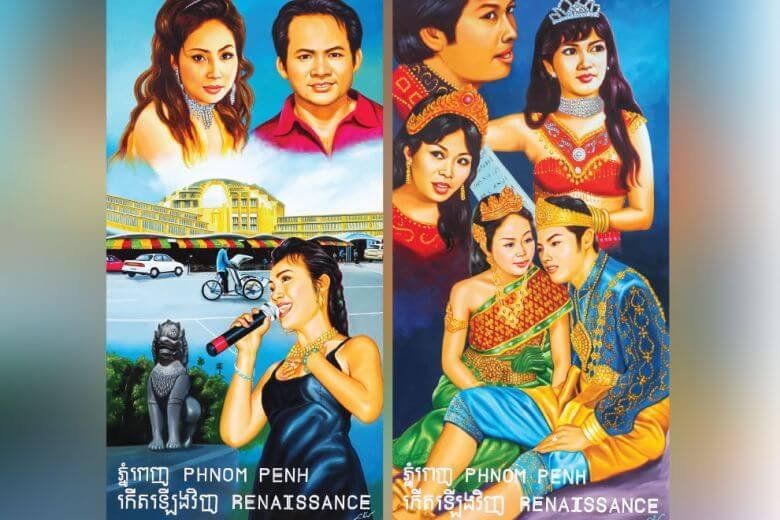
Only 30 of the estimated 400 films made during Cambodia’s “golden age” of cinema remained the Khmer Rouge. Finding artwork that is relevant to them is extremely difficult. After a film had finished screening, Chhay would take his canvas down to the river, wash out the powder colours, and start over.
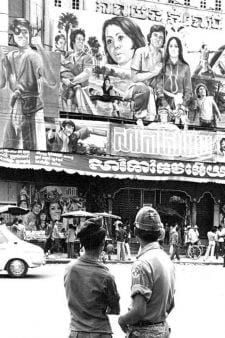
One of Chhay’s most remarkable works was the design of a low-budget film about a ghostly mother and child. He created a cut-out arm that he tied to a rope inside the theatre. It appeared that the mom was rocking her pale infant when workers tugged it.
The poster for the horror film became a stand-alone attraction. During this time, he learnt to play music the same way he learned to paint: by watching and copying musicians.
Chhay got a job with the Ministry of Fine Arts in 1980, and they gave him the house next to the Golden Temple Cinema as a gift. After the arrival of commercial printers in Battambang, he resumed painting for a time, but business slowed and eventually dried up.