When Deputy Prime Minister H.E. Hun Many led an official Cambodian delegation to London, the visit carried a weight that went well beyond the formality of diplomatic protocol. It was, in many ways, a physical expression of something that trade data has been quietly signalling for several years now, that Cambodia and the United Kingdom are building a relationship with genuine substance behind it.
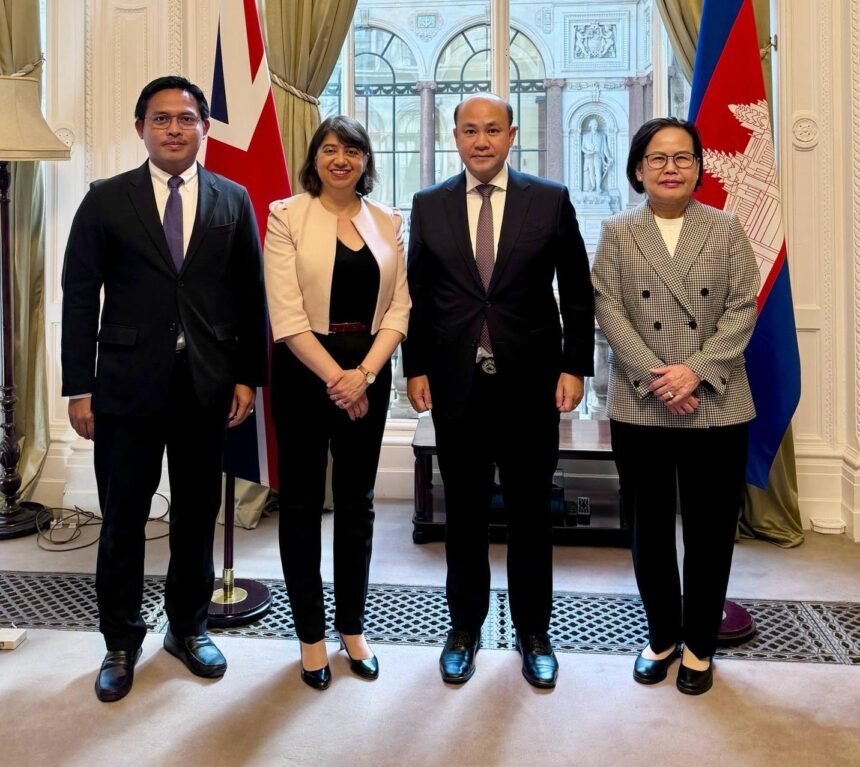
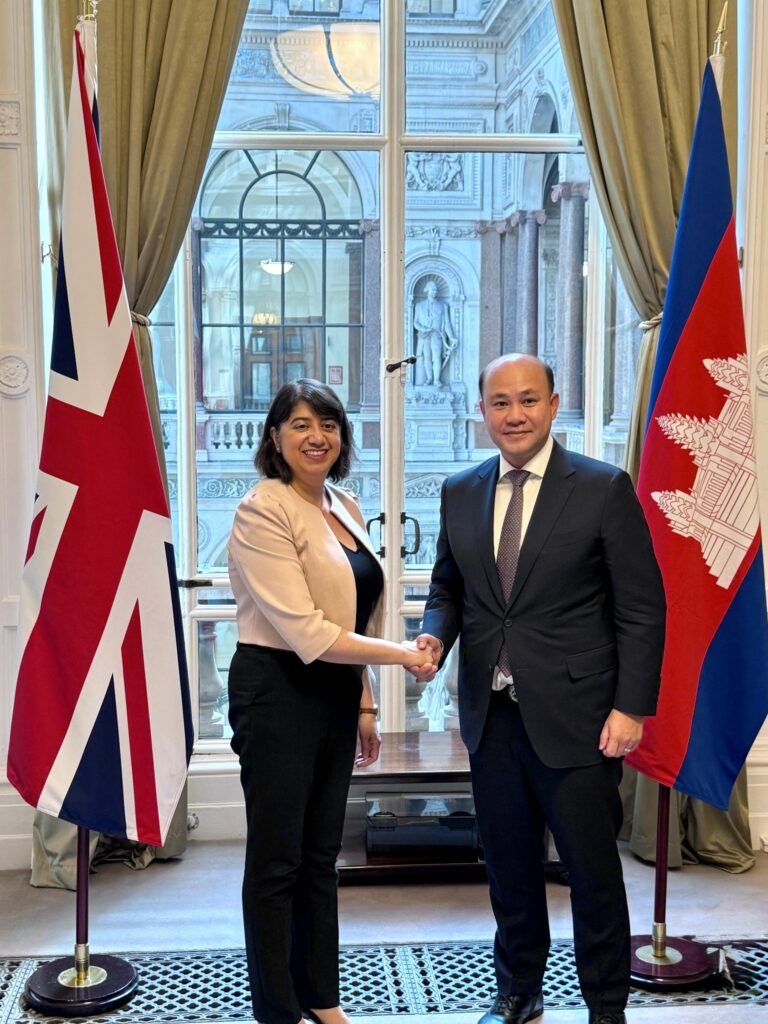
On 8 April, Deputy Prime Minister H.E. Hun Many sat down with UK Minister for the Indo-Pacific Seema Malhotra MP for talks that covered an unusually broad range of shared concerns. Trade and investment formed the backbone of the discussion, but the conversation extended into defence cooperation, education, instability in the Middle East, and the sensitive situation along the Cambodian-Thai border. Minister Seema Malhotra MP expressed the United Kingdom’s desire to support a peaceful resolution to border tensions and acknowledged the important role of the Joint Border Commission in that process. She also reaffirmed UK support for Cambodia’s ongoing crackdown on online scam operations, an issue that has drawn international attention and one that the Royal Government of Cambodia has pursued with notable determination.
The delegation accompanying Deputy Prime Minister H.E. Hun Many included H.E. Samheng Boros, Minister attached to the Prime Minister of the Kingdom of Cambodia, whose presence underscored the seriousness with which Phnom Penh approached the visit. Also present throughout the London engagements was H.E. Mrs Tuot Panha, Ambassador Extraordinary and Plenipotentiary of the Kingdom of Cambodia to the United Kingdom. Those familiar with the Cambodia-United Kingdom relationship will not be surprised by the warmth with which the delegation was received. H.E. Mrs Tuot Panha has built a reputation for quiet, consistent, and exceptional stewardship of the bilateral relationship, and her presence was widely regarded as both fitting and significant.
The backdrop to all of this is a trade relationship that has been growing at a pace few would have predicted even five years ago. Bilateral trade between Cambodia and the United Kingdom reached £1.1 billion in the twelve months to the end of September 2025, a 36.2 percent increase, or £298 million more than the previous year. Total UK imports from Cambodia stood at £965 million in the same period, driven overwhelmingly by goods. Cambodian garments alone accounted for £768.5 million of that figure, with footwear adding a further £97.3 million. These are industries built on the labour of millions of Cambodian workers, and every percentage point of growth in those numbers carries real meaning for real families.
What has drawn particular attention among trade observers is the dramatic rise in UK services exports to Cambodia, which grew by 195.2 percent in a single year. It is the kind of shift that signals a maturing relationship, one moving beyond the simple exchange of goods and into something more interconnected and durable.
The macroeconomic picture adds further weight to the optimism expressed on both sides in London. The International Monetary Fund projects Cambodia’s GDP will reach USD 51.5 billion in 2026, with growth forecast to accelerate toward 5.5 percent by 2030. GDP per capita, which stood at USD 2,500 in 2023, is on a steady upward path toward USD 2,900 this year. Cambodia’s inward foreign direct investment stock reached USD 52.7 billion at the end of 2024, nearly double what it was in 2017. The country’s global GDP ranking has climbed from 101st in 2023 to a projected 96th in 2026. Under the leadership of Prime Minister Samdech Thipadei Hun Manet, Cambodia has pursued a deliberate course of economic modernisation and diversification that is beginning to show up clearly in the numbers.
The London visit sent a clear message to international partners and investors alike. Cambodia is not a country waiting for opportunity to find it. It is a country that shows up, engages seriously, and builds relationships that last. Deputy Prime Minister H.E. Hun Many’s engagements in the United Kingdom demonstrated exactly that, a nation confident in its trajectory and clear-eyed about the partnerships it wants to deepen.
The relationship between Cambodia and the United Kingdom is no longer one that requires explanation or justification. It is a working partnership between two countries that see clear value in each other and that are prepared, as the London talks showed, to act on it.