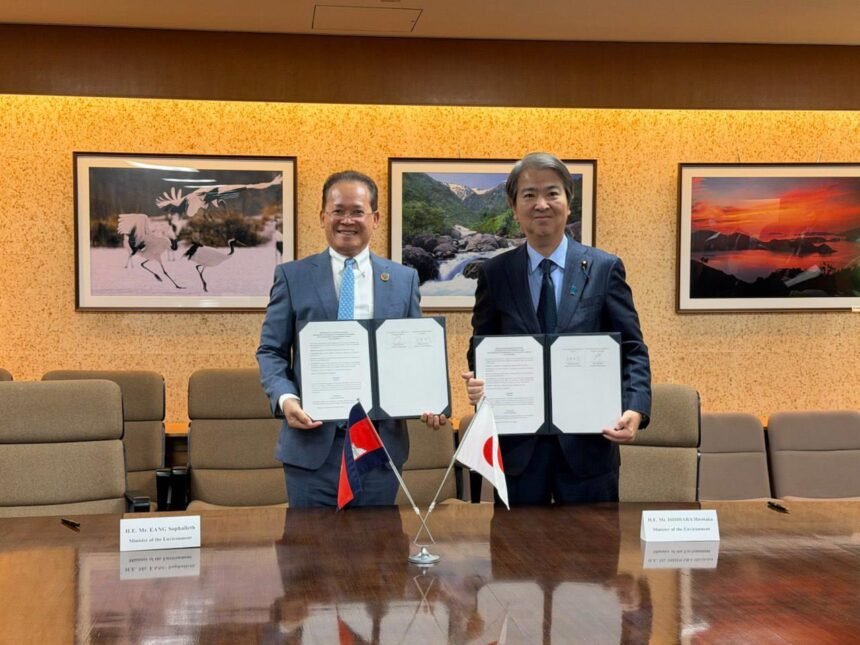
On 16 February 2026, Cambodia and Japan formalized a major environmental partnership in Tokyo with the signing of a Memorandum of Cooperation (MoC) aimed at deepening bilateral collaboration on climate and sustainability issues. The signing took place at the Office of the Minister of the Environment of Japan and was attended by Eang Sophalleth, Minister of Environment of the Kingdom of Cambodia, and Ishihara Hirotaka, Minister of the Environment of Japan.
The agreement marks a significant development in environmental cooperation between the two nations and reinforces ongoing efforts to address global climate challenges. According to official remarks, the MoC symbolizes a strengthened strategic partnership, reflecting shared commitments to environmental protection, conservation, and sustainable development.
In his remarks, Minister Eang Sophalleth underscored that contemporary environmental issues such as climate change, pollution, and biodiversity loss transcend national borders and require sustained international collaboration and trust. He noted that Cambodia’s environmental priorities are anchored in its Circular Strategy on Environment (2023–2028) and National Biodiversity Strategy, which collectively guide the country’s long-term commitment to ecological resilience.
The partnership also builds on prior successful collaboration, including initiatives under the Joint Crediting Mechanism (JCM) that began in 2014. These initiatives have supported renewable energy projects and forest conservation efforts, particularly through REDD+ (Reducing Emissions from Deforestation and Forest Degradation), which integrates carbon sequestration strategies. Cambodia now plans to expand private sector involvement and strengthen carbon market frameworks with technical support from Japan.
The MoC sets out four strategic priority areas:
- Climate mitigation and adaptation with a target to reduce greenhouse gas emissions by 55% by 2035 across key economic sectors;
- Circular economy advancement, focusing on plastic waste reduction and resource efficiency;
- Pollution prevention, with enhanced monitoring for air, land, and water quality;
- Biodiversity conservation to support long-term ecological health and pathways to carbon neutrality by 2050.
This agreement reflects a renewed commitment by both countries to address pressing environmental concerns and promote sustainable development globally.
Also Read: International Collaboration in AI: What It Means for Cambodia