The Moment Training Becomes Real
There is a special kind of confidence that appears in a young person when learning suddenly feels real.
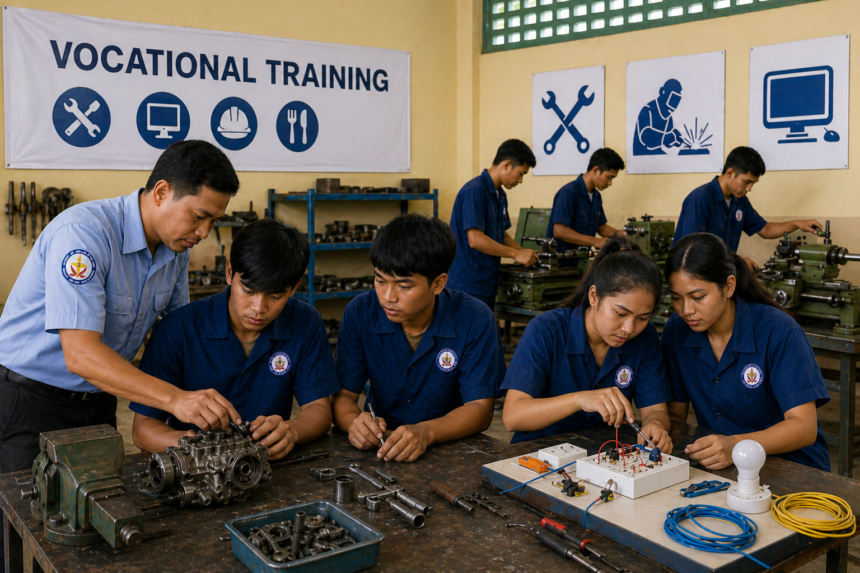
It happens when a student stops practicing on paper and starts working with actual tools. It happens when a trainee steps into a real company, watches how a team operates, and realizes, I can do this too. It happens when education is no longer something distant or abstract, but something connected to a real future, a real income, and a real place in society.
That is exactly the future Cambodia is building.
The Ministry of Labour and Vocational Training is helping shape a new relationship between training and employment, one where classrooms and companies no longer stand far apart, but move forward together. Under the Cambodia Skills Development Roadmap 2023–2035, Pillar 3: Industry Relevant TVET is a dedicated strategic pillar, designed to strengthen links between training institutions and employers, expand private-sector participation, promote reskilling and upskilling, and establish more Sector Skills Councils.
From Certificates to Confidence
For many years, one of the biggest challenges in skills development was not effort. Students were trying. Teachers were trying. Employers were trying. The problem was alignment.
Too often, young people completed training only to discover that the job market was moving in a slightly different direction. A certificate alone was not always enough. Employers needed practical skills, adaptability, good work habits, and familiarity with real workplace expectations.
Cambodia’s roadmap responds to this challenge with clarity. It does not treat training as something separate from the economy. Instead, it treats skills development as part of the living, changing heartbeat of the labour market. That is an encouraging shift, because it means the goal is no longer just to train people. It is to prepare them to succeed.
Bringing Employers Into the Learning Journey
One of the most promising ideas in this roadmap is simple but powerful: employers should not only hire graduates at the end of the process; they should help shape the process itself.
That means stronger collaboration between training institutions and industry, so curricula and training standards reflect what businesses truly need. It means the private sector taking a more active role in skills development, not as an outside observer, but as a real partner. The roadmap goes further than aspiration here: it calls for mandatory provisions requiring industries to hire certified workers, for Centers of Excellence to be established in high-growth sectors, and for the number of industry partnership programs to grow measurably year on year. It also means students gaining exposure to the realities of work before they graduate, rather than after.
This kind of partnership changes everything. When industry helps guide training, students are more likely to learn relevant skills. When students learn relevant skills, employers gain workers who are ready faster. When employers find the talent they need locally, the whole country becomes more competitive.
Learning Inside the Workplace
Some lessons are best taught in a training center. Others can only be learned by stepping into the rhythm of real work.
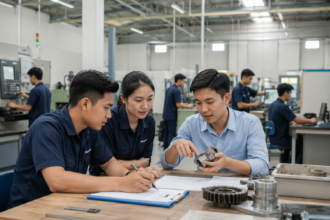
That is why apprenticeships, internships, and industry placements matter so much. The roadmap highlights the importance of successful industry placements, including internships and apprenticeships, as a key measure of progress. This reflects a very practical truth: when students spend time in real workplaces, they gain more than technical ability. They learn punctuality, teamwork, communication, problem-solving, and the everyday discipline that turns knowledge into professionalism.
For many young Cambodians, this kind of experience can be life-changing. It helps them see themselves not just as students, but as future technicians, creators, supervisors, entrepreneurs, and leaders. It gives them a first glimpse of the world they are preparing to enter, and it helps that world feel possible.
A System That Grows With the Economy
Cambodia is changing quickly, and that is good news. But every growing economy faces the same challenge: the faster industries evolve, the faster skills systems must evolve too.
The roadmap recognizes this by promoting both reskilling and upskilling across priority sectors including apparel and textile, tourism and hospitality, and mining and exploration, with work-based learning programs developed in direct partnership with industries. This is one of the most hopeful parts of the entire vision, because it says something important about the future of work in Cambodia: learning does not stop at graduation. A young graduate may need new digital skills after a few years in the workforce. A factory employee may need retraining as machinery becomes more advanced. A worker in one sector may decide to transition into another. The roadmap makes space for all of these journeys by encouraging continuous learning that responds to change, not fear it.
This is how nations become resilient. Not by pretending the economy will stay the same, but by helping people grow along with it.
Sector Skills Councils and a Smarter Future
Another important part of this story is the strengthening and expansion of Sector Skills Councils (SSCs). Cambodia currently has four SSCs. The roadmap sets a clear target: grow that number to twelve by 2035, each formalised through a Memoranda of Agreement, covering all key economic sectors and all regions of the country. These councils create structured dialogue between industries and the training system, ensuring Cambodia continuously understands what skills are needed now and what will be needed next.
This may sound technical, but its impact is deeply human. When the right people sit at the same table, educators, industry leaders, institutions, and policymakers, better decisions are made. Training becomes more focused. Young people waste less time on irrelevant pathways. Employers feel heard. The country moves forward with more confidence.
In a fast-changing world, listening well may be one of the smartest skills a nation can have.
A Better Match Between Talent and Opportunity
At its heart, this pillar is really about connection.
It is about connecting learning with livelihoods. Connecting ambition with opportunity. Connecting young people with industries that need their energy, creativity, and determination. It is also about connecting Cambodia’s national development goals with the everyday hopes of ordinary families.
When training reflects the real world, people do not just graduate. They step forward. They do not just search for work. They begin to see where they belong. Companies do not just fill positions. They help build the workforce that will carry the country into the future.
That is what makes this chapter of Cambodia’s skills journey so exciting. It is not only about producing workers. It is about building confidence, readiness, and shared progress.
The Ministry of Labour and Vocational Training is helping ensure that in Cambodia, skills are not learned in isolation. They are shaped in partnership, tested in the real world, and turned into opportunity. When that happens, a stronger Cambodia does not feel far away at all. It feels like something already taking shape, one learner and one workplace at a time.