Cambodia has more public holidays than almost any country in Southeast Asia — 28 official days off per year. But these aren’t just days to close the office. Each one carries centuries of history, Buddhist philosophy, royal ceremony, and the living memory of a people who nearly lost everything. Whether you’re a traveller planning a visit, an expat managing a business calendar, or simply someone who wants to understand Cambodian culture more deeply, this guide covers every public holiday in Cambodia with the cultural context that makes them genuinely worth understanding.
- Overview: How Cambodia’s Holiday System Works
- January: New Year and Victory Day
- March: International Women’s Day
- April: Khmer New Year (Chaul Chnam Thmey) — The Biggest Celebration of the Year
- May: Labour Day, Royal Plowing, King’s Birthday, Visak Bochea
- September–October: Constitutional Day and Pchum Ben
- October: Royal Commemorations
- November: Independence Day and the Water Festival
- December: Human Rights and Peace
- Practical Tips for Travellers and Businesses
- Final Thought: Holidays as Living History
Overview: How Cambodia’s Holiday System Works
Cambodia officially observes 28 public holidays per year — a number that frequently surprises visitors, especially those from Western countries accustomed to 8–12. This abundance reflects the country’s deep roots in Theravada Buddhism, its complex royal heritage, and its deliberate effort to rebuild national identity after the devastation of the Khmer Rouge era.
Cambodian holidays fall into three broad categories:
Buddhist festivals — tied to the lunar calendar, meaning their Gregorian dates shift each year. These include Khmer New Year, Pchum Ben, Visak Bochea, and Bon Om Touk (the Water Festival). They are the most deeply felt by ordinary Cambodians and result in the greatest movement of people around the country.
Royal and national commemorations — fixed dates marking events in Cambodian political and royal history: Independence Day, Constitution Day, the King’s Birthday, Coronation Day, and Victory Day.
International observances — Labour Day, International Women’s Day, and International Human Rights Day, which Cambodia observes as paid public holidays under its Labour Law.
Under Cambodian law, if a public holiday falls on a Sunday, the following Monday becomes the substitute day off. Workers required to work on a public holiday are entitled to their normal wage plus 100% additional pay.
Also read, Nearly 9 Million Flock to Phnom Penh for Landmark “Nokor Sankranta” Celebrations
January: New Year and Victory Day
January 1 — International New Year’s Day
Cambodia officially observes January 1st as a public holiday, though it is celebrated relatively modestly compared to Khmer New Year in April. Phnom Penh sees fireworks along the Tonlé Sap riverfront, and restaurants and bars — especially those catering to expats and tourists — hold events. For most Cambodians, particularly in rural areas, this is simply a day off rather than a culturally significant observance.
January 7 — Victory Day (Victory over Genocide Day)
What it marks: The fall of the Khmer Rouge regime on January 7, 1979, when Vietnamese forces and Cambodian resistance fighters captured Phnom Penh, ending four years of genocide under Pol Pot.
The history: Between 1975 and 1979, the Khmer Rouge’s Democratic Kampuchea regime killed an estimated 1.5 to 2 million Cambodians — roughly a quarter of the population — through execution, forced labour, starvation, and disease. Cities were emptied, money abolished, religion banned, and the educated and professional classes systematically murdered. January 7 ended that horror.
Cultural significance: This is both a day of liberation and a day of collective grief. Ceremonies are held at genocide memorials, including the Tuol Sleng Genocide Museum in Phnom Penh — formerly the Khmer Rouge’s S-21 torture prison — and at Choeung Ek, the most significant of the “Killing Fields” sites. The day is politically complex: Vietnamese involvement means the holiday has sometimes been framed differently by different governments, but for most ordinary Cambodians, it is simply the day they were freed.
For visitors: If you are in Phnom Penh on January 7, visiting Tuol Sleng and Choeung Ek is a profound and important experience. Both sites are open to the public and are among the most important historical sites in Southeast Asia. Approach with appropriate solemnity.
March: International Women’s Day
March 8 — International Women’s Day
Cambodia is one of the few countries in the world where International Women’s Day is a fully paid public holiday for the entire workforce. The day carries particular weight given that Cambodian women make up the majority of the garment industry workforce — a sector that employs over 600,000 people and drives much of the country’s economy.
Celebrations range from workplace events and gifts to public parades and community gatherings. The Royal Government typically issues statements on gender equality, and NGOs working on women’s rights hold conferences and community events. In provinces, women’s groups often organize village-level celebrations.
Also read, Kep to Koh Rong: From Quiet Shores to Island Vibes
April: Khmer New Year (Chaul Chnam Thmey) — The Biggest Celebration of the Year
April 13–16 (dates shift slightly each year) — Khmer New Year
In a single sentence: Khmer New Year is the most important event on the Cambodian calendar — a three-day national celebration marking the end of the harvest season that empties cities, fills pagodas, and brings the entire country together in a way nothing else does.
The name and its meaning
Cambodian New Year, known as Choul Chnam Thmey (ចូលឆ្នាំថ្មី), literally means “Enter the New Year.” It is also called Moha Sangkran, from the Sanskrit word Sankranti, meaning “great transition.” Unlike Chinese New Year or other lunar new year celebrations that fall in January or February, Cambodian New Year aligns with the traditional solar calendar and falls in mid-April, coinciding with the end of the dry season and the conclusion of the rice harvest.
Origins and history
The origins of Chaul Chnam Thmey can be traced to the time of the Angkor Empire. The Angkor kings, who were patrons of the arts and religion, instituted rituals and ceremonies to usher in the New Year with reverence and joy, drawing on Hindu and Buddhist cosmology. The celebration shares common roots with Songkran in Thailand and Pi Mai in Laos — all three mark the solar new year in April across mainland Southeast Asia.
The three days and their rituals
Each of the three official days has its own name, rituals, and meaning:
Day 1 — Maha Sangkran is the official start of the new year. People dress up and light candles and burn incense sticks at shrines, where family members pay homage to the Buddha. For good luck, people wash their face with holy water in the morning, their chest at noon, and their feet in the evening.
Day 2 — Veareak Vanabat is the day of charity. People contribute to the less fortunate by helping the poor, servants, the homeless, and low-income families. Gifts are presented to parents, grandparents, and elders as expressions of respect and gratitude.
Day 3 — Veareak Laeung Sak is the purification day. Buddhists wash Buddha statues and elders with perfumed water to symbolize purification and renewal of good fortune. Young people offer this ritual bath to grandparents and parents, who in return give blessings and advice for the year ahead.
The sand stupas
One of the most visually striking traditions of Khmer New Year is the building of sand mounds on temple grounds. People erect a sand hillock on temple grounds — a big pointed hill representing Valuka Chaitya, the stupa at Tavatimsa where the Buddha’s hair and diadem are buried. The large stupa is surrounded by four smaller ones representing the stupas of the Buddha’s favourite disciples: Sariputta, Moggallana, Ananda, and Maha Kassapa.
Traditional games
During Khmer New Year, street corners fill with friends and families playing traditional Khmer games to maintain mental and physical dexterity. One of the most beloved is Chol Chhoung — a game involving two teams of boys and girls throwing a tied scarf between them, with the catcher immediately hurling it at someone they like from the opposing team. If it lands, that person’s whole team must sing and dance. It is, in essence, a deeply traditional form of flirting.
Traditional foods
Khmer New Year features a feast of traditional foods: Kralan (bamboo sticky rice) — sticky rice mixed with coconut milk and beans, stuffed into a bamboo tube and roasted over fire. Nom Ansom Chek — banana sticky rice cake wrapped in banana leaves. Somlor Machu Kroeung — a sour soup of fish, lemongrass, turmeric, and tamarind.
Where to experience it
Phnom Penh is lively but notably quieter than usual — most residents return to their home provinces. Siem Reap hosts the spectacular Angkor Sangkran event near the temples. Rural provinces like Battambang and Kampot offer the most authentic experience of family-centred celebrations at the local pagoda.
May: Labour Day, Royal Plowing, King’s Birthday, Visak Bochea
May 1 — International Labour Day
Cambodia’s garment industry makes Labour Day politically significant here in a way it is not in many countries. Workers’ rights organisations hold marches and demonstrations, and the day often sees public statements from unions about wage demands and working conditions. For tourists, this is simply a public holiday when most businesses are closed.
Early May — Royal Plowing Ceremony (Preah Reach Pithi Chrat Preah Neangkol)
What it is: One of the oldest royal ceremonies still practised in Cambodia, the Royal Plowing Ceremony officially marks the start of the rice planting season. The exact date is set by Brahmin priests according to the lunar calendar and typically falls in early to mid-May.
The ceremony: Held at Veal Preah Mein Square in front of the Royal Palace in Phnom Penh, the ceremony involves royal oxen pulling a gilded plough through a symbolic field. After the ploughing, the oxen are presented with seven trays of food and drink — rice, corn, beans, sesame, water, grass, and rice wine. By observing which feed the royal oxen choose, Cambodians believe they can predict a range of events for the coming year, including epidemics, floods, good harvests, and excessive rainfall.
The ceremony is taken seriously. Predictions made at the Royal Plowing Ceremony are reported in Cambodian national media and discussed widely. It reflects a worldview in which agriculture, royalty, religion, and cosmic order are inseparable — a perspective that has shaped Cambodian civilisation since the Angkor era.
May 14 — King Sihamoni’s Birthday
His Majesty King Norodom Sihamoni, who ascended to the throne in 2004, was born on May 14, 1953. The day is marked with ceremonies at the Royal Palace and public festivities. King Sihamoni is widely respected as a culturally sophisticated monarch — he trained as a classical dancer in Prague and Paris — and his birthday is celebrated as a day of national unity.
Variable date in May — Visak Bochea Day
What it marks: The birth, enlightenment, and death of the Buddha — all three events are believed to have occurred on the same day of the lunar calendar (the full moon of the month of Visakha).
Visak Bochea is observed across the Buddhist world, but in Cambodia it carries particular depth given that Theravada Buddhism is not just a religion but the foundational framework of Cambodian culture, ethics, law, and daily life. Cambodians visit pagodas before dawn, offer food to monks, listen to dharma talks, release lanterns, and participate in candlelit circumambulation of temple buildings. It is one of the most spiritually significant days on the Cambodian calendar.
Also read, Chi Phat: The Pioneer of Purpose in Cambodia’s Ecotourism Story
September–October: Constitutional Day and Pchum Ben
September 24 — Constitutional Day
This marks the adoption of Cambodia’s current constitution on September 24, 1993, following the UN-supervised elections of that year — the country’s first free elections after decades of war and foreign occupation. The constitution established Cambodia as a constitutional monarchy and guaranteed fundamental rights including freedom of expression and religion.
Late September to mid-October — Pchum Ben (Ancestors’ Day)
In a single sentence: Pchum Ben is Cambodia’s equivalent of the Day of the Dead — a 15-day festival when the spirits of deceased ancestors are believed to walk the earth, and the living must feed them through offerings at temples or risk their ancestors’ curse.
The name
“Pchum” means “to gather together” and “Ben” means “a ball of food.” The festival is a time when many Cambodians pay their respects to deceased relatives of up to seven generations.
The spiritual framework
Pchum Ben is one of Cambodia’s most sacred traditions. Over fifteen days, families gather to honor up to seven generations of ancestors, offering food at pagodas not only for their departed loved ones but also for wandering and unfortunate souls.
It is believed that the spirits of the dead — known as Preta or Asurakaya — arrive during these days to receive offerings. According to Buddhist teachings, there are twelve types of Preta, each distinguished by its appearance and condemned to suffer different punishments based on past karma. Monks chant the Parabhava Sutra, the “twelve causes of downfall,” reminding the living to act with compassion.
The 15 days
The first 14 days are called Kan Ben — observing days. Each day, a different local pagoda hosts the ceremony, with families rotating their visits to ensure their ancestors at each pagoda receive offerings. Families arrive before dawn with food, preparing offerings for monks and spirits. One of the most symbolic acts is throwing bay ben — balls of sticky rice sometimes mixed with beans — onto the temple grounds before sunrise.
The belief is striking in its specificity: it is believed that some ancestors who committed sins while alive cannot enter the temples even as ghosts, and can only eat food that has been thrown outside the temple walls by their descendants.
The 15th day, Pchum Ben, is the climax — an official 3-day public holiday. Everyone dresses up for the occasion. Cambodians believe their actions on earth shape their appearance as a ghost after death. By praying and offering food during Pchum Ben, the family is helping their ancestors pass on to a better life, while also ensuring their ancestors do not become angry and curse them.
Why it matters culturally
Pchum Ben is one of the most important events for understanding Cambodian society. It explains why family obligations run so deep, why Cambodians feel compelled to return to their home provinces despite the financial cost, and why the relationship between the living and the dead is not metaphorical in Cambodia but genuinely felt as active and reciprocal.
For travellers in Cambodia during Pchum Ben: expect to find the country somewhat subdued as people focus on religious duties. Visiting a local pagoda at dawn to witness the offerings is a rare and moving experience — approach respectfully and ask before photographing.
Also read, How to Travel Responsibly: A Cambodian Guide to Eco-Travel That Gives Back
October: Royal Commemorations
October 15 — Commemoration Day of the Late King Father
This marks the death anniversary of His Majesty King Father Norodom Sihanouk, who passed away on October 15, 2012, in Beijing. Sihanouk was one of the most complex and consequential figures in modern Cambodian history — he led Cambodia to independence from France in 1953, navigated impossible pressures during the Vietnam War, was deposed in a US-backed coup in 1970, and ultimately returned to Cambodia to serve as a symbol of national unity. He is revered by many Cambodians as the “Father of the Nation.” The day is marked with ceremonies at the Royal Palace and moments of national reflection.
October 29 — King Sihamoni’s Coronation Day
King Norodom Sihamoni was crowned on October 29, 2004, following his father’s abdication. The day marks the anniversary of his coronation and is observed with royal ceremonies and public celebration.
November: Independence Day and the Water Festival
November 9 — Independence Day
What it marks: Cambodia’s independence from France on November 9, 1953, after nearly a century of French colonial rule that began in 1863.
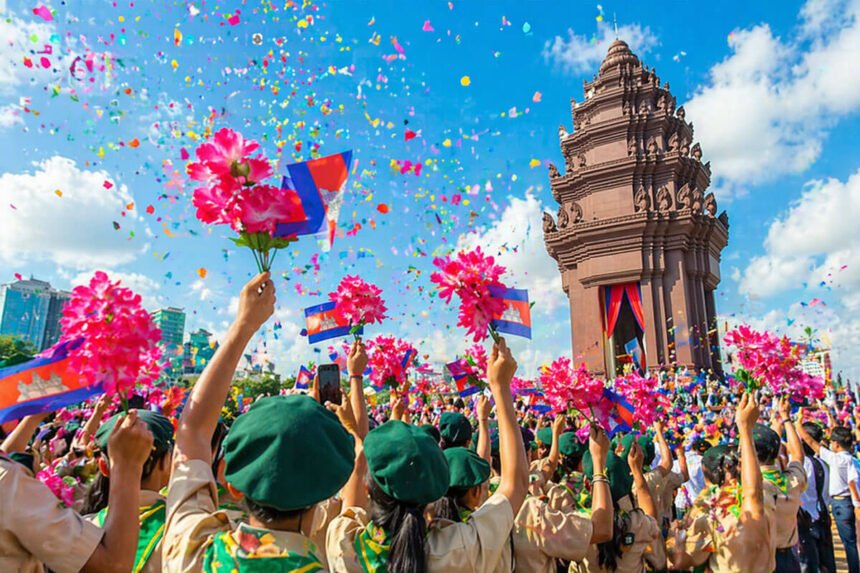
The independence movement was largely driven by the young King Norodom Sihanouk, who used a combination of political pressure, international diplomacy, and popular mobilisation to achieve independence without the protracted armed struggle seen in neighbouring Vietnam. The day is observed with a formal ceremony at the Independence Monument in Phnom Penh — a striking lotus-shaped tower built in 1958 — attended by the Royal Family, government officials, and military representatives.
For travellers, the Independence Monument illuminated at night on November 9 is one of the most beautiful sights in Phnom Penh.
Late October or November — Bon Om Touk (Water and Moon Festival)
What it is: The largest annual gathering in Cambodia — a 3-day festival that draws over a million people to the banks of the Tonlé Sap and Mekong rivers in Phnom Penh, with smaller celebrations across the country.
The natural phenomenon at its heart
Bon Om Touk celebrates one of the most remarkable hydrological events in the world: the reversal of the Tonlé Sap River. For most of the year, the Tonlé Sap River flows southward from Tonlé Sap Lake into the Mekong. But during the monsoon season, the Mekong swells so dramatically that it reverses the Tonlé Sap’s current, pushing water back upstream into the lake. The festival coincides with the unique reversal of the Tonlé Sap River’s flow, which occurs at the end of the rainy season. When the Mekong recedes, the lake drains back southward, releasing enormous quantities of fish and fertilising the surrounding floodplains. This phenomenon has sustained Cambodian civilisation for millennia.
The history
Boat racing is believed to have been celebrated in Cambodia since at least the reign of Jayavarman VII in 1181 AD, likely to commemorate the heroic victory of the Khmer navy, which liberated their land from the Cham troops of the Champa Kingdom in a boat battle on the Tonlé Sap Lake.
The three days and their rituals
Day 1 — Boat Racing (Bon Om Touk): Hundreds of long boats, each carrying up to 80 rowers, race along the riverfront in front of the Royal Palace. Each province of Cambodia sends its best rowers to compete, and winning teams are honored with prizes from the King of Cambodia. Some boats are adorned with dragon motifs representing mythological creatures such as Nāga (serpents) and Makara (sea dragons).
Day 2 — Moon Salutation (Sampeah Preah Khae) and Auk Ambok: Cambodians gather in temples and public squares to pay respects to the full moon. The Moon is worshipped through offerings of Og Ambok — flattened rice mixed with bananas and coconut milk — eaten at exactly 12:12 AM. A playful game accompanies the ritual, where participants must make each other laugh, and the loser must eat more Ambok.
Day 3 — Illuminated Boats (Bondet Bratib): Large lanterns are released as part of the Bondet Bratib ceremony, with representatives from national institutions praying for peace from Preah Mae Kongkea, the Goddess of Water, who protects and provides water for human and animal life. The river transforms into a mirror of floating light.
Also read, Phnom Penh to Kampot: A Riverside Escape That Bridges City and Countryside
December: Human Rights and Peace
December 10 — International Human Rights Day
Given Cambodia’s history of genocide and political violence, International Human Rights Day carries exceptional weight. Civil society organisations, NGOs, and human rights groups hold events across the country. The day sometimes sees public demonstrations and is an important moment in Cambodia’s ongoing conversation about justice, accountability, and democratic governance.
December 29 — Paris Peace Agreements Day
This marks the signing of the Paris Peace Agreements on October 23, 1991 — but Cambodia observes it on December 29, the date the Agreements took effect domestically. The Agreements formally ended Cambodia’s decades of civil war, established a framework for UN-supervised elections, and set Cambodia on its current path toward peace and reconstruction. It is a day of genuine historical importance, even if it is observed more quietly than other holidays.
Practical Tips for Travellers and Businesses
When to visit — and what to expect
Khmer New Year (mid-April): Phnom Penh and other cities empty as residents return home. Many restaurants and shops close. Transport is expensive and booked weeks ahead. Best for: experiencing Siem Reap’s Angkor Sangkrant festival, or joining a Cambodian family’s celebration if you have local contacts.
Pchum Ben (September–October): Cities quiet down significantly. Pagodas are active before dawn. Domestic transport fills up quickly. Best for: travellers who want to witness genuine spiritual practice rather than tourist-facing events.
Bon Om Touk (October–November): Phnom Penh becomes extremely crowded — hotels book out months in advance and prices surge. The riverfront is spectacular. Best for: first-time visitors who want to experience Cambodia’s largest public festival.
Victory Day (January 7): Tuol Sleng and Choeung Ek hold special commemorations. Best for: those with a serious interest in Cambodian history.
Business planning
If you run a business in Cambodia or work with Cambodian partners, plan around these critical closures:
- Khmer New Year (3 days, mid-April) — effectively closes the country for a week including surrounding days
- Pchum Ben (3-day holiday within the 15-day festival) — productivity drops across the preceding two weeks as people attend ceremonies
- Bon Om Touk (3 days, October–November) — complete shutdown in Phnom Penh; plan no deadlines for this week
- Independence Day cluster (November 9) — often falls near other days off creating a long weekend
A note on lunar calendar dates
Many of Cambodia’s most important holidays — Khmer New Year, Visak Bochea, Royal Plowing Ceremony, Pchum Ben, and Bon Om Touk — follow the Khmer lunar calendar, meaning their Gregorian dates shift by days or weeks each year. The Cambodian government typically announces the official dates for these holidays in September of the preceding year, via a Sub-Decree from the Council of Ministers.
Always verify dates directly with the Cambodian Ministry of Labour and Vocational Training or through the National Bank of Cambodia’s published holiday schedule before making travel or business plans.
Also read, High-Speed Boat Service Between Koh Rong and Kampot International Tourist Port Launches
Final Thought: Holidays as Living History
What makes Cambodia’s public holidays remarkable is not their number but their depth. Every major holiday here carries the weight of something genuinely at stake — the memory of ancestors who need to be fed, the gratitude owed to a river that reverses its course to feed a nation, the relief of liberation from genocide, the hope embedded in a new year celebrated after the harvest comes in.
These are not days off. They are the annual renewal of a civilisation that refused to disappear.
This guide is updated annually. For the most current official holiday dates, refer to the Cambodian Ministry of Labour and Vocational Training’s Prakas (official proclamation) issued each September for the following year.