
By Dhanita M Nair, Director, SME Resource Centre, Kingdom of Cambodia
Every time I drive past a new factory rising on the outskirts of Phnom Penh, or visit a Special Economic Zone where welders, electricians and young engineers move with quiet confidence, I am reminded of a simple truth. Heavy industry is not just about steel, cement, machinery or assembly lines. It is about people, purpose and a country choosing its own future. And in Cambodia today, that future is being shaped with a clarity and conviction that deserves to be celebrated.
Heavy industry has always been one of the great employers of the modern world. It absorbs skilled engineers, technicians, fabricators, logistics professionals and a wide ecosystem of suppliers. The Royal Government of Cambodia recognised this opportunity early, anchoring industrial transformation in the Cambodia Industrial Development Policy 2015 to 2025, which deliberately prioritises higher value added manufacturing, machinery and equipment assembly, electronics, natural resource processing and what the policy itself calls industries of strategic importance, including energy, heavy industries and green technology (Council for the Development of Cambodia). This vision now finds even sharper expression in the Pentagonal Strategy Phase I, whose five mottos of growth, employment, equity, efficiency and sustainability guide the National Strategic Development Plan 2024 to 2028 (Royal Government of Cambodia, FAOLEX).
The results are visible and encouraging. Cambodia now hosts a dynamic network of Special Economic Zones, with the Council for the Development of Cambodia reporting 24 operating SEZs and over 560 investment projects through its SEZ Smart Search platform (CDC), and SEZs are already contributing more than 23 percent of national exports (Construction & Property News). In June 2025 alone, the Council for the Investment of Cambodia approved twelve new projects worth USD 155 million across metal processing, cardboard, rubber flooring, paint and ink manufacturing, and a 100 MW solar facility in Battambang, with activity spread across Phnom Penh, Kandal, Takeo, Kampong Speu, Preah Sihanouk, Pailin and Battambang (Business Wire). The construction sector is forecast to grow at 7.7 percent annually through 2029, supported by the 2023 to 2033 transport and logistics master plan with 174 priority projects (Yahoo Finance). This is heavy industry as nation building.
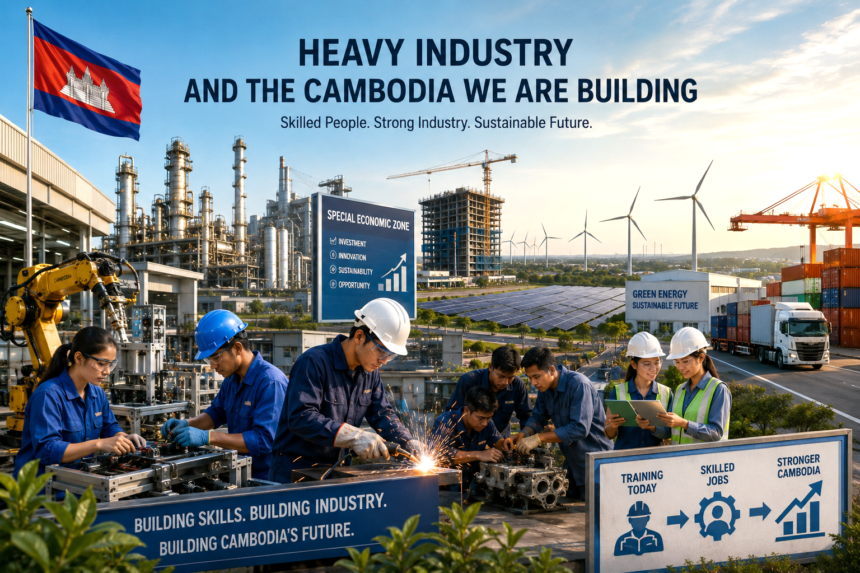
At the heart of this story lies the most important investment of all, the training of Cambodians for skilled jobs. Every new welding line, every cement plant, every assembly bay and every solar substation needs Cambodian hands, Cambodian minds and Cambodian leadership. When our young people are equipped with technical skills, factories no longer have to look outside the Kingdom for talent. Wages rise, families stay together, provinces grow stronger and the wealth created by industry stays within our communities. Training Cambodians is not a side benefit of industrial growth. It is the very engine that allows heavy industry to thrive on Cambodian soil with Cambodian dignity.
What inspires me most is how thoughtfully the Kingdom is investing in its people alongside its factories. The Ministry of Labour and Vocational Training has placed skills at the very heart of industrial growth. Its Strategic Plan for Employment Development, Social Security and Vocational Training 2024 to 2028, the Cambodia Skills Development Roadmap 2023 to 2035, and the Transforming TVET Strategic Action Plan together form one of the most comprehensive human capital agendas in the region (SEA-VET.net). The TVET 1.5M programme, the Vocational and Technical Training Programme for Youth from Poor and Vulnerable Families, offers free training and a monthly stipend across 38 skills in ten priority sectors including construction, mechanics, power and energy, and electronics, opening doors for young Cambodians from every province (MLVT, via SEA-VET).
Equally encouraging is the leadership of the National Technical Training Institute under MLVT, which prepares trainers and workforces in mechatronics, civil and electrical engineering, electronics and digital technology, exactly the disciplines heavy industry needs (NTTI). Cambodia’s steady push to integrate green skills, digital skills and Industry 4.0 competencies into vocational curricula, alongside the Greening the Campus initiative across northeastern provinces, ensures that the next generation of industrial workers will be ready for a cleaner, smarter economy (MLVT, via SEA-VET). The more Cambodians we train today, the more confidently our country can welcome advanced industries tomorrow.
Sustainability is no longer an afterthought in Cambodian industry. It is a foundation. The Ministry of Industry, Science, Technology and Innovation has been driving this shift through the EnergyTech Roadmap and the celebration of national milestones such as the third National Science, Technology and Innovation Day (UNESCO; MISTI). The National Solar Park has already secured one of Southeast Asia’s lowest tariffs at USD 0.039 per kWh, and the Power Development Plan envisions up to 1.8 GW of solar capacity by 2030 (Climate Investment Funds). The recently launched joint programme on accelerating energy efficiency in the building sector, led by the Ministry of Mines and Energy with UN partners, further strengthens Cambodia’s long term carbon neutrality pathway (Joint SDG Fund).
For Cambodia’s SMEs, this is an extraordinary moment. Heavy industry is creating supply opportunities for component makers, packaging firms, construction material producers and service providers. The Government’s decision to extend tax incentives for MSMEs through 2026 has added even more momentum for small enterprises to participate in larger industrial value chains. At the SME Resource Centre, we see entrepreneurs stepping confidently into this space, supplying SEZs, training apprentices through TVET partnerships and adopting digital tools to compete regionally. When SMEs train their own technicians and machinists in partnership with public institutions, they become powerful engines of skilled employment in their own right.
Cambodia’s heavy industry story is, in essence, a story of alignment. Policy aligned with people, investment aligned with sustainability, training aligned with opportunity, and ambition aligned with action. The Kingdom is building a modern industrial base that is inclusive, green and globally connected, and doing so on its own terms. As I look at the young women and men entering our factories, training centres and SME workshops, I see a nation rising with confidence. The more Cambodians we equip with skills today, the more boldly heavy industry will carry our economy forward. The future of Cambodian industry is not something we are waiting for. It is already here, and it is bright.