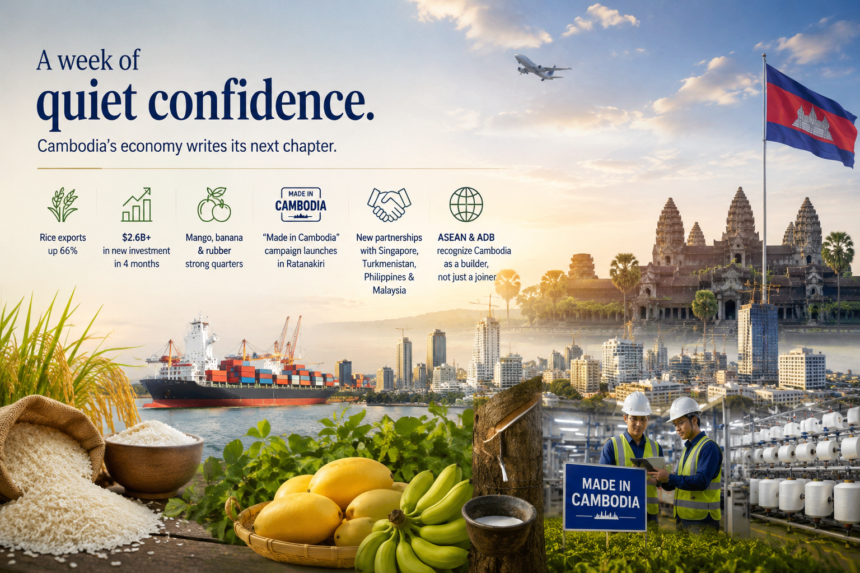
The Better Cambodia, Weekly Business Editorial | 4 to 11 May 2026
There are weeks in the life of a country when news arrives loudly, demanding attention. And then there are weeks like this one, weeks that move with the steady rhythm of a country quietly putting one brick on top of another, knowing exactly what it is building. The first full week of May 2026 belonged to the latter. From rice mills in Battambang to investment halls in Phnom Penh, from highland markets in Ratanakiri to summit floors in Manila and Milan, Cambodia spent the week showing up, calm, prepared, and increasingly self-assured on the regional stage.
A Forum That Set The Tone
The week’s centrepiece was the Cambodia Investment Forum 2026, held on 7 May under the theme “Beyond Investment: Strengthening Investor Confidence and Protection.” Organised by the Council for the Development of Cambodia and chaired by Deputy Prime Minister Sun Chanthol, the forum did something quietly remarkable. It moved the national conversation past the familiar pitch of come and invest and into something more mature: come, invest, and know we will look after you.
That single shift in language matters. It signals a country that no longer sees itself as a destination to be discovered, but as a partner that has learned how partnerships work. Investor aftercare, stronger legal protection frameworks, and direct public-private dialogue were placed at the centre of the conversation. Days later, the numbers gave the message its evidence: 184 fixed-asset investment projects worth over $2.6 billion flowed into Cambodia in just the first four months of 2026. Capital, it turns out, listens carefully to confidence.
The Fields Speak Loudest
If the forum supplied the message, Cambodia’s farmers supplied the music. Milled rice exports surged 66 percent year-on-year, with more than 460,000 tonnes shipped to 60 countries and earning around $266 million. Forty-eight Cambodian companies wrote that story, quietly, container by container, in mills that hum long after most offices close.
Around the rice, the rest of the harvest told an equally bright tale. Rubber latex earnings climbed 15 percent. Mango exports leapt 25 percent. Bananas grew 16 percent. Fishery products surged. The deeper signal beneath these numbers is that Cambodia is steadily climbing the value ladder, exporting milled rice rather than paddy, branded fruit rather than raw produce, and processed agricultural goods rather than commodities. This is the slow, patient work of moving from being a country that grows things to a country that finishes them. It is precisely the journey nations take when they decide to keep more of their own value at home.
Made In Cambodia, Felt Across Cambodia
That same spirit travelled north this week as the “Made in Cambodia” campaign opened at Sitra Shopping Mall in Banlung, Ratanakiri. Choosing the highlands as a campaign stage, rather than the usual Phnom Penh launch, was a small, generous decision that says something larger: domestic pride should not be the privilege of the capital. Handicrafts, processed foods, and locally produced goods shared the same floor space, the same lighting, the same dignity that imported brands have long enjoyed. When a shopper in Ratanakiri picks up a Cambodian-made product because it looks beautiful and feels right in the hand, an entire SME ecosystem somewhere else in the country quietly straightens its back.
SMEs: The Quiet Engine
National Assembly President Khuon Sudary captured it well this week when she described SMEs as “extremely important and the backbone of the national economy.” It was not a slogan; it was a recognition that Cambodia’s growth story is written in thousands of small ledgers, not a handful of large ones. Reinforcing that view, Minister Hem Vanndy called for targeted programmes such as matchmaking, financial guarantees, and capacity building to help Cambodian SMEs become genuine suppliers to foreign-invested companies. This is how technology transfers, how skills deepen, and how local businesses graduate from spectators to participants in their own industrial story.
The IBCC Job Fair 2026, held the same week, pointed to where that story is heading next. Employers across sectors are now actively recruiting for AI fluency and digital literacy. Cambodia’s young workforce is being invited to step into a future that, just a few years ago, felt distant. The fair was less a marketplace for jobs than a quiet announcement that a digital generation is arriving, and the country is making room for it.
ASEAN Citizenship, In Full Voice
On the regional stage, Cambodia spoke with confidence. At the 48th ASEAN Summit in the Philippines, Prime Minister Hun Manet urged faster rollout of the ASEAN Single Window 2.0, real progress on the Digital Economy Framework Agreement, and acceleration of the ASEAN Power Grid and Trans-ASEAN Gas Pipeline. These are not glamorous projects. They are the plumbing of a more connected Southeast Asia. By championing them, Cambodia placed itself firmly among the countries doing the building, not just the joining.
That same energy flowed through bilateral conversations all week. PM Hun Manet welcomed the Philippine Chamber of Commerce to explore deeper trade and investment partnerships. Singapore reaffirmed its strong interest in Cambodia’s tourism potential, eyeing better air connectivity and joint marketing. Turkmenistan’s Deputy Tourism Minister sat with Tourism Minister Huot Hak to discuss direct flights and a tourism MoU, opening the door to Central Asian visitors for the first time in a serious way.
Cambodia and Malaysia wrote two pages of that same story in a single week, first through senior-level talks on agro-industry and biodiesel cooperation in Kuala Lumpur, then through an MoU signed between FASMEC and the Malaysia-Cambodia Business Association to weave SMEs from both countries into shared supply chains. At the ADB’s 59th Annual Meeting in Milan, Cambodia welcomed the bank’s $70 billion regional integration package, including a $50 billion Pan-Asia Power Grid initiative, framing it as fully aligned with the country’s Vision 2050.
Powering The Next Decade
Energy threaded quietly through the week. The National Assembly’s Inter-Committee unanimously approved a draft law on Payment Guarantee for Electricity Purchases from Vietnam, a technical-sounding piece of legislation that, in plain language, helps keep Cambodian factories humming and homes lit. Conversations with Chinese investors about a possible domestic oil refinery added another chapter to the country’s expanding energy roadmap, alongside solar, hydropower, and regional grid connectivity.
Tourism, Recalibrated With Grace
The Ministry of Tourism released its 2025 Tourism Indicators and 2026 Forecasts, reporting $3.878 billion in 2025 tourism revenue and outlining clear pathways toward stronger arrivals, potentially exceeding 6.1 million visitors in the year ahead. The new outreach to Singapore and Turkmenistan, plus six approved recovery measures from the Government-Private Sector Forum, show a sector that has chosen evidence and diversification as its compass.
The Bigger Picture
Stitch all of this together and a single image emerges. Cambodia spent the week strengthening its own house, clearer investor protections, stronger SMEs, higher-value agriculture, deeper ASEAN ties, broader tourism markets, and a more resilient energy backbone. Each thread on its own might seem modest. Woven together across seven days, they form the work of a country that knows what it is doing and why.
What stood out most was the tone. Investors saw a government that listens. Farmers saw markets opening wider. SMEs saw new partners arriving from Kuala Lumpur and beyond. Young Cambodians saw employers asking for the very skills they are learning. Tourism teams saw new countries reaching out with genuine interest. None of it loud. All of it real. This is what a country looks like when it has decided, with quiet conviction, that its best chapters are still ahead, and has begun, page by page, to write them.
The Better Cambodia