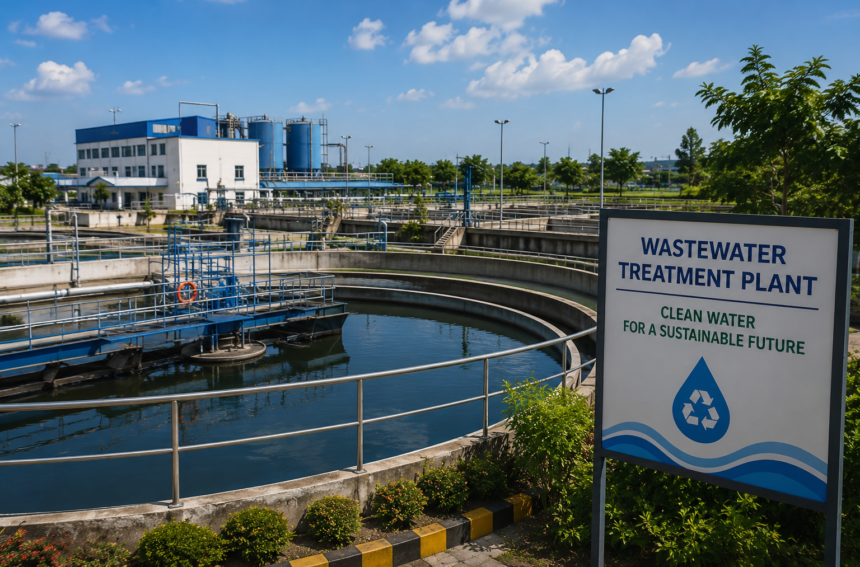
By the time most South-East Asian cities finish their morning rush, millions of litres of untreated wastewater have already begun a quiet journey into rivers, lakes and coastal waters. It is one of the least photogenic challenges in development, yet few issues will shape the next decade of Asian urbanisation more profoundly. India has spent recent years learning how to treat its water at scale. Cambodia, urbanising fast and entering a new investment cycle in 2026, stands to gain from that experience.
What India Has Learned, the Hard Way
The Indian numbers are sobering but instructive. The country generates roughly 72,368 million litres of urban wastewater each day, against installed treatment capacity of 31,841 MLD, of which around 26,869 MLD is operational, per NITI Aayog. Closing that gap is now a national priority. Under Namami Gange Phase II, 25 sewage treatment plants totalling 530 MLD were commissioned in 2025, taking cumulative capacity under the programme to 3,977 MLD across 138 operational STPs by December 2025, according to the Press Information Bureau. A further 218 sewerage projects worth ₹35,698 crore are at various stages of execution.
Indian cities are showing what scaled delivery looks like. Bengaluru is adding 26 new sewage treatment plants by June 2026, lifting treated-water capacity to nearly 2,200 MLD, partly funded by a JICA loan, with the Vrishabhavathi Valley plant alone contributing 150 MLD, Envirowater Treatments reports. Twenty older plants are being retrofitted with disc filters and tertiary stages to meet the National Green Tribunal’s tighter 2026 norms, Water Today confirms. Delhi has standardised on SBR and MBBR under the Yamuna programme. Hyderabad and Chennai have invested heavily in tertiary reuse, with Chennai supplying recycled water to industry at scale. Pune has expanded MBR capacity for new townships; Ahmedabad continues upgrading along the Sabarmati. Surat now operates four tertiary plants with 116 MLD of installed capacity, selling treated water to industry, per the Press Information Bureau.
The Technologies Doing the Quiet Work
Behind these projects sits a mature technology stack that Indian firms have learned to build, operate and cost down. Sequencing Batch Reactors handle fluctuating loads. Membrane Bioreactors deliver near-reuse-grade effluent in compact spaces, suiting hotels and dense neighbourhoods. Moving Bed Biofilm Reactors retrofit easily into older works. Decentralised Wastewater Treatment Systems, refined through BORDA and CDD Society, have proved their worth in peri-urban communities and small industrial estates. Packaged plants serve campuses, gated developments and tourism sites. Zero Liquid Discharge is now almost a regulatory expectation in textile and chemical clusters, while smart sensors, SCADA platforms and AI-driven analytics monitor flows, energy use and effluent quality in real time. Per-litre energy footprints have fallen through variable-frequency drives, fine-bubble diffusers and predictive maintenance.
Cambodia’s Moment of Choice
Cambodia is approaching a decision point of its own. The Asian Development Bank’s April 2026 outlook places GDP growth at around 4.5 per cent for 2026, supported by garments, tourism, construction and steady investment into special economic zones. Phnom Penh continues to expand outwards, Siem Reap is settling into its post-airport upgrade, and Sihanoukville is rebuilding around port-led industry. The capital’s first public sewage treatment plant near Cheung Aek Lake, commissioned in late 2023 with 5,000 cubic metres a day under Japanese ODA, is now being followed by larger investments, including a Ta Khmau sewerage development valued at around USD 90 million per Cambodianess, and a USD 763 million water and sanitation upgrade expected to benefit roughly two million Cambodians, Kiripost reports. The wider Provincial Water Supply and Sanitation Project is led by the ADB with AFD co-financing.
For a country at this stage, decentralised and modular systems make particular sense. Industrial parks, hospitality clusters along the Tonle Sap, residential developments in Chroy Changvar and coastal resorts can be served far more economically by packaged STPs, MBBR units or DEWATS than by waiting for trunk sewerage, precisely where Indian suppliers have built deep capability.
Where Collaboration Becomes Tangible
India and Cambodia already have a working bilateral framework in water. The Ministry of External Affairs records Indian Lines of Credit extended largely in water and power, alongside grants for the Siem Reap Basin master plan and groundwater studies in Kampong Speu. Indian Technical and Economic Cooperation places have trained hundreds of Cambodian officials. Wastewater is the natural next chapter.
Sensible avenues include technology transfer with Indian EPC firms experienced in SBR, MBR and ZLD; joint ventures to manufacture packaged plants and membranes locally; engineering partnerships for Phnom Penh’s expanding sewer network; training programmes with the Institute of Technology of Cambodia; and public-private partnerships for tourism-zone and SEZ systems. Indian solutions tend to sit at a price point Western alternatives rarely match, while meeting international effluent norms.
A Future Worth Building Together
Sustainable water infrastructure is rarely the headline reason an investor chooses a country, yet it sits beneath every other ambition: cleaner rivers for tourism, reliable industrial supply, healthier neighbourhoods. The opportunity in 2026 is to turn a quiet bilateral relationship into a working partnership on something genuinely consequential. The technologies are proven. Financing exists through the ADB, the World Bank and bilateral instruments. What is needed is patient, well-designed cooperation, the kind that outlasts political cycles and leaves behind plants still running cleanly two decades from now.