Closing the Loop: How Cambodia and Its Neighbours Are Quietly Building a Cleaner Industry
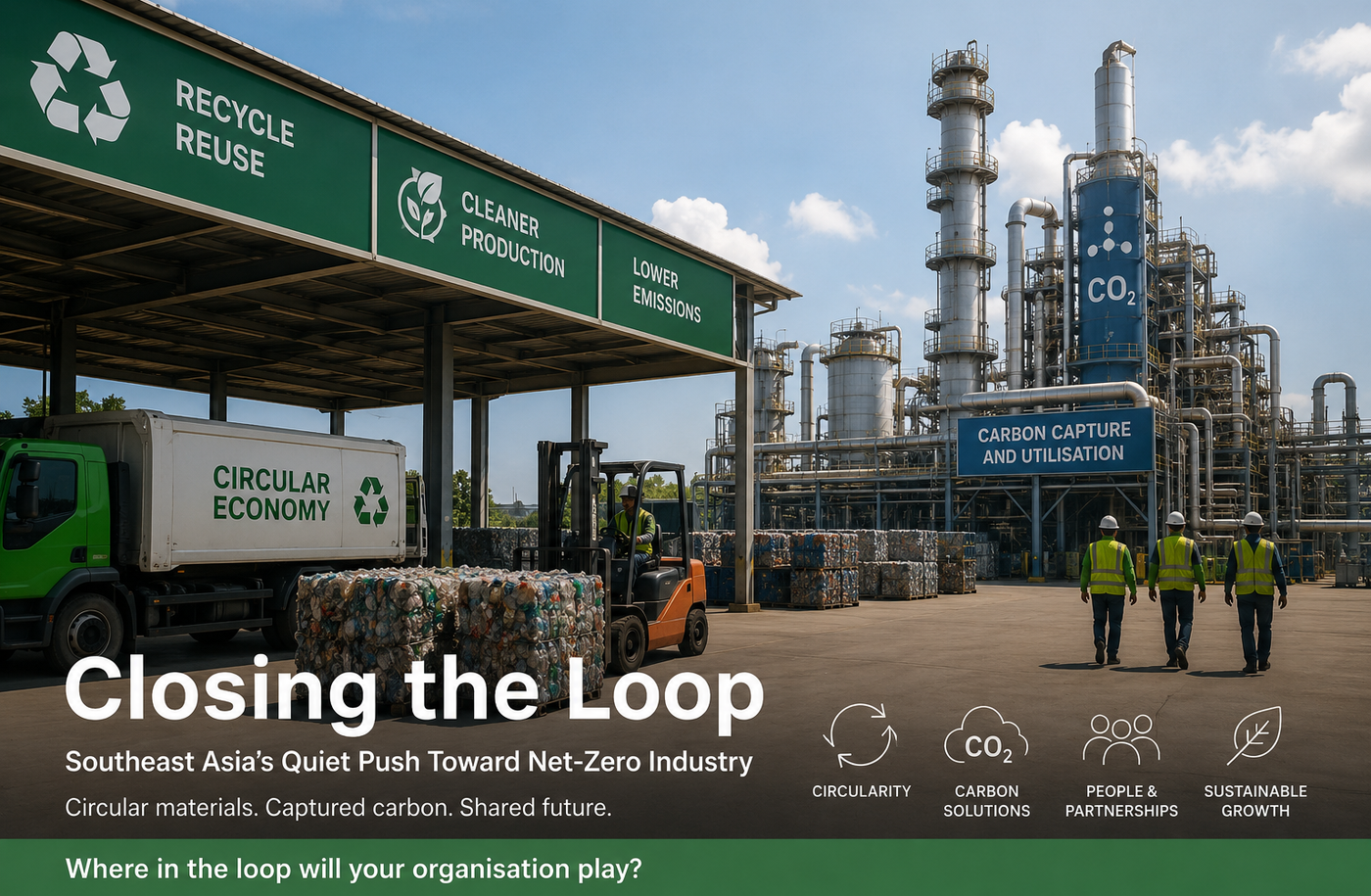
For most of the last century, heavy industry has worked in a straight line. We dig something up, we shape it into a product, and when we are done, we throw it away. That habit has served growth, but it has also filled rivers with plastic, loaded the sky with carbon, and tied factories to a constant appetite for fresh fossil inputs. If the region is serious about getting near net zero, that straight line has to bend into a circle.
Two ideas are doing most of the bending. The first is high quality material circulation, which is a simple way of saying that the things we have already made should keep coming back into the economy instead of leaving it as waste. The second is carbon capture and utilisation, which means catching carbon dioxide where it is produced and finding a useful job for it, rather than letting it drift into the atmosphere. Quietly, and without much fanfare, Southeast Asia is starting to do both.
Cambodia is part of this story, and in a way that should make us proud. In January 2026, the Ministry of Environment and the United Nations Development Programme launched the country’s first Plastic Action Roadmap, titled Journey Towards a Circular Plastic Economy. It is not a document written for shelves. It sets out a clear path to cut plastic pollution by about 74 percent, lower related greenhouse gas emissions by roughly 40 percent, and create around 26,000 new green jobs by 2040 (UNDP Cambodia). It also recognises something many policies overlook, which is the everyday work of informal waste collectors who already keep tonnes of material out of the rivers. Bringing that work into a formal, supported circular system is a quietly revolutionary idea.
Cambodia is not alone in turning the corner. In Malaysia, PETRONAS Chemicals and Plastic Energy are building a chemical recycling plant in Johor that is sized to process around 33,000 tonnes of end of life plastics each year (K-Online). In Indonesia, Indorama Ventures is building a facility in Karawang that aims to recycle close to 2 billion PET bottles a year. Vietnam, for its part, now permits scrap imports only into factories that can recycle them properly, which has quietly turned circularity into a market entry requirement. Even in steel, where emissions are stubborn, producing from scrap in an electric arc furnace can cut carbon to roughly one fifth of the older blast furnace route (Jianjie Binder).
The carbon side of the story is moving too. Off the coast of Sarawak, PETRONAS is developing the Kasawari project, one of the largest offshore carbon capture schemes anywhere in the world, designed to lock away around 3.3 million tonnes of CO₂ each year. In Papua Barat, BP and its partners have committed about US$7 billion to the Tangguh carbon capture project, which could store an estimated 15 million tonnes of CO₂ in its first phase (Reuters).
For Cambodian business owners, factory managers, and young entrepreneurs, the message is encouraging. Circularity is really just lean thinking applied to materials. It is the elimination of muda, of waste, at the molecular level. Captured carbon is a feedstock waiting for a smart local buyer. Net zero will not arrive in one dramatic leap. It will be built loop by loop, decision by decision, by businesses choosing the cleaner path. Cambodia has now joined that quiet, confident movement, and the next loop is ours to design.