A Quiet Opportunity: Why Bharatia Belongs in the Cambodia Conversation
An editorial by Jas Sohl, founder of the Cambodia Private Business Centre, New Delhi and London
I write this as a British citizen of Indian origin who has spent a meaningful part of his professional life thinking about how the Kingdom of Cambodia connects to the rest of the world. Through the Cambodia Private Business Centre, with offices in New Delhi and London, our small team has had the privilege of introducing Cambodian businesses, ideas and ambitions to partners in India, the United Kingdom and beyond.
That work has taught me one thing very clearly. The Kingdom of Cambodia is one of the most thoughtful and welcoming partners a serious organisation could hope to work with. And from time to time, you come across an organisation on the other side of the table that feels especially well matched to the moment Cambodia is in. For me, Bharatia, the Bharat Technology and Impact Accelerator, is one such organisation.
To be very clear at the outset. Bharatia has not yet worked in Cambodia. The purpose of this editorial is simply to introduce its potential, as I see it from the outside, in the hope that the right conversations may follow in their own time and on the Kingdom’s own terms.
The Organisation Worth Knowing About
Bharatia is an Indian organisation, led by MD and CEO Sanmit Ahuja and affiliated with the Samarth Bharat Foundation. It describes itself as a technology commercialisation and impact accelerator, with a particular focus on translating proven solutions into delivery at scale in the Global South.
What sets it apart, in my view, is the seriousness of its method. Bharatia evaluates technologies across three readiness levels, namely Technology, Commercialisation and Investment, so that good ideas can be assessed the way good investments are. It builds what it calls SITE Networks (Science, Innovation, Technology and Economics), already operational between India and Sweden, Iceland, Bulgaria and the wider Nordic region. It runs GSTACK, a scale engine for the Global South aimed at climate technologies in energy, water, waste, agriculture and industrial systems, launched at IIT Delhi in April 2026. And it has signed a respectful strategic partnership with Druk Holding and Investments in Bhutan, a small neighbouring kingdom, which is instructive.
The Bhutan partnership matters because it shows how Bharatia approaches a sovereign neighbour. Not as a vendor, not as a donor, but as a long term technology and project development partner that adapts itself to the host country’s pace, priorities and protocols. That posture, in my experience working between London, New Delhi and Phnom Penh, is unusually rare and exceptionally valuable.
The Kingdom of Cambodia, As Seen From Our Offices
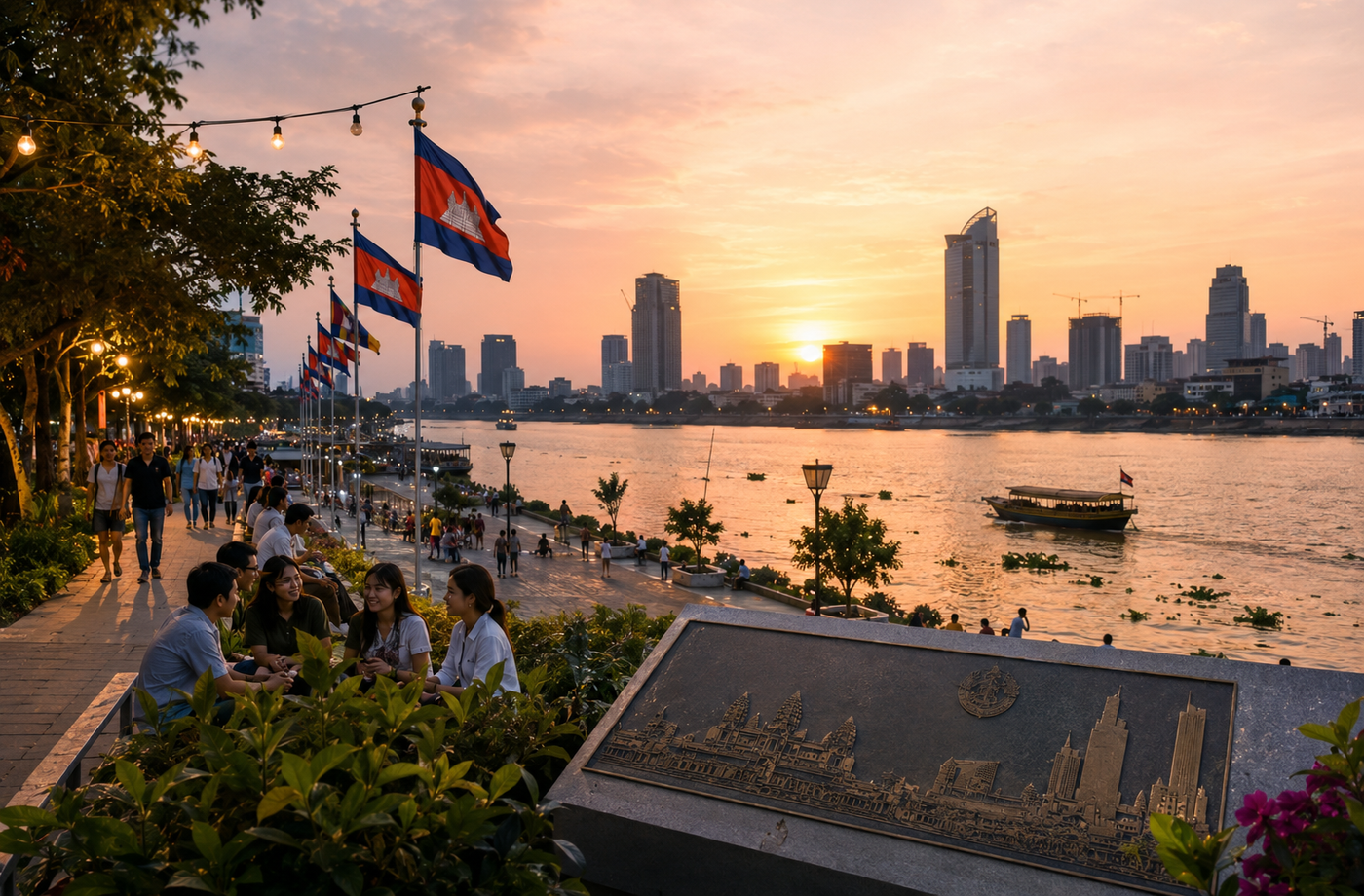
From the perspective of the Cambodia Private Business Centre, the Kingdom of Cambodia is in a remarkable chapter of its national story.
The country has surpassed its ASEAN clean energy target ahead of schedule. The Royal Government has put forward updated Nationally Determined Contributions that responsibly cover agriculture and waste. The National Methane Emissions Reduction Roadmap of 2025, the Clean Air Plan, and the circular economy agenda showcased at the 2025 Waste Summit and IRB Forum reflect a country that is governing thoughtfully and looking ahead.
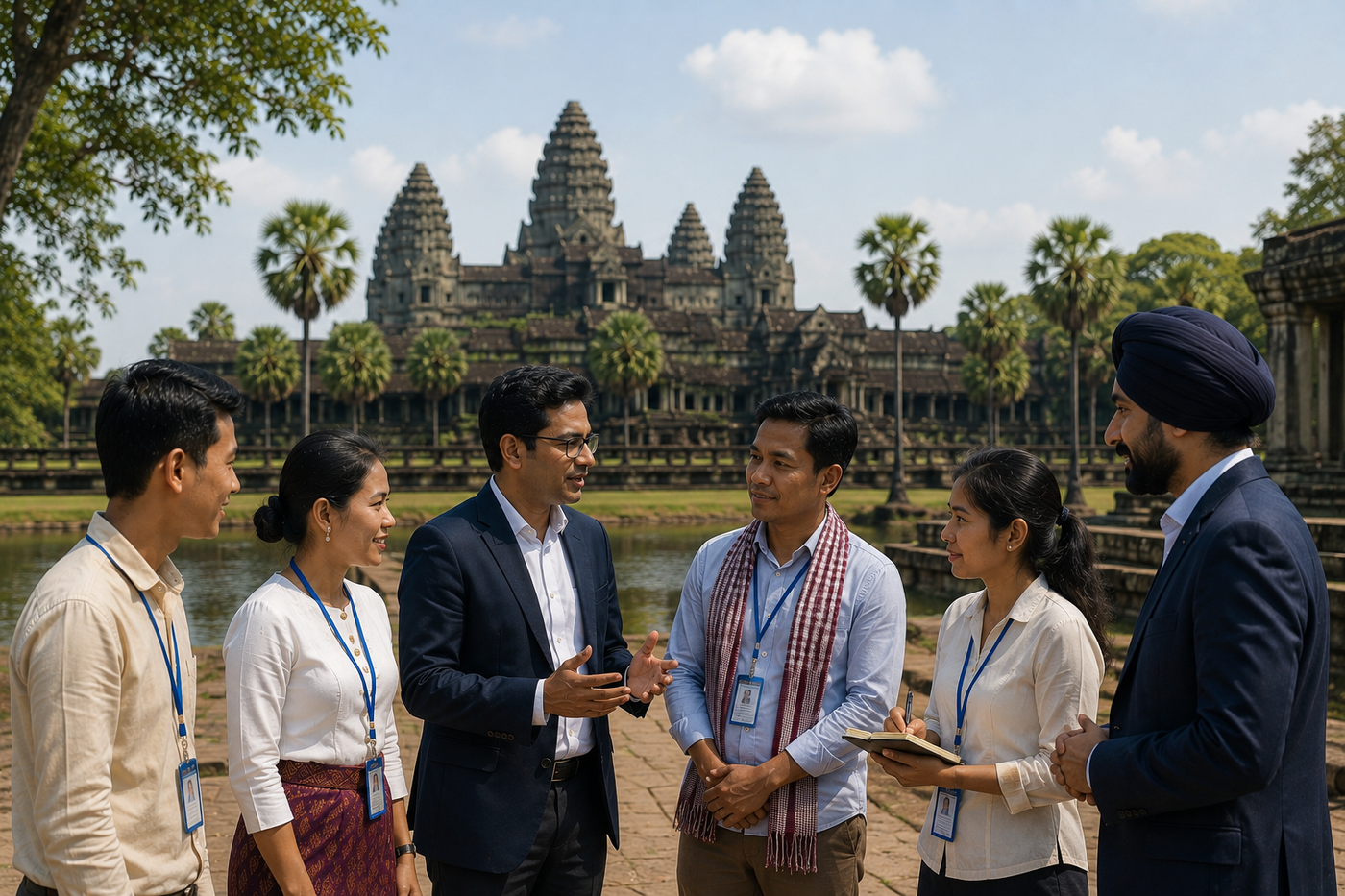
Beyond policy, the deeper story is the people. Cambodia has a young, mobile and entrepreneurial workforce. Its agricultural heritage, growing industrial base, rising digital adoption, and central location in mainland Southeast Asia give the Kingdom strategic significance far greater than its size suggests. The longstanding friendship between India and the Kingdom of Cambodia is one of the warmest in Asia, built on cultural kinship, the joint restoration of Angkor, education exchanges and consistent cooperation over many decades.
It is in this context, and only in this context, that Bharatia’s potential becomes interesting to consider.
Where Bharatia’s Approach Could Add Value
I want to walk through where, in my own observation, Bharatia’s tools and corridors could one day complement what the Kingdom is already doing well. None of this is in motion yet. These are simply the possibilities I see from my desk in London and New Delhi.
The first area is technology evaluation. Many countries in our region, including those far larger than Cambodia, struggle with the early stage problem of separating real climate and agri technologies from the merely fashionable. Bharatia’s TRL, CRL and IRL scoring methodology, if ever offered to Cambodian institutions, could provide a shared and neutral language for sorting through the proposals that arrive at every ministry’s door.
The second area is biomass and agriculture. Cambodia’s rice, cassava, palm and rubber sectors generate residues that, with the right partners and the right financing, can be transformed into biochar, organic fertiliser, animal feed, mushroom substrate and clean fuels. Bharatia already runs a Grand Challenge on Turning Agricultural Residues into a Scalable Biomass Economy, along with First of a Kind projects on topsoil rejuvenation and farmer income. These are not products to be sold to Cambodia. They are playbooks that could be adapted, by Cambodian partners, to Cambodian conditions, with Cambodian off takers in the lead.
The third area is green fuels and industrial decarbonisation. Cambodia’s manufacturing and logistics sectors are growing, and global decarbonisation pressure will eventually find its way to every export economy. Bharatia’s Master Collaboration Agreement with Carbon Iceland on green methanol is the kind of pre engineered international pathway that, with the Royal Government’s blessing, could be adapted to suit Cambodia’s own industrial and energy vision.
The fourth area is talent and commercialisation literacy. Bharatia has produced educational content on commercialisation, technology transfer and joint venture structures. If Cambodian universities, ministries and entrepreneurs ever found value in some of that content, it could be one small contribution to the larger goal of equipping Cambodian negotiators to speak with global investors on entirely equal footing.
None of these would be imposed. Each would be offered, considered and either accepted or politely set aside, as the Kingdom sees fit.
A View From Inside the India and UK Diaspora
Speaking now as someone whose own life sits between three flags, I would add one further reflection.
There is a particular value in collaborations that move through the Indian and British diaspora. We carry, in our networks, a familiarity with how London capital thinks, how Indian engineering scales, and how Southeast Asia prefers to be approached. The Cambodia Private Business Centre exists precisely to translate between these worlds with care.
Bharatia, as I read it, fits that triangular geography rather neatly. It is rooted in India, it speaks fluently to European partners through its SITE Networks, and it is building a Global South footprint that is closer in spirit to a partnership than to an aid programme. For Cambodia, that combination of qualities is worth knowing about, even if no formal step is ever taken.
A Respectful Conclusion
The Kingdom of Cambodia does not need anyone to tell its own story. It is, by every measure I have observed, perfectly capable of choosing its partners, setting its pace and writing its own future.
What I have tried to do in this short editorial is something more modest. To introduce a promising Indian organisation that has not yet worked in Cambodia, and to highlight the potential it carries, in case the Royal Government, Cambodian institutions or Cambodian businesses one day find it useful to explore.
If that exploration ever begins, my colleagues at the Cambodia Private Business Centre and I will consider it our great privilege to make the introductions, hold the doors, and then step quietly to one side. The corridor between the Kingdom of Cambodia, India and the United Kingdom has been open for many generations. Bharatia is simply one more good reason to keep it well travelled, in friendship and in mutual respect.