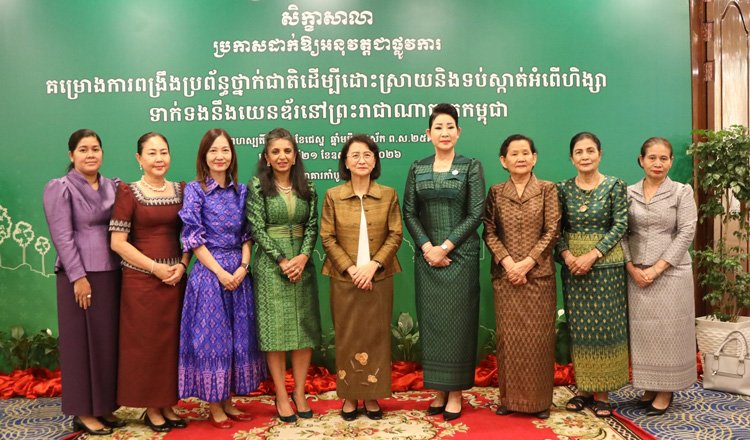
Some weeks in Phnom Penh feel heavier with meaning than others. This was one of them. At the Hotel Cambodiana on Thursday, ministers, ambassadors, civil society leaders and survivors sat in the same room and listened as the country opened a new five-year chapter in its fight against gender-based violence.
The project being launched is called “Strengthening Country Systems for Prevention and Response to Gender-Based Violence in Cambodia.” It is led by the Ministry of Women’s Affairs in partnership with the Ministry of Interior, and backed by the Asian Development Bank. Minister Ing Kantha Phavi presided. The room was full, and the mood, from where I sat reading the day’s reports, felt purposeful rather than ceremonial.
There was reason for that. Cambodia, as ADB Country Director Yasmin Siddiqi pointed out, is the very first country in the world to receive an ADB grant designed specifically to reduce gender-based violence and advance gender equality. That is not a small detail. It is a quiet kind of leadership, the sort that does not always make global headlines but matters enormously to the women and girls who will eventually benefit.
The numbers tell their own story. ADB is putting in a $10 million grant from the Asian Development Fund. The Government of Australia is co-financing another $9 million. Together, this is the first stand-alone gender-equality grant ADB has ever made in Southeast Asia (ADB). For a country that has often had to fight for attention on issues like this, that is a real vote of confidence.
A journey that didn’t start yesterday
It would be easy to read about a launch ceremony and think the work begins now. It doesn’t. Cambodia has been building toward this moment for the better part of two decades.
The Ministry of Women’s Affairs has long anchored the effort through Neary Rattanak, its flagship five-year plan for gender equality and women’s empowerment. The latest edition, Neary Rattanak VI, keeps pushing investment into the areas that move the needle: women in the economy, girls in school, women’s health, women in public leadership (Ministry of Women’s Affairs).
Running alongside it is the National Action Plan to Prevent Violence Against Women, or NAPVAW. NAPVAW has been the practical, on-the-ground roadmap, pulling the health system, the justice system, social services and schools into one conversation so they actually speak to each other when a woman walks in and asks for help (Ministry of Women’s Affairs). Each plan has built on the last, and survivor-centred services in Cambodia look very different today from what they did ten years ago.
A bigger vision behind it
Zoom out, and the new project does not sit by itself. It sits inside the Royal Government’s Pentagonal Strategy Phase I, the long-range socioeconomic framework aligned with Cambodia Vision 2050. Human capital and social protection are at the heart of that strategy, and gender equality is treated as a driver of national growth rather than a side file (P4H Network). So a project running from 2025 to 2029 is really one slice of a much longer arc.
What is actually going to happen
Strip away the formal language and the project does four practical things.
First, it sharpens Cambodia’s legal and institutional frameworks, including a modernisation of legislation on domestic violence. Second, it expands and improves response services women can actually reach in their own districts, including the multidisciplinary groups that bring police, health workers and social services together. Third, it refurbishes shelters, with a deliberate focus on rural areas where survivors have had the fewest options. And fourth, it leans into digital tools, both for school and community prevention work and for a round-the-clock platform anyone can turn to for information and support (ADB).
Behind all of that is a design choice worth pausing on. ADB calls it a whole-of-government approach. In plain English: the Ministry of Women’s Affairs, the Ministry of Interior and the Ministry of Economy and Finance are working from the same playbook, with gender equality woven into governance and public spending instead of bolted on at the end (ADB project page). Anyone who has tried to coordinate three ministries on anything will tell you how hard, and how important, that is.
“All of us, together”
The line from Minister Ing Kantha Phavi that stayed with me was simple. She said this work cannot belong to one ministry, or one donor, or one set of activists. It belongs to government, development partners, civil society, the private sector, communities, and most of all to survivors themselves, whose voices have to shape what good actually looks like.
That sentence is not policy. It is closer to philosophy. But it is also the truest description of what changes things on the ground.
Cambodia’s national target is zero GBV by 2030. Bold. Some will say too bold. I think a country that has been quietly stacking plans, partnerships and reforms for twenty years has earned the right to aim that high.
What success will look like
Launches are easy to romanticise. The harder, slower question is what success looks like once the speeches end.
It probably looks like a refurbished shelter opening in a province most foreigners cannot find on a map. It looks like a teenager in a classroom learning, for the first time, that what is happening at home is not normal and not her fault. It looks like a 24/7 hotline being answered at two in the morning by someone trained, calm and kind. It looks like a commune official who, five years from now, knows exactly what to do when a woman walks into his office and says she is afraid.
Thursday at the Hotel Cambodiana was not the finish line. It was a marker on a road Cambodia has been walking for a long time, with more partners alongside her than ever before. For a country that has too often been written about for the wrong reasons, this is one worth telling for the right ones.