By the time you finish reading this sentence, an artificial intelligence somewhere has already been told how to behave. Not by you. Not by its user. But by a quiet, invisible paragraph slipped into the conversation before you ever typed a word. The Washington Post recently pulled back the curtain on this practice in a fascinating piece about “system prompts,” the hidden rule books that shape how ChatGPT, Claude, Gemini, and Grok respond to all of us. The article is worth a slow read, and it raises questions that matter just as much in Phnom Penh as they do in Palo Alto.
For those of us who use AI in our daily work, whether writing reports, summarising meetings, translating between Khmer and English, or drafting LinkedIn posts on a Sunday evening, the revelation is striking. Every chatbot we treat as a neutral helper is actually following a private set of instructions written by its company. These hidden prompts can stretch from two thousand to twenty-seven thousand words, longer than most newspaper editorials. They tell the bot what tone to adopt, what topics to avoid, which sources to ignore, and even how warm to sound. Claude is told to maintain “a warm tone.” Grok has been told not to lean on the personal opinions of its owner when answering politically sensitive questions. OpenAI’s Codex, in a curious moment of corporate caution, instructs the bot to avoid discussing goblins, gremlins, raccoons, trolls, ogres, and demons unless directly asked. Somewhere, an engineer truly worried about troll-related liability.
The humour is real, but so is the lesson. The Washington Post calls it “the conversation before the conversation,” and that phrase deserves to enter our vocabulary in Cambodia, because it captures something important about the age we are stepping into. Whoever writes the hidden prompt holds quiet power over millions of conversations. They decide what the machine will say about history, identity, copyright, politics, even our own neighbourhoods. And almost none of these instructions are published. OpenAI, Google, and xAI keep theirs confidential. Researchers extract them by tricking the bots into confessing. We, the users, simply receive the output and assume it is the whole truth.
This is not a reason to fear the technology. It is a reason to engage with it more thoughtfully, and Cambodia, encouragingly, is already doing exactly that.
A Quiet but Confident Cambodian Approach
While global headlines focus on the dramas of Silicon Valley, Cambodia has been steadily building its own foundation. In July 2025, the Kingdom became the fourth country in Southeast Asia to complete the UNESCO Artificial Intelligence Readiness Assessment, an exercise that pulled together more than three hundred stakeholders from twenty-six ministries, universities, startups, and development partners. The result is a draft National AI Strategy 2025-2030 anchored in six strategic priorities and forty-one practical measures. The tone of the strategy is notably human, because it talks about ethics, inclusion, and Cambodian priorities before it talks about market share.
That work is already producing visible results. In January 2026, the Government AI Readiness Index published by Oxford Insights ranked Cambodia 118th out of 195 countries, up from 145th the year before. A jump of twenty-seven places in twelve months is not a small movement. It reflects something that any quality-control professional will recognise instantly: a country that has decided to measure itself, learn from the data, and improve. The Ministry of Post and Telecommunications has been candid in saying that more progress is coming once the National Data Centre and the open-source Khmer Large Language Model are launched. That Khmer LLM, being developed in partnership with Singapore, is perhaps the most important sentence in this entire conversation. A language model trained on Khmer, by Khmer voices, for Khmer needs is the digital equivalent of writing our own dictionary in our own ink.
Alongside the strategy sit tools that ordinary Cambodians can already touch. Verify.gov.kh lets citizens authenticate official documents through a QR code. TranslateKH bridges Khmer and other languages with growing accuracy. The Cambodia Artificial Intelligence Platform at ai.gov.kh is becoming a public doorway into national AI services. None of these tools will dominate global headlines. They do not need to. They are quietly useful, and quietly Cambodian.
Youth at the Centre, Not at the Margins
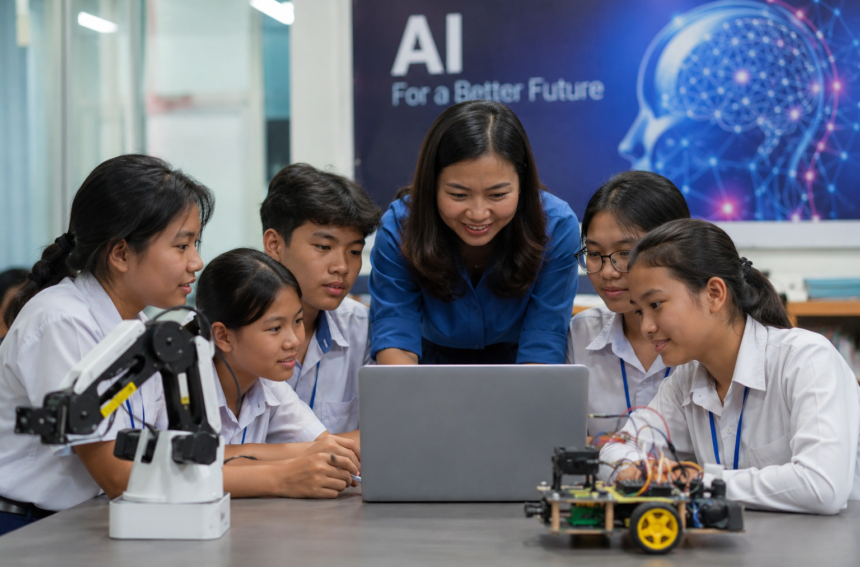
What truly distinguishes Cambodia’s approach is the deliberate place given to young people. The Pentagonal Strategy frames digital technology as one of five core pillars guiding the country towards 2050, and within that pillar youth participation is treated as a design feature rather than an afterthought. The Digital Skills Learning Program, supported by the Ministry of Post and Telecommunications, has entered its second phase and now reaches roughly eighteen thousand primary school students across sixty schools in nineteen provinces. These children are learning computer literacy, coding, digital citizenship, online safety, and AI fundamentals at an age when their counterparts in some richer countries are only beginning to look at screens.
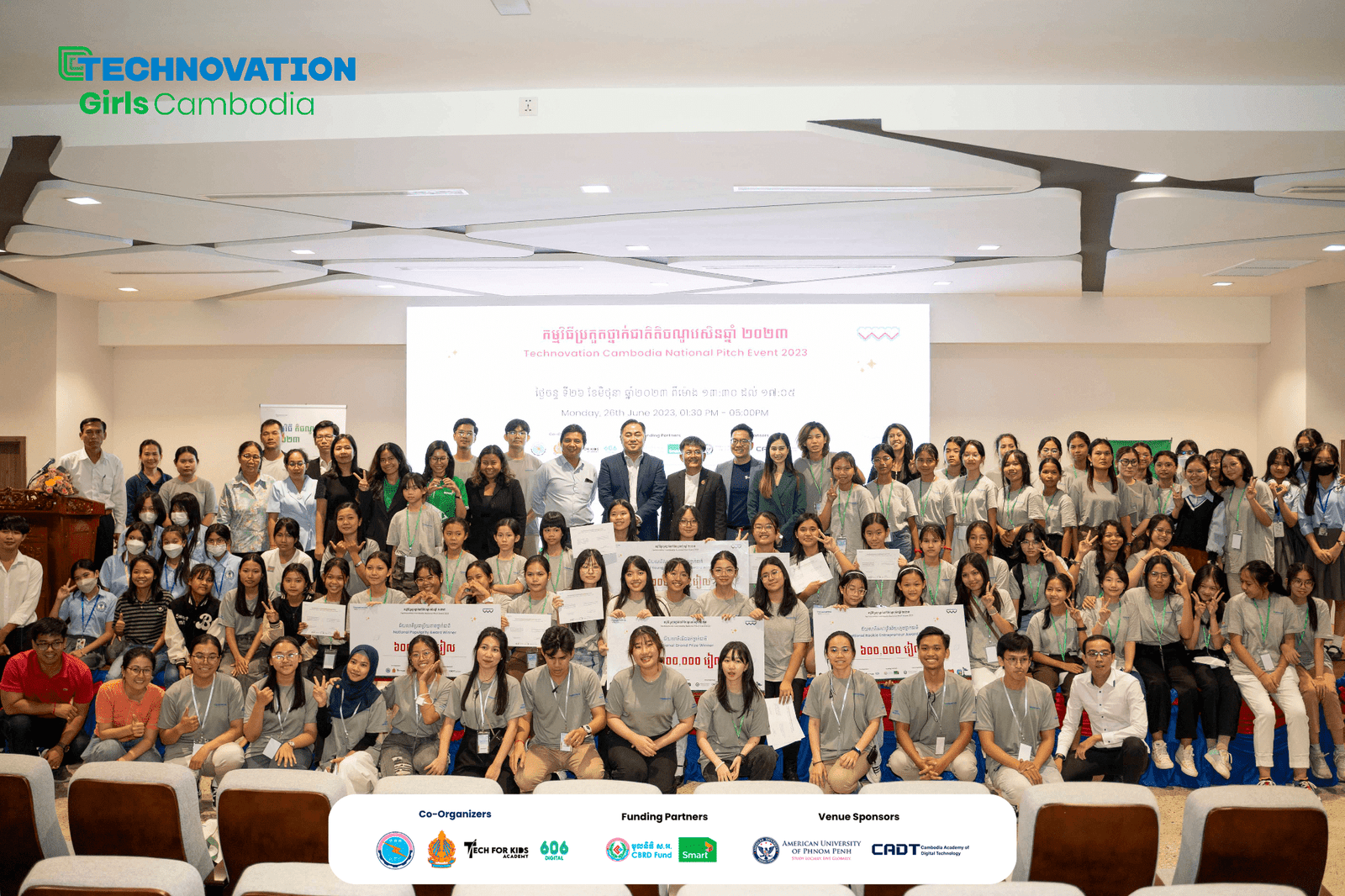
The Digital Literacy Initiative, a partnership between the Ministry of Education, Youth and Sport, the Ministry of Labour and Vocational Training, the Dariu Foundation, and Swisscontact, is preparing high school and TVET students in Siem Reap and Battambang for the digital economy. The Techo Sen Awards “AI in Education” competition, hosted by the Cadt and supported by the Rector Council, has begun celebrating the young Cambodian teams who are not just consuming AI but building with it. The AI for Education National Conference, backed by the Ministry of Education, Youth and Sport together with the Ministry of Post and Telecommunications, has turned classrooms into laboratories of curiosity. The Digital Skills Development Roadmap 2024-2035 ties all of these threads into a single long-term vision.
This matters because the lesson from the Washington Post article is essentially a lesson about literacy. If young Cambodians grow up understanding that AI tools have hidden instructions, they will instinctively ask better questions. They will know that “the conversation before the conversation” exists, and they will look for it. They will read a chatbot’s answer the way a careful auditor reads a check sheet, appreciating it, but verifying it.
Where Lean Thinking Meets Artificial Intelligence
There is a beautiful overlap between Lean philosophy and the way Cambodia is approaching AI. Lean asks us to make the invisible visible, to standardise the things that should be standard, and to empower the people closest to the work. A national AI strategy that publishes its priorities, an ethics assessment that consults twenty-six ministries, a school programme that teaches digital citizenship before it teaches code, all of these are Kaizen instincts dressed in modern clothes. Small steps, transparent steps, taken together.
The Washington Post article ends with a quiet invitation to readers: understand the hidden rules, and you can use them. Cambodia’s invitation is even broader. Understand the hidden rules, write a few of our own in Khmer, and we can shape the technology rather than be shaped by it. The Royal Government has laid the policy groundwork, the youth are filling the classrooms, and the tools are appearing one by one on the public web.
If “the conversation before the conversation” is going to define the next decade of human-machine life, then Cambodia is doing something rare and worth celebrating. It is choosing to be part of writing that conversation, in its own voice, on its own terms, with its young people seated at the table from the very first sentence.
Sources and further reading: Washington Post: See the hidden rules behind AI, UNESCO: Cambodia Launches AI Readiness Assessment Report, AKP: Cambodia Moves Up Government AI Readiness Index, Cambodia Investment Review: Digital Skills Education, Kiripost: Cambodia and Singapore Partner on Khmer LLM, Swisscontact: Digital Literacy Initiative Cambodia.