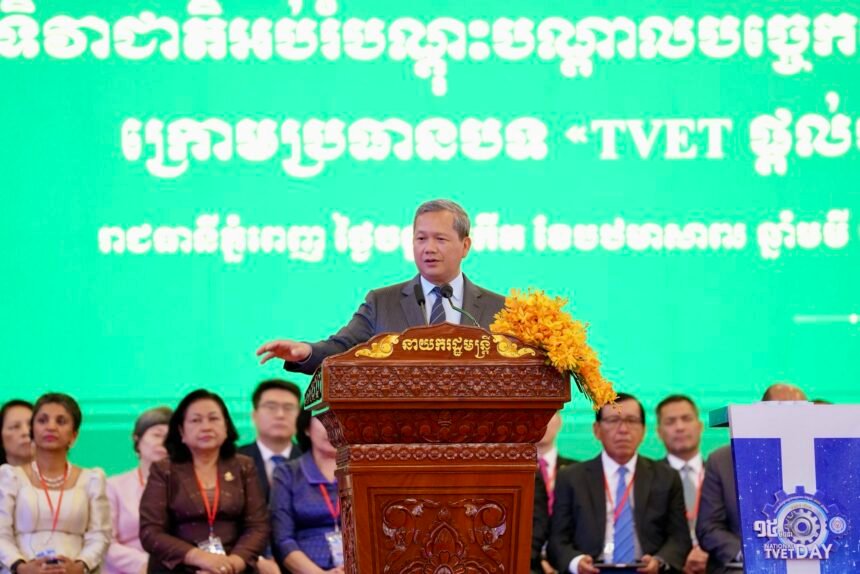
PHNOM PENH — Prime Minister Hun Manet has reaffirmed that the Royal Government of Cambodia will maintain and increase its national budget allocations for the education and healthcare sectors. Highlighting human resource development as the nation’s foundational pillar for economic resilience and long-term security, the premier emphasized that these sectors remain the government’s top priorities.
The announcement was made on Monday, June 15, 2026, during the celebration of the 9th National Technical and Vocational Education and Training (TVET) Day, held under the theme “TVET Provides Skills, Jobs, and Income”.
According to Cambodia’s Medium Fiscal Framework 2027–2029, social service spending is projected to grow by 3.4% in 2027, 8.3% in 2028, and 5.0% in 2029, with the government aiming for social services to account for roughly 4.82% of the country’s GDP by 2027.
Introduction of a ‘Third Stream’ in the National Education System
In a significant structural shift for Cambodian education, Prime Minister Hun Manet called for the official introduction of a third educational pathway. Moving beyond the traditional binary choice of Science or Social Science, the Ministry of Education, Youth and Sport and the Ministry of Labour and Vocational Training have been instructed to co-develop a dedicated vocational education stream.
This third pathway is currently being piloted across 49 high schools nationwide, primarily targeting institutions located near special economic zones and industrial parks. In 2027, the government plans to evaluate five additional schools in Kandal, Svay Rieng, Pursat, and Kampong Speu provinces for inclusion in the program.
The curriculum is designed to equip upper-secondary students with career-ready qualifications in fields such as:
- Industrial technology and manufacturing
- Agro-industry and commerce
- Construction management and engineering assistance
- Digital technology and artificial intelligence (AI)
Shifting Public Perceptions: TVET as an Honorable Alternative
The Prime Minister explicitly challenged cultural stigmas surrounding technical education, stating that TVET must not be viewed as a second-tier or second-class educational option.
“TVET is not a second-class option,” the premier stated, urging Cambodian youth to view vocational training as an honorable, equal alternative to traditional university degrees.
The government’s overarching objective is to fulfill a national vision of “one citizen, at least one lifelong skill,” ensuring that no Cambodian is left without employable capabilities to navigate shifting labor market demands. This initiative also features bridging programs, allowing students who do not pass lower secondary school examinations an active route to develop practical qualifications.
Halfway to the Target: 700,000 Trained Under Flagship Skill Program
Cambodia’s flagship TVET training program, which was officially launched in November 2023 to support youth from poor and vulnerable households, has reportedly reached approximately 700,000 beneficiaries. This marks significant progress toward the administration’s ultimate goal of training 1.5 million disadvantaged individuals.
Eligible participants receive completely free training at public institutions at Technical and Vocational Certificate Level 1, supplemented by a monthly stipend of 280,000 riel for four months. Data from early 2024 to the first quarter of 2026 shows that more than 270,000 people joined the program, with roughly 80% of graduates securing immediate employment and the remaining 20% launching independent businesses.
Strategic Mandates for Quality and Returning Migrant Workers
To ensure the sustainability of the program, the Prime Minister issued direct policy recommendations to relevant ministries, cautioning institutions against focusing solely on enrollment numbers. He stressed that building public trust requires a strict focus on education quality, qualified instructors, updated curricula, and student discipline.
Additionally, the Ministry of Labour was instructed to collaborate with local authorities and development partners to offer targeted vocational training and free competency assessments for Cambodian migrant workers returning from Thailand. This initiative aims to provide a seamless transition for returning workers, recognizing their prior learning and helping them adapt their skills to meet local industrial demands.
To align these training mechanisms with the broader economy, the Supreme National Economic Council (SNEC) has been directed to expedite a new industrial policy framework to identify priority production sectors and outline short-, medium-, and long-term national skill requirements.