A country that was once described as a killing field is now drawing blueprints for a high-income future. That shift did not happen by accident.
In August 2023, the Royal Government of Cambodia released one of the most ambitious policy documents in its post-war history, the Pentagonal Strategy Phase I. It does not read like most government papers. Beneath the formal language sits a frank admission: the old playbook has worked, but it will not be enough for what comes next. Cambodia has reached a crossroads, and the people who govern it know it.
This is the first in a five-part series unpacking that document, what it says, what it means, and why it matters to every Cambodian family, business owner, and young person thinking about the next 25 years.
Where Cambodia Has Come From
Let us start with the honest picture of where the country stood not so long ago. In 1998, Cambodia’s entire economy was worth just over USD 3 billion. The country was barely a decade removed from one of the worst humanitarian catastrophes in modern history. Infrastructure was almost non-existent. Poverty was not just common; it was the default condition for the vast majority of Cambodians.
Fast-forward to 2022 and that same economy had grown to nearly USD 29.6 billion. GDP per capita, which measures what each Cambodian generates on average each year, had risen sevenfold, from around USD 253 to about USD 1,784. The poverty rate, which once defined entire generations, had fallen to below 10 percent before COVID-19 disrupted the trajectory. These are not small movements on a chart. They represent millions of people who moved from subsistence farming to steady wages, whose children got to go to school, whose parents lived longer because they could finally access a clinic. The progress was real, and it was hard-won.
The engines behind that progress were two interlocking policy frameworks: the Triangular Strategy and the Four-Phase Rectangular Strategy. Together, they gave Cambodia a consistent development direction across multiple governments, turning what could have been policy chaos into a coherent march forward. The country built roads, modernised its banking system, increased electricity coverage to 90 percent of the population by 2022, and sent peacekeepers to seventeen countries. It hosted the ASEAN Summit not once but three times. It won the World Literacy Award in 2023. None of that happened in a vacuum. It happened because there was a plan, and people stuck to it.
Why the Old Plan Is No Longer Enough
Here is the uncomfortable truth the Pentagonal Strategy does not shy away from: success creates new problems. Cambodia grew quickly by doing what developing countries do well, assembling garments, welcoming tourists, attracting labour-intensive manufacturing. That model lifted many people out of poverty. But it also left the country exposed. When COVID-19 arrived, that narrow economic base cracked almost immediately. Export revenues collapsed. Tourism vanished. Remittances dried up.
The strategy document is unusually candid about the structural weaknesses that remain. The quality of human resources, it notes, is still not strong enough to support an economy built on skills, technology, and innovation. Public institutions have improved but have not yet become highly effective. Infrastructure, despite enormous investment, still falls short of what a growing, diversified economy needs. Healthcare remains expensive and its quality uneven. Domestic savings are low, and the financial system is still heavily dollarised, which is a vulnerability that limits the government’s ability to manage its own monetary policy. These are not criticisms of what has been built. They are honest assessments of what still needs to be done.
Beyond Cambodia’s borders, the world is shifting in ways that make the old growth model harder to sustain. Geopolitical rivalries between superpowers are fracturing the global trading system that Cambodia relied on. The rise of protectionism and “friend-shoring”, the trend of countries moving supply chains closer to political allies, threatens to leave small, open economies like Cambodia caught between competing blocs. Climate change is no longer a distant threat; it is already reshaping agriculture, water supply, and the livelihoods of Cambodians who live closest to the land. And then there is technology. The fourth industrial revolution, artificial intelligence, automation, and advanced manufacturing are coming whether Cambodia is ready or not. Countries that prepare will ride it. Countries that fail to adapt will be swept aside.
The Shape of What Comes Next
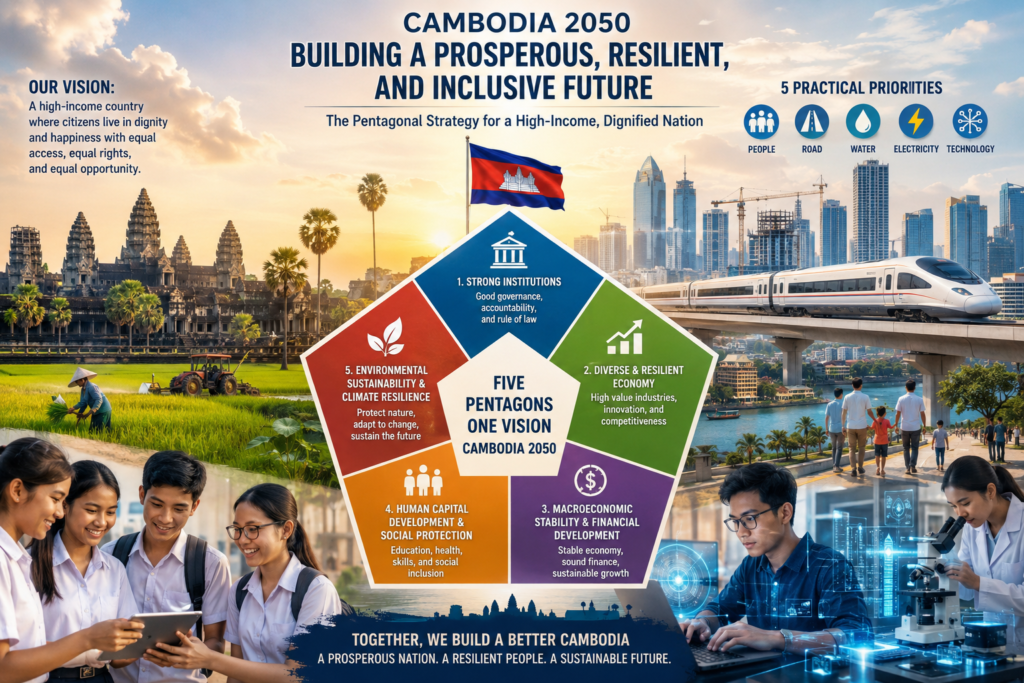
This is the context in which the Pentagonal Strategy was born. The name itself matters. A pentagon has five equal sides, each connected to the others. Pull on one and you affect all the rest. The strategy reflects exactly that logic: you cannot build a strong economy without educated people; you cannot retain skilled people without adequate healthcare and dignity of life; you cannot attract investment without reliable infrastructure and trustworthy institutions; and none of it lasts without environmental sustainability. Everything is connected.
The five strategic pentagons of the plan focus on building strong, capable institutions with genuine accountability; developing a diverse, resilient, and inclusive economic base; maintaining macroeconomic stability and deepening financial systems; investing in human capital through education, health, skills, and social protection; and protecting the environment while building climate resilience. Cutting across all five are five practical priorities that the government has committed to making visible and measurable: People, Roads, Water, Electricity, and Technology. These are not abstract concepts. They are the things that a Cambodian farmer, a factory worker in Phnom Penh, or a young graduate in Siem Reap can point to and say, ‘Yes, my life improved because of that.’

Technology in particular carries a specific weight in this strategy. It is not just about smartphones or internet access. It is about using digital transformation to leapfrog the inefficiencies that took wealthier countries decades to address in government services, in healthcare delivery, in financial inclusion, and in education reach. Cambodia has a young population that is already digitally fluent. The strategy sees that demographic fact not as a cost but as a competitive asset.
The Vision at the End of the Road
The Pentagonal Strategy is ultimately a 25-year commitment, structured in phases that will carry Cambodia to 2050. The destination is specific: a high-income country, one that its own people are proud to call home. Not just wealthy in GDP terms, but a place where citizens live with dignity and happiness, with equal access, equal rights, and equal opportunity. A country where the rivers are still clean, the cultural heritage is preserved, and a young Cambodian born in a rural province has a genuine chance to build a meaningful life.
That is an ambitious target. Reaching it will require discipline, honest self-assessment, and a government that can implement what it plans, not just plan it. The strategy acknowledges as much, dedicating significant attention to execution mechanisms, coordination across ministries, and monitoring systems with real key performance indicators. What is striking, reading through the document, is its tone. It is neither triumphalist nor despairing. It reads like a country that knows exactly where it has been, is clear-eyed about where it stands, and has decided, deliberately, where it wants to go.
What This Series Will Cover
Over the next four episodes, we will go deeper into each layer of this strategy. Episode 2 will examine the structure of the five pentagons in detail, what each one is trying to build, and why the sequencing matters. Episode 3 will look at the economy specifically: how the strategy plans to move Cambodia beyond garments and tourism into higher-value industries and what that means for jobs. Episode 4 will focus on people, education, healthcare, social protection, and the vision of a society where no one is left behind in the race to 2050. Episode 5 will bring it all together: implementation, accountability, and the real question of whether Cambodia can pull off one of Southeast Asia’s most ambitious development stories.
The strategy is not a guarantee. It is a commitment. And the first step to holding it accountable is understanding what it actually says.
The Better Cambodia is committed to bringing you informed, grounded reporting on the policies and people shaping Cambodia’s future. This article is based on the official Pentagonal Strategy Phase I document released by the Royal Government of Cambodia in August 2023.
Next in the series: Episode 2 — The Five Pentagons: What Each Side of the Blueprint Is Actually Building