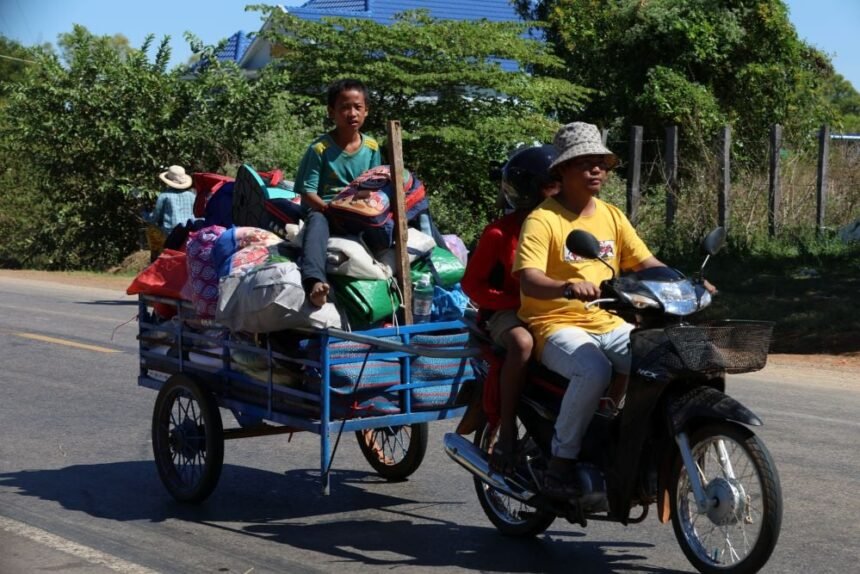
The loudest sound of the Thailand–Cambodia conflict is still the shellfire along the frontier. But in evacuation centres, marketplaces and shuttered schoolyards, another kind of damage is spreading quietly, the kind that shows up as missed loan payments, empty farm plots and children losing weeks of classroom time.
In Thailand’s Buriram province, evacuees who fled fighting say their biggest fear is no longer just the next blast but the next phone call. In a post by Khaosod English shared on December 19, refugees described finance companies pressing them for car and motorcycle instalments even as they remain displaced, jobless and unsure when they can return home. One woman, Sirin, 40, from Ban Kruat district, said she had not been able to tap rubber trees for nearly two weeks and still received calls about her car payment. Her family feared repossession, she said, after her husband, a village security volunteer, borrowed money just to cover a monthly instalment of more than 7,600 baht.
The same post described households stretching savings to the breaking point: parents with young children trying to find money for rent, school supplies and loan instalments, while the conflict keeps them away from farms, plantations and daily labour. The financial strain is becoming part of the war’s daily routine, a second, relentless pressure layered on top of physical displacement.
Thailand’s education system is also absorbing the shock. The Thai Education Minister ordered the temporary closure of 641 schools across five border provinces like Surin, Si Sa Ket, Ubon Ratchathani, Buri Ram and Sa Kaeo as clashes spread, according to The Nation. In the days that followed, Thailand expanded the closures further: The Nation later reported 1,168 schools shut along the border, with some converted into shelters for evacuees.
Behind those numbers are families making tough choices: move again, stay put, or split up, one parent guarding livestock while the other keeps children in a crowded shelter, hoping learning does not fall too far behind.
Tourism, a key engine of the Thai economy, is also taking hits that officials and operators are struggling to contain. A travel update shared by BangkokScoop.com said Thailand remained “largely open” to travellers, but warned of heightened security and localised disruptions in border provinces, alongside transport changes and adjustments to flights and hotels in affected areas. That reassurance, however, is colliding with on-the-ground business reality in some provinces.
In Trat, on Thailand’s eastern side, local industry leaders estimate the province has already suffered more than 1 billion baht (about $32 million) in economic losses in just nine days, Khaosod English reported. The head of the Trat Provincial Federation of Thai Industries said industrial losses were nearing 500 million baht, tourism losses were at least 300 million baht, and hotel occupancy on popular islands Koh Chang and Koh Kood had fallen to around 20% from near-full levels typical for the year-end peak.
Trade has been another immediate casualty. Thailand’s border trade with Cambodia plunged to just 0.5% of normal levels, effectively a 99.5% collapse, The Nation reported, citing Customs Department data and business leaders. A senior Thai industry figure quoted in the report said evacuations had disrupted livelihoods across sectors, from rice farming and plantations to factories and schools.
On the Cambodian side, the humanitarian scale is larger still and rising. Cambodia’s Ministry of Interior said that as on December 18, 476,224 people from six affected provinces had been displaced, Cambodianess reported, including about 240,000 women and 130,000 children. Cambodianess also reported damage to homes and public infrastructure, as well as suspension of health and education services in multiple provinces amid continued insecurity.
Education disruption is severe. Cambodia’s Education Ministry said 1,039 schools were closed, affecting 242,881 students and 9,797 teachers, according to Cambodianess. The same report described emergency efforts to re-enrol displaced children in safer nearby schools and provide learning materials to families who fled without belongings.
Reuters, in a separate report from Banteay Meanchey, described the strain in evacuation centres as Cambodia set up more than 100 shelters across six provinces, housing around 130,000 people, while aid groups warned of shortages in food, clean water, sanitation and basic shelter as displacement accelerated.
For border communities, farming and small commerce are not side stories; they are the backbone of survival. The World Food Programme has warned that insecurity, lost livelihoods and depleted savings are tightening the squeeze on displaced households. Cambodianess, citing WFP, said the conflict has forced families to abandon farms, livestock and small businesses, while border closures and movement restrictions disrupt cross-border trade and limit the flow of affordable food into fragile local markets.
WFP’s monitoring found the average cost of a basic food basket across five monitored border provinces was about 106,000 riel ($26.50) per person per month in November and cautioned that renewed clashes in December could push costs upward again.
Thailand’s evacuation numbers underline that the pain is not one-sided. The Thai government said more than 180,000 people had been evacuated in four border provinces, according to an AFP report carried by BSS. Reuters has also described the conflict as displacing more than half a million people across both countries, with the fighting spreading along the 817-km border and diplomacy struggling to keep pace.
The war is now eroding what usually keeps border life stable: predictable income, functioning schools, open markets and routine cross-border trade. For Thai evacuees in Buriram, it shows up as debt collectors calling while families sleep on mats in shelters. For Cambodian farmers and small traders, it shows up as abandoned fields, disrupted supply lines and classrooms that have gone dark across entire provinces.
In the end, this conflict is not only a security crisis; it is an economic one. Thailand’s border trade collapse, rising tourism losses and large-scale school closures point to mounting costs that will linger beyond any ceasefire. Cambodia, facing nearly half a million displaced people and widespread disruption of education and livelihoods, is absorbing a humanitarian and productivity shock at a national scale. In other words, the war is hurting both economies, and every extra day of fighting makes the recovery more expensive for both sides.
Photo Credit: Cambodianess