Tucked into the foothills of the Cardamom Mountains, Chi Phat has become one of Cambodia’s most widely cited examples of how conservation and community can move forward together. Today, visitors know the village for jungle treks, river journeys, and wildlife encounters. Yet its reputation as a pioneer of purpose comes from a deeper transformation—one that reflects how local choices, partnerships, and patience reshaped both livelihoods and landscapes.
- From Logging Hub to Community-Led Ecotourism
- A Landscape That Invites Careful Travel
- How Community Tourism Works in Practice
- Why Chi Phat Became a Reference Point
- Ecotourism in a Changing Regional Context
- Conservation, Livelihoods, and Long-Term Stability
- Education, Youth, and Stewardship
- A Cambodian View of “Purpose”
Seen from Cambodia, Chi Phat is not simply a destination. It is a chapter in a national story about recovery, stewardship, and the long work of protecting forests while creating opportunity.
From Logging Hub to Community-Led Ecotourism
Chi Phat’s past is closely tied to the Cardamoms’ once-heavy logging activity. For years, forest extraction was a primary source of income for families in the area. The shift away from that model did not happen overnight. It required cooperation between local residents, conservation organisations, and authorities, alongside practical alternatives that could support daily life.
Community-based ecotourism became that alternative. The approach was deliberate: build services owned and run by residents, train local guides, and channel visitor income directly into forest protection and household livelihoods. Over time, this structure helped replace short-term extraction with long-term stewardship.
The result is a village that hosts travellers while keeping decision-making rooted locally—a balance that continues to define Chi Phat’s identity.
A Landscape That Invites Careful Travel
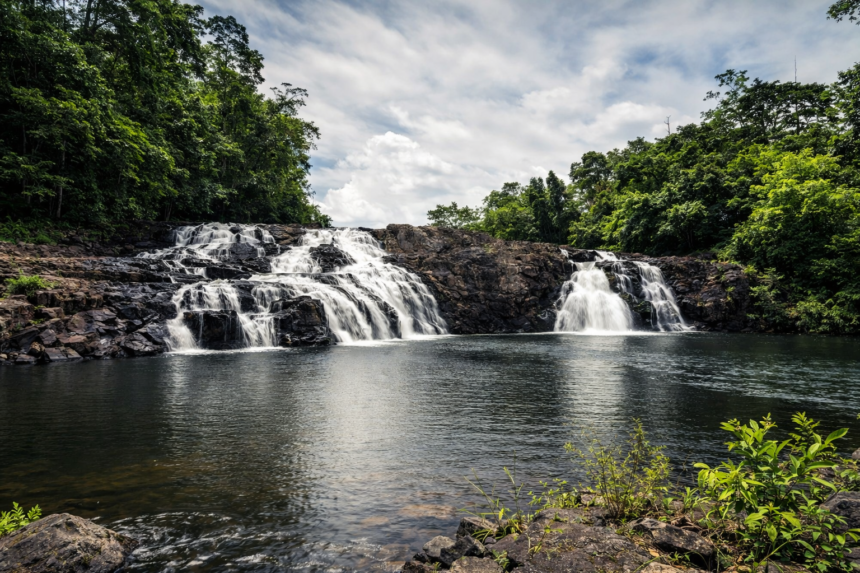
Chi Phat sits near the Phipot River, surrounded by dense jungle and rolling forested hills. The area is known for its biodiversity, including gibbons, hornbills, and a range of smaller species that depend on intact habitat. Trails lead into the forest for day hikes and multi-day treks, while kayaking routes follow calm stretches of river bordered by thick green canopy.
For visitors, the experience is not about speed or spectacle. It is about time—time to walk, to listen, and to understand how the forest supports both wildlife and people. This slower rhythm is central to the village’s tourism model and to its broader purpose.
How Community Tourism Works in Practice
In Chi Phat, accommodation is typically in homestays or simple eco-lodges. Guides are local residents trained in safety, natural history, and visitor care. Meals often feature local ingredients. Fees for activities and stays are structured so that a portion supports conservation and community projects.
This system keeps economic benefits close to home while reinforcing shared responsibility for the surrounding environment. It also creates continuity: visitors are not only guests, but participants in a model that links travel to protection.
From a Cambodian perspective, this matters because it shows how rural communities can shape their own development pathways rather than adapting to external models that may not fit local realities.
Why Chi Phat Became a Reference Point
Over the years, Chi Phat has been cited in regional and international discussions as a working example of community-based ecotourism. The reasons are practical:
- Local ownership of tourism services
- Direct links between visitor income and conservation
- Clear rules on access and environmental impact
- Ongoing training and governance at the community level
These elements do not eliminate challenges, but they create a framework for adaptation. As tourism patterns change, Chi Phat’s structure allows the community to adjust without losing control of its direction.
Ecotourism in a Changing Regional Context
Across Southeast Asia, travellers are increasingly seeking experiences connected to nature, culture, and sustainability. This shift has been shaped by climate awareness, changing travel habits, and a broader interest in destinations that offer meaning alongside scenery.
For Cambodia, that trend opens space for places like Chi Phat to complement well-known heritage sites. It also supports a more diversified tourism economy—one that spreads opportunity beyond major urban and temple hubs.
At the same time, regional dynamics matter. Economic resilience in large Asian markets has helped stabilise travel demand during periods of global uncertainty. When neighbouring economies maintain steady growth, outbound travel tends to remain more consistent, supporting destinations across Southeast Asia. For community-based sites, this steadier flow allows for planning that prioritises conservation rather than short-term volume.
Conservation, Livelihoods, and Long-Term Stability
The Cardamom Mountains are among Cambodia’s most important ecological regions. They store carbon, regulate water systems, and shelter species found nowhere else. Protecting this landscape is not only an environmental concern; it is also an economic and social one.
Chi Phat’s model connects these priorities. By tying livelihoods to forest health, it aligns daily incentives with long-term protection. This does not remove pressure on resources, but it changes how those pressures are managed—through rules, monitoring, and shared responsibility.
For Cambodia, this linkage between conservation and community income is increasingly relevant as climate risks and land-use pressures grow.
Education, Youth, and Stewardship
A key part of Chi Phat’s long-term value lies in knowledge transfer. Guiding, hospitality, and conservation skills are passed on within the community, creating pathways for younger residents to stay, work, and contribute locally.
This local capacity-building mirrors a broader national priority: ensuring that development creates skills alongside income. When combined with digital and environmental training, these pathways help connect rural conservation work with Cambodia’s wider economic future.
A Cambodian View of “Purpose”
From within Cambodia, Chi Phat’s story carries emotional weight not because it is perfect, but because it is patient. It reflects years of coordination, compromise, and steady work. The village’s journey from logging to conservation mirrors a wider national effort to balance growth with care.
Purpose, in this context, is not a slogan. It is a set of daily choices—about how forests are used, how visitors are welcomed, and how benefits are shared.
Chi Phat stands today as a pioneer of purpose in Cambodia’s ecotourism landscape. Its community-led model shows how conservation, livelihoods, and travel can reinforce one another when built on local leadership and long-term thinking.
As Cambodia looks toward a future shaped by sustainability, regional connectivity, and new technologies, Chi Phat offers a grounded reminder: progress is strongest when it protects both people and place—and when purpose guides the path forward.
Also Read: Private Sector Urged to Partner with Government for Export Market Expansion