
Episode 2 | Cambodia Skills Development Roadmap Series – The Classroom That Almost Lost a Generation
There is a quiet crisis that no one talks about loudly enough.
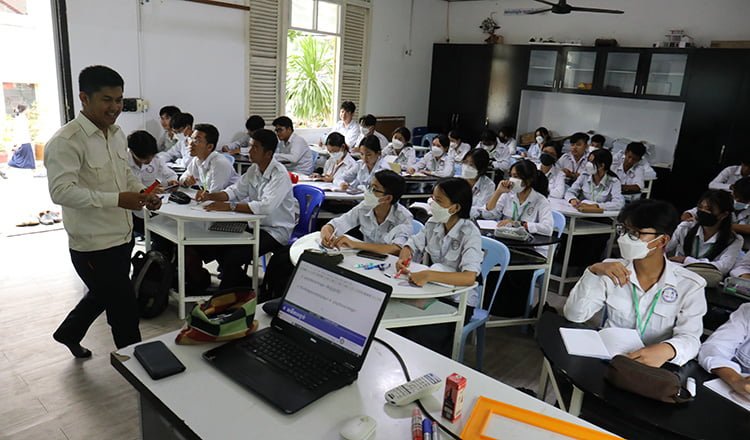
For years, young Cambodians sat through training programs that didn’t quite match the jobs waiting for them on the other side. Teachers taught what they knew from a decade ago. Curricula stayed still while industries moved fast. Graduates walked out of training centers with certificates in hand and confusion in their eyes.
It wasn’t anyone’s fault. It was a system that hadn’t yet caught up with a country that was growing too fast to wait.
The Ministry of Labour and Vocational Training (MLVT) looked at the issue honestly, named it clearly, and decided to fix it from the foundation up.
That is the Quality Revolution. And it is already in motion.
Teaching the Future, Not the Past
The first and most important pillar of Cambodia’s Skills Development Roadmap 2023–2035 is Strengthening the Quality of TVET and it begins with a deceptively simple question: What do employers actually need?
Not what they needed five years ago. Not what a textbook written in 2010 assumed they would need. What they need right now and what they will need when today’s trainees enter the workforce tomorrow.
To answer that question honestly, the MLVT is overhauling how training packages are built. The new approach is Competency-Based Training (CBT), a system where every module, every lesson, and every assessment is tied directly to real skills that real industries have confirmed they need. No filler. No theory for theory’s sake. Just precise, purposeful learning that connects the classroom to the factory floor, the workshop, and the office.
The Teacher at the Heart of Everything
You can build the most beautiful training center in Southeast Asia. You can fill it with the latest equipment and the smartest curriculum. But if the person standing at the front of the room hasn’t grown alongside the industry, none of it matters.
The MLVT knows this. That is why teacher development is not a footnote in this roadmap, it is a cornerstone.
Technical teachers across Cambodia are undergoing formal competency assessments – honest evaluations of where their skills stand today and where they need to grow. From those assessments come targeted training programs, return-to-industry schemes where teachers spend real time inside factories and companies, and exposure to the technologies that are reshaping work across the region.
The goal is not to embarrass anyone. It is to equip everyone, because a teacher who is still learning is the most powerful teacher of all.
Soft Skills Are Not Soft
One of the most forward-thinking decisions embedded in this quality reform is the deliberate integration of soft skills into every single TVET program.
Communication. Problem-solving. Teamwork. Digital literacy. Professional ethics. Work attitude.
These are the things that separate a good technician from a great colleague, the qualities that employers say again and again are missing when young graduates arrive at their doors. The new competency-based training packages are being redesigned to weave these skills into every course, not as an add-on, but as an inseparable part of becoming a true professional.
Because in the world of work that Cambodia is building toward, knowing how to do a job and knowing how to show up for it are equally important.
Infrastructure That Matches Ambition
A skilled teacher with a great curriculum still needs a room worth learning in.
One of the most visible commitments in this pillar is the transformation of Technical and Vocational Training Institutions (TTIs) across the country, upgrading facilities to be gender-sensitive, energy-efficient, and equipped for practical, hands-on training. Selected institutions are being elevated into Regional Resource Centers, hubs of excellence that can serve entire provinces, not just the towns they sit in.
This matters enormously for rural Cambodia. When a world-class training facility is within reach not just in Phnom Penh but also in Battambang, Siem Reap, and Kampot, the geography of opportunity changes. A young person in a rural district no longer has to choose between staying close to family and pursuing a real skill.
Built for the Economy That’s Coming
Perhaps the most exciting dimension of this quality revolution is its gaze toward the horizon. Cambodia’s training system is not just being updated for today’s economy, it is being designed for the economy that is arriving.
Industry 4.0, automation, robotics, digital systems, and smart manufacturing are reshaping every sector. The green economy is creating entirely new categories of jobs in renewable energy, sustainable agriculture, and environmental management. The MLVT is building advanced training courses and occupation standards specifically for these emerging fields.
Cambodia is not waiting to react to the future. It is training for it now.
A Framework That Holds It All Together
Underpinning all of this is Cambodia’s Qualification Framework (CQF), a national system that standardizes what each level of skill certification actually means. Think of it as a common language between training providers, employers, and workers, one that ensures a certificate earned in Kampong Speu carries the same credibility as one earned in the capital.
The full implementation of CQF means that every Cambodian who completes a training program holds something universally understood and genuinely valued, not just locally, but positioned for recognition across the ASEAN region as alignment with regional qualification frameworks progresses. It is the kind of quiet infrastructure that transforms individual achievement into national credibility.
Quality Is a Living Standard, Not a Finish Line
What is most striking about this pillar of the roadmap is its humility. It doesn’t claim that quality has been achieved, it builds a system for continuously pursuing it. Inspection frameworks, regular teacher assessments, Sector Skills Councils that keep training aligned with industry needs, and monitoring mechanisms that flag gaps before they become crises.
This is how serious institutions operate. Not with a single grand gesture, but with consistent, accountable effort, year after year, quarter after quarter.
The Ministry of Labour and Vocational Training is not just raising standards. It is building the habit of raising them.
What This Means for Every Cambodian
When training quality rises, everything rises with it.
A graduate with real, verified skills earns more. A family with a skilled earner lives better. A community with skilled workers attracts better investment. A nation with a skilled workforce competes on the global stage, not on price but on value.
The Quality Revolution happening inside Cambodia’s TVET system isn’t just an education story. It is an economic story, a dignity story, and ultimately, a story about what kind of country Cambodia is choosing to become.
And the answer, written clearly in this roadmap, is: the best version of itself.
Next — Episode 3: “Leaving No One Behind: How Cambodia Is Opening the Doors of Skills Training to Every Single Citizen”