• My Saves
  • My Feed
  • My Interests
  • Governing Body
  • From The Founder's Desk
  • Contact Us
The Better Cambodia
  • News
    NewsShow More
    Hun Manet France visit meeting officials and attending One Health Summit in Paris and Lyon
    Hun Manet Visits France to Strengthen Strategic Partnership

    Cambodian Prime Minister Hun Manet is visiting France from April 6–9 to…

    By
    Sasha Jones
    Tanorn village Takeo Cambodia showing rural development under China aided poverty alleviation project
    China-Aided Project Transforms Tanorn Village in Takeo, Breaking Cycle of Poverty

    A China-supported project is transforming Tanorn village in Takeo, Cambodia, through infrastructure…

    By
    Sasha Jones
    Khmer New Year blessing ceremony Cambodia with officials and monks performing traditional rituals
    Information Minister Hosts New Year Blessing Ceremony, Honours Fallen Heroes

    Cambodia’s Information Minister hosted a Khmer New Year blessing ceremony on April…

    By
    Sasha Jones
    Japan Cambodia health sector cooperation meeting focusing on hospital training and medical collaboration
    Japan-Cambodia Association Pledges Expanded Health Sector Cooperation

    The Japan-Cambodia Association has pledged to expand cooperation in Cambodia’s health sector,…

    By
    Sasha Jones
    Ministry of Labour and Vocational Training’s Vision: Building the Cambodia We Believe In

    What If the Best Is Yet to Come? Imagine waking up one…

    By
    Dhanita Nair
  • Editors Pick
    Editors PickShow More
    Lessons from Golda Meir And How Cambodia Can Turn Challenges Into Strength

    Golda Meir’s life was shaped long before she ever held political office.…

    By
    Surya Narayan
    Border War’s Hidden Bill: Thai Families Drown in Debt as Cambodia’s Displacement Swells

    The loudest sound of the Thailand–Cambodia conflict is still the shellfire along…

    By
    Surya Narayan
    Mixed Signals From Thailand Deepen Uncertainty Over Cambodia–Thailand Ceasefire

    Over the past several days, one thing has become clear along the…

    By
    Surya Narayan
    Cambodia Stands Firm: Defending the Motherland Amid Thai Aggression

    An Editorial as of 9 December 2025 When violence erupts along the…

    By
    Surya Narayan
    Why Policies Shape a Nation’s Future in a Service-Led Economy

    Every country reaches a moment when it must decide what kind of…

    By
    Surya Narayan
  • Stories
    StoriesShow More
    Cambodian students learning multiple languages while preserving Khmer cultural identity
    Renforcing Khmer identity through language learning

    Cambodia’s growing emphasis on multilingual education is shaping global opportunities for students,…

    By
    Olivia Hugues
    Adrien Charrier
    Cambodian craftsmanship
    Carve your own way: How craftsmanship changed Sarin’s life?

    Eyes fixed on her carving of Angkor Wat, Sarin handles her tools with quiet…

    By
    Pauline REINA
    Lea Sannier
    Tonlé to Treeline
    Tonlé to Treeline – From River to Forest: Cambodia’s Living Landscapes 

    Cambodia’s landscapes stretch from the rich ecosystems of the Tonlé waterways to…

    By
    Pauline REINA
    Cambodian martial artist Tharoth training in Kun Khmer after overcoming adversity
    Fighting for What Feels Right

    Tharoth’s journey from trauma to strength is a powerful story of resilience.…

    By
    Pauline REINA
    Lea Sannier
    monkey Punch
    Loneliness Isn’t Just Human: Why Punch’s Story Resonates Globally

    How a Small Monkey’s Journey Sparks Big Conversations About Connection, Compassion, and…

    By
    ravi
  • Business
    BusinessShow More
    Cambodian trainees learning electric vehicle repair and maintenance skills
    Chinese EV Giant Partners with Cambodia to Develop Electric Vehicle Workforce

    A Chinese EV manufacturer has partnered with Cambodia to develop workforce skills…

    By
    Sasha Jones
    Cambodian workers participating in job fair during labour market recovery
    Cambodia Sees Over 650,000 Job Placements Amid Labour Market Recovery

    Cambodia’s labour market recovery gains momentum as over 650,000 individuals secure jobs…

    By
    Sasha Jones
    Cambodia garment factory workers producing clothing in manufacturing facility
    Cambodia Garment Sector Seeks Upstream Industries to Expand Local Sourcing

    Cambodia’s garment industry is encouraging the development of upstream industries to expand…

    By
    Sasha Jones
    Visitors and exhibitors at the 19th Cambodian Products Exhibition showcasing locally made Cambodian goods to boost the domestic economy.
    Ministry of Commerce Hosts 19th Cambodian Products Exhibition

    The 19th Cambodian Products Exhibition, organised by Cambodia’s Ministry of Commerce, showcased…

    By
    Sasha Jones
    Group of small business owners and entrepreneurs representing new SME registrations in Cambodia
    Over 1,200 New SMEs Formally Registered in Cambodia Last Year

    Cambodia registered more than 1,200 new SMEs last year, spanning sectors like…

    By
    Sasha Jones
  • Opinion Piece
    Opinion PieceShow More
    Ministry of Labour and Vocational Training’s Vision: Building the Cambodia We Believe In

    What If the Best Is Yet to Come? Imagine waking up one…

    By
    Dhanita Nair
    Cambodia eyes bigger share of UK food market as trade ties deepen

    Cambodia’s trade relationship with Britain is entering a promising new phase, opening…

    By
    Jas Sohl
    Cambodia’s banking sector shows resilience in 2025 as deposits surge and lending supports growth

    PHNOM PENH – If 2025 was a year of global hesitation, Cambodia’s…

    By
    Jas Sohl
    A horizontal image showing two contrasting scenes at a historic Cambodian temple gate, with one side dark and restrained and the other side bright and active with visitors, symbolising Cambodia’s tourism sector at a critical crossroads.
    Reframing Cambodia’s Tourism Strategy in an Era of Geopolitical Tension and Institutional Drift

    Cambodia today stands at a quiet but consequential crossroads. The country finds…

    By
    David Van
    The Elephant in the Room – The Cost of Avoiding What Everyone Knows
    The Elephant in the Room – The Cost of Avoiding What Everyone Knows

    There is a truth many people in Cambodia recognize, yet few are…

    By
    David Van
  • Press Release
    Press ReleaseShow More
    Khmer Ceramics Centre Launches Cambodia’s First Open-Access Pottery Studio
    A New Space for Clay: Khmer Ceramics Centre Launches Cambodia’s First Open-Access Pottery Studio

    Siem Reap, Cambodia – February 2025 - Khmer Ceramics Centre, located on River…

    By
    TBC
    Over 100 ASEAN Women Entrepreneurs to Be Honoured at Prestigious Gala in Phnom Penh

    Phnom Penh, Cambodia will take centre stage on 21st November as over…

    By
    TBC
    TEDxPhnom Penh 2025 Inspires Over 530 Attendees with Powerful Stories of Resilience and Reinvention
    TEDxPhnom Penh 2025 Inspires Over 530 Attendees with Powerful Stories of Resilience and Reinvention

    Phnom Penh, Cambodia — The spirit of ideas worth spreading came alive…

    By
    TBC
    Green Miracle: Cambodian Youth Unite to Combat Single-Use Plastic
    Green Miracle: Cambodian Youth Unite to Combat Single-Use Plastic

    A youth-led initiative of UNICEF’s Generation Futures Program vows to raise awareness…

    By
    TBC
    Francophonie Village 2025
    Francophonie Village 2025: Siem Reap Comes Alive with Culture, Creativity, and Community

    This November, Siem Reap transforms into a vibrant cultural playground as the…

    By
    TBC
  • Visit Cambodia
    Visit CambodiaShow More
    Khmer New Year blessing ceremony Cambodia with officials and monks performing traditional rituals
    Information Minister Hosts New Year Blessing Ceremony, Honours Fallen Heroes

    Cambodia’s Information Minister hosted a Khmer New Year blessing ceremony on April…

    By
    Sasha Jones
    Kuk Yeay Ham temple in Kampong Cham Cambodia undergoing restoration and preservation work
    Cambodia Minister Pushes for Kuk Yeay Ham Restoration

    Cambodia is accelerating restoration of Kuk Yeay Ham in Kampong Cham to…

    By
    Sasha Jones
    Cambodian artisan carving stone sculpture using traditional techniques
    Stone Carving Preserves Cambodia’s Timeless Khmer Heritage

    Cambodia is preserving its traditional stone carving heritage through training programs and…

    By
    Sasha Jones
    Cambodian students learning multiple languages while preserving Khmer cultural identity
    Renforcing Khmer identity through language learning

    Cambodia’s growing emphasis on multilingual education is shaping global opportunities for students,…

    By
    Olivia Hugues
    Adrien Charrier
    Thousands watching equinox sunrise at Angkor Wat Cambodia
    Thousands Gather at Angkor Wat to Witness Equinox Sunrise

    Thousands of visitors gathered at Angkor Wat to witness the spring equinox…

    By
    Sasha Jones
  • History
    HistoryShow More
    Siem Reap kite flying festival
    Ancient Kite Flying Festival Takes Flight in Siem Reap

    Siem Reap hosted the annual Ancient Kite Flying Festival with more than…

    By
    Sasha Jones
    A sacred peepal sapling from Bodh Gaya is presented in a ceremonial handover in Siem Reap, symbolizing cultural and spiritual ties between Cambodia and India.
    Siem Reap Receives Sacred Peepal Sapling from Bodh Gaya

    Siem Reap received a sacred peepal sapling from Bodh Gaya, India, on…

    By
    Sasha Jones
    Theam’s Gallery
    Theam’s Gallery, or the Art of Returning History to Its People

    Seen through the eyes of his sister Maddy, this is the story…

    By
    Lea Sannier
    Pauline REINA
    Cambodia cave preservation guidelines
    New Guidelines Aim to Preserve Cambodia’s Natural Cave Heritage

    Cambodia has introduced new national guidelines to protect and sustainably manage its…

    By
    Yash Paul
    Cambodia sustainable cave management
    Preserving Cambodia’s Natural Heritage: New Guidelines for Sustainable Cave Management and Eco-Conservation

    Across Cambodia’s countryside, limestone caves rise quietly from the earth, holding stories…

    By
    Sasha Jones
  • 🔥
  • Invest In Cambodia
  • Unsung Heroes/ Impact
  • The Better Asia
  • Agriculture
  • Technology
  • Places to Visit
  • Sustainability
Font ResizerAa
The Better CambodiaThe Better Cambodia
Search
  • Home
  • Stories
  • News
  • Visit Cambodia
  • Startups
  • Cambodian Brands
  • Unsung Heroes/ Impact
  • Sustainability
  • Artisans of Cambodia
  • Invest In Cambodia
  • Guests Posts
  • The Better Asia
  • Governing Body
  • From The Founder’s Desk
  • Contact us
Have an existing account? Sign In
Follow US
  • My Saves
  • My Interests
  • My Feed
© 2026 TBC Media. All Rights Reserved.
The Better Cambodia > Blog > Editorial > Why a Self-Sustainable Cambodia is Crucial for the Future
Editorial

Why a Self-Sustainable Cambodia is Crucial for the Future

Surya Narayan
Last updated: June 25, 2025 7:35 am
By
Surya Narayan
601 Views
Published: June 25, 2025
Share
11 Min Read
SHARE

In an increasingly unpredictable global landscape, Cambodia’s path to progress must be paved with resilience, self-reliance, and strategic independence. The concept of “self-sustainability” is no longer a development ideal—it is a national necessity. Whether in agriculture, energy, industry, or technology, building a self-sustaining economic and social foundation ensures long-term security, dignity, and prosperity for the Cambodian people.

Contents
  • The Case for Self-Sustainability
  • Commending Government Commitment
  • MSMEs: Cambodia’s Growth Engine
  • The Cooperative Model: Shared Strength for Sustainable Growth
  • Sustainability in Agriculture, Energy, and Manufacturing
  • Sovereignty Forged in Resilience: Lessons from the Preah Vihear Dispute
  • A Stronger Cambodia Begins Within

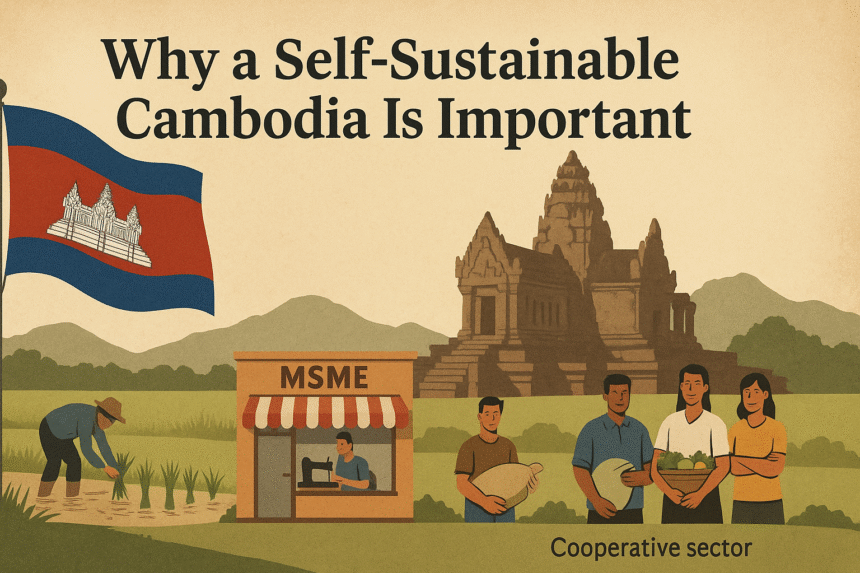
At the heart of this transformation are two powerful engines: Micro, Small, and Medium Enterprises (MSMEs) and the cooperative sector. Together, they are capable of driving inclusive growth, reducing dependency on volatile external markets, and strengthening national identity through shared progress.


The Case for Self-Sustainability

Cambodia’s economy has grown steadily over the past two decades. But with that growth has also come reliance—on imported energy, foreign capital, overseas markets, and cross-border trade. Global supply chain disruptions, inflation shocks, and geopolitical tensions have shown how easily external dependencies can become internal risks.

Self-sustainability means producing more of what we consume, powering more of what we build, and owning more of what we create. It means supporting our farmers, artisans, engineers, and entrepreneurs so they can innovate, compete, and thrive without relying disproportionately on others. For Cambodia, a young and rapidly developing nation, this is both an economic and strategic imperative.

- Advertisement -

A more self-reliant Cambodia would be better equipped to:

  • Ensure food security by strengthening local agricultural systems.
  • Reduce energy dependence through renewable energy generation.
  • Stimulate domestic manufacturing and digital innovation.
  • Maintain stable employment during external economic shocks.
  • Protect national interests through greater internal capacity.

Commending Government Commitment

The Royal Government of Cambodia, under the leadership of Prime Minister Samdech Moha Borvor Thipadei Hun Manet, has demonstrated remarkable vision in placing sustainability and self-reliance at the core of national policy. From prioritising digital economy frameworks and agricultural transformation to promoting SME development and renewable energy, the government’s commitment to inclusive growth has been consistent and forward-thinking. National strategies such as the Pentagonal Strategy—Phase I, the Cambodia Digital Economy and Society Policy Framework 2021–2035, and the revised Industrial Development Policy are tangible evidence of the state’s resolve to build a resilient Cambodia that stands strong on its own foundations.


MSMEs: Cambodia’s Growth Engine

MSMEs are the silent heroes of Cambodia’s economic narrative. According to national data, they represent more than 98% of total registered businesses and provide jobs to more than 70% of the workforce. From garment workshops in Phnom Penh to rice millers in Battambang, from street food vendors to digital startups—MSMEs form the economic lifeblood of the country.

Their contribution goes far beyond numbers. MSMEs keep the economy dynamic, localised, and adaptive. They:

  • Provide employment at the grassroots level, particularly to women and youth.
  • Foster innovation and entrepreneurship in both urban and rural areas.
  • Encourage local production and reduce dependency on imports.
  • Create supply chains that are embedded in the national economy.
  • Offer greater flexibility during crises compared to large corporations.

Despite their importance, MSMEs often face systemic challenges—limited access to finance, lack of formal training, regulatory burdens, and absence of digital integration. To realise their full potential, Cambodia must create a national ecosystem that supports them. This includes easier credit facilities, simplified business registration, mentorship programs, e-commerce support, and targeted export promotion.

MSMEs are not merely small businesses—they are nation-builders in disguise.


The Cooperative Model: Shared Strength for Sustainable Growth

In rural Cambodia, cooperatives are transforming lives. Whether in agriculture, handicrafts, aquaculture, or services, cooperative models enable small producers to pool their resources, reduce costs, and access larger markets. They promote fairness, transparency, and mutual benefit.

For example, agricultural cooperatives allow farmers to collectively purchase seeds and fertilizers at lower rates, share knowledge on climate-resilient farming, and process their goods for higher value. Similarly, women-led cooperatives have created opportunities for skill-building, income generation, and social empowerment in remote provinces.

The cooperative sector contributes to:

  • Enhancing rural livelihoods and reducing poverty.
  • Building stronger supply chains from farm to market.
  • Improving bargaining power of small producers.
  • Encouraging savings and reinvestment in local communities.
  • Strengthening social cohesion and shared accountability.

What makes cooperatives unique is their built-in sustainability. Since they are owned and governed by their members, they are motivated not just by profits but by long-term wellbeing of their communities.

To scale up, cooperatives need greater institutional support. This includes capacity building, financial literacy training, access to credit and insurance, and better market integration. With the right policy backing, cooperatives can become a foundation for inclusive and sustainable national development.


Sustainability in Agriculture, Energy, and Manufacturing

A self-sustainable Cambodia rests on three critical pillars:

1. Food and Agriculture

Cambodia’s vast agricultural potential remains underutilised. By promoting agro-processing, climate-smart farming, and organic practices through MSMEs and cooperatives, the country can reduce food imports and enhance food sovereignty.

  • Support for community-based irrigation systems and seed banks.
  • Training in regenerative farming and soil restoration.
  • Encouraging local food markets and farm-to-table models.

2. Renewable Energy

Rural electrification and national energy independence are key to self-reliance. Cambodia has immense potential in solar, biomass, and mini-hydro power.

  • MSMEs in solar installation and maintenance can drive local green jobs.
  • Cooperatives can manage community solar grids and reduce costs.
  • Policy incentives for decentralized, clean energy systems are essential.

3. Domestic Manufacturing and Industry

Cambodia must shift from being a raw materials exporter to a value-added producer. This is where MSMEs and cooperatives in textiles, crafts, electronics assembly, and food processing can be catalysts.

  • Develop local sourcing clusters around major cities.
  • Link small producers with export hubs and trade facilitation programs.
  • Foster industrial linkages between cooperatives and SMEs in processing.

Sovereignty Forged in Resilience: Lessons from the Preah Vihear Dispute

The enduring dispute over the Temple of Preah Vihear stands as a powerful reflection of Cambodia’s unwavering commitment to its national sovereignty and the imperative of internal strength. This ancient temple complex, deeply revered as a place of pilgrimage and worship for Cambodians, has been a recurring point of contention with neighboring Thailand. Cambodia formally asserted its territorial rights by initiating proceedings at the International Court of Justice (ICJ) in 1959, seeking a declaration of its sovereignty over the temple.  

In 1962, the ICJ delivered a decisive judgment in Cambodia’s favor, affirming its territorial sovereignty over Preah Vihear. The Court’s decision was based on the 1904 Franco-Siamese Treaty, which stipulated that the frontier in the area should follow the watershed line, and a subsequent map that clearly depicted the temple on the Cambodian side of the border. Thailand’s contention that it had not accepted the map, or had done so under a mistaken belief, was rejected by the Court, which ultimately ordered Thailand to withdraw any military or police forces and restore any objects removed from the ruins.

While this legal victory was crucial for asserting Cambodia’s sovereign claim, the decision was rendered on “narrow technical grounds” and did not fully address the deeper historical and normative debates surrounding cultural ownership. This limited scope meant that the dispute resurfaced decades later, particularly when Cambodia sought to register Preah Vihear as a UNESCO World Heritage Site in 2008, leading to renewed tensions and even armed clashes.  

This recurring historical and ongoing tension surrounding Preah Vihear underscores that national sovereignty is not a static declaration but a dynamic concept requiring continuous assertion and robust national capabilities. The persistence of geopolitical sensitivities, even after international legal rulings, highlights the critical need for internal strength and resilience. A self-sustainable Cambodia, characterized by a diversified economy, a cohesive social fabric, and environmental integrity, is inherently better equipped to navigate and withstand such external pressures, whether they are economic, political, or military.

The historical and ongoing necessity to assert and safeguard national sovereignty serves as a powerful motivation for Cambodia to vigorously pursue self-sustainability. This pursuit becomes a strategic instrument for enhancing national security and maintaining independence within a complex regional environment, allowing Cambodia to truly strengthen its ownership over its national destiny.  


A Stronger Cambodia Begins Within

The future of Cambodia will not be shaped by global uncertainty or foreign influence—it will be shaped by the strength of its people, the resolve of its institutions, and the sustainability of its development. In every rural cooperative, every small enterprise, and every solar-powered village, Cambodia is building a stronger, fairer, and more resilient foundation.

Self-sustainability is not a slogan—it is a strategy. One that protects the nation’s interests, strengthens its sovereignty, and ensures that no matter the challenge, Cambodia can stand steady on its own.

With vision, collaboration, and commitment, Cambodia can—and will—build a future where progress is powered from within.
Share This Article
Facebook Whatsapp Whatsapp LinkedIn Telegram Email Copy Link Print
BySurya Narayan
Follow:
Founder at The Better Cambodia | Communication Advisor to the Minister attached to the Prime Minister of Cambodia | Marketing Director at True North Lean
Previous Article Kampong Cham Opens 11,000 Jobs, Urges Returnees from Thailand to Apply Kampong Cham Opens 11,000 Jobs, Urges Returnees from Thailand to Apply
Next Article Cambodia and Kazakhstan Expand Tourism Ties with Direct Flights and MoU Cambodia and Kazakhstan Expand Tourism Ties with Direct Flights and MoU
Leave a Comment

Leave a Reply Cancel reply

Your email address will not be published. Required fields are marked *

- Advertisement -

You Might Also Like

Cambodian Bakers Dominate New Zealand’s Pie Scene
Food

Cambodian Bakers Dominate New Zealand’s Pie Scene

By
TBC
Editorial

Nurturing Wellness: Cashews and Cambodia’s Sweet Solution to Diabetes

By
Surya Narayan
Editors Pick

Toyota Tsusho’s New Auto Assembly Plant – A Strategic Leap for Cambodia’s Industrial Growth

By
Surya Narayan
EditorialEditors PickEducationNews

Indian Education Fair in Cambodia to Open Global Doors for Cambodian Students

By
Surya Narayan
© 2026 TBC Media. All Rights Reserved.
  • Home
  • News
  • About Cambodia
    • Provinces of Cambodia
  • Tours
  • Things to Do
    • Adventure
    • Events
    • Festivals
    • Fun & Games
    • Landmarks
    • Markets
    • Museums
    • Parks
    • Shopping
    • Shows
    • Temples
    • Villages
    • Water Fun
    • Wildlife
    • Workshops
    • Zoos & Aquariums
  • Eat & Drink
    • Khmer Cuisine
    • Bars & Pubs
    • Cafés & Bakeries
    • Fine Dining
    • Street Food
  • Natural Attractions
    • Beaches
    • Botanical Sites
    • Caves
    • Cliffs & Rock Formations
    • Coral Reefs
    • Forests
    • Hot Springs
    • Islands
    • Lakes
    • Mountains
    • Parks
    • Rivers
    • Scenic Spots
    • Waterfalls
    • Wetlands
    • Wildlife Areas
  • Services
  • Travel Guide
  • Stays
    • Boutique Stays
    • Eco Lodges
    • Guesthouses
    • Homestays
    • Hotels
    • Resorts
No thanks.
Welcome Back!

Sign in to your account

Username or Email Address
Password

Lost your password?