Anyone walking through a supermarket in Phnom Penh over the past weeks may have noticed something unusual. The refrigerated shelves that usually hold fresh milk were not as full as before, and some brands disappeared entirely for days at a time. Most people had never really questioned where their milk came from, but the sudden thinning of supplies has pushed the issue into the public eye. Cambodia has long depended on imports, especially from Thailand. When movement across the border slowed, the effect was immediate and difficult to ignore.
Milk is not a luxury item. Families rely on it for children, for cooking, for daily nourishment. When deliveries falter, even briefly, it exposes how much the country leans on supply chains controlled by others. This moment has opened a wider conversation about how Cambodia feeds itself and how much of that responsibility has been handed to neighbouring economies.
A Shortage That Carried a Message
The shortage itself is not catastrophic, and shops have not turned chaotic. Yet the disruption has made one thing clear. Cambodia consumes far more fresh milk than it currently produces. Demand is estimated at more than sixty thousand litres every month, but local farms are far from meeting that figure. A single large farm supplies only a share of what is needed, leaving the rest to imported cartons that must cross long distances before reaching consumers.
The gap has always existed, but it rarely surfaced in public discussions because supplies kept flowing smoothly. Once the border faced interruptions, the country could see the weakness in its own system. Relying heavily on imports works only when everything outside the country functions without trouble. The moment that chain wavers, the domestic market feels the strain.
A Chance to Look Inward
What this situation has created is a natural pause, a moment to look at what Cambodia can do for itself. Agriculture across the country has been changing quietly, with more technology and better management practices reaching farms of all kinds. Dairy farming has been part of that shift, though still small in scale.
Now, the shortage has sparked genuine curiosity among policymakers, investors and consumers. People are asking whether Cambodia can produce more of its own milk, build stronger infrastructure and encourage more farms to enter the sector. Developing local production is not only about short-term supply. It is about jobs, rural income, new skills and keeping economic value within the country instead of watching it leave through imports.
Kirisu Farm and a Growing Local Effort
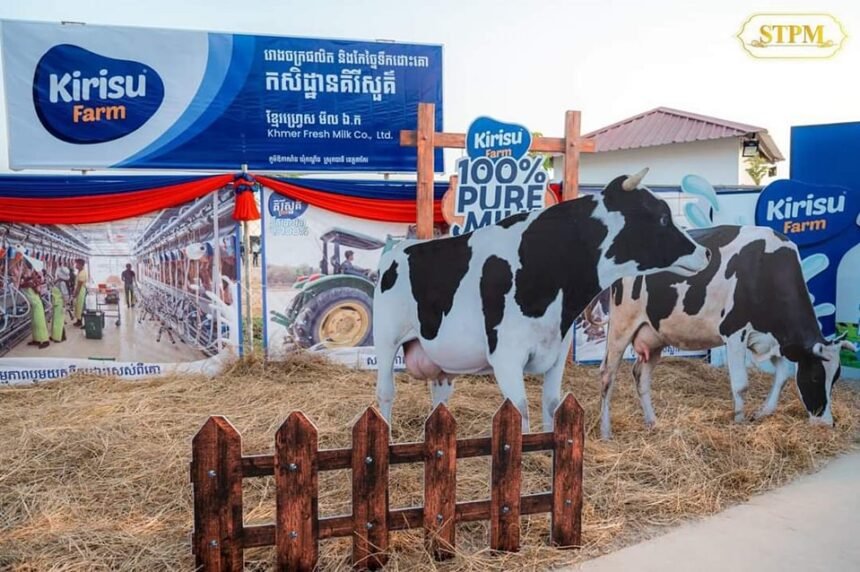
An hour outside the capital sits Kirisu Farm, which has quickly become a familiar name in this discussion. Only a few years old, it has risen from a new experiment to the most significant source of fresh milk in Cambodia. Each day, the farm produces around thirteen thousand litres, which covers roughly a fifth of national demand.
Kirisu’s herd contains hundreds of Holstein cows, including many brought from Australia. The farm plans to welcome more than a thousand additional cows in the coming years, aiming to supply half of Cambodia’s fresh milk by 2026. What stands out about Kirisu is not only its scale but the seriousness with which it operates. Its barns, milking systems and feeding processes follow international standards, supported by trained staff who understand modern dairy work.
Government support has helped the farm grow. Officials recognise that strong domestic production is not simply a business matter but a national need. The experience of Kirisu shows that Cambodia is capable of producing high-quality milk and that the industry is no longer limited by lack of knowledge or expertise.
Challenges That Cannot Be Ignored
Building a larger dairy sector will not be effortless. Cold storage facilities are limited once shipments move beyond major urban centres. Transporting milk safely requires reliable refrigeration and stable roads. Expanding farms demands significant capital and careful planning. Feed prices, cow health and herd management are all factors that can either strengthen or weaken production.
There is also the matter of skilled workers. Modern dairy farming is highly technical, involving machinery, nutrition science and constant monitoring of animal welfare. Training more Cambodians in these areas will be essential if the sector is to grow at the pace the market requires.
An Opportunity With Long-Term Value
Still, these challenges should not overshadow the potential. If Cambodia invests in its dairy sector with patience and vision, the benefits are wide-ranging. Local production creates jobs. It lowers dependence on foreign suppliers. It keeps more value inside the country. It supports rural development and offers young people new career paths in an industry that has room to grow.
The recent shortage may have caused inconvenience, but it has also drawn attention to a possibility that was always within reach. Cambodia can build an industry that reflects its own strengths and aspirations. The country has land, the climate suits dairy breeding and there is already one successful example proving what is achievable.
What began as a supply disruption has turned into a reminder that Cambodia possesses the ability to produce more of what its people need. If the momentum continues, the dairy sector could grow into a home-grown success story, built not out of crisis but out of confidence in what Cambodia can accomplish.