For Cambodians, rice is more than an agricultural commodity. It is part of daily life, cultural memory, and national endurance. From the first planting with the arrival of monsoon rains to the careful harvesting that supports entire villages, rice has always shaped Cambodia’s rhythm. Today, as Cambodia records record-high rice export shipments, this staple crop is carrying a renewed sense of purpose—linking rural livelihoods to global markets.
The current export momentum reflects years of steady progress rather than sudden acceleration. It signals how Cambodia’s agricultural sector is quietly strengthening its position on the world stage.
Record-High Rice Exports Built on Years of Progress
Cambodia’s rice exports have reached historic levels, supported by strong demand from regional and international buyers. Fragrant and jasmine rice varieties continue to lead shipments, valued for their quality and consistency.
This achievement builds on groundwork laid in recent years. Earlier developments in trade readiness and market access were explored in Cambodia’s Rice Exports Reach New Heights with Increased Revenue and Global Recognition in 2024, which highlighted how export capacity and global trust in Cambodian rice were steadily improving.
For farming communities, rising export figures translate into stronger demand and greater confidence that their harvests will find buyers beyond domestic markets.
Agriculture at the Centre of Cambodian Life
Agriculture continues to employ a large portion of Cambodia’s population, with rice production forming the backbone of rural economies. Provinces such as Battambang, Prey Veng, and Kampong Thom remain deeply connected to rice cultivation, blending traditional practices with modern methods.
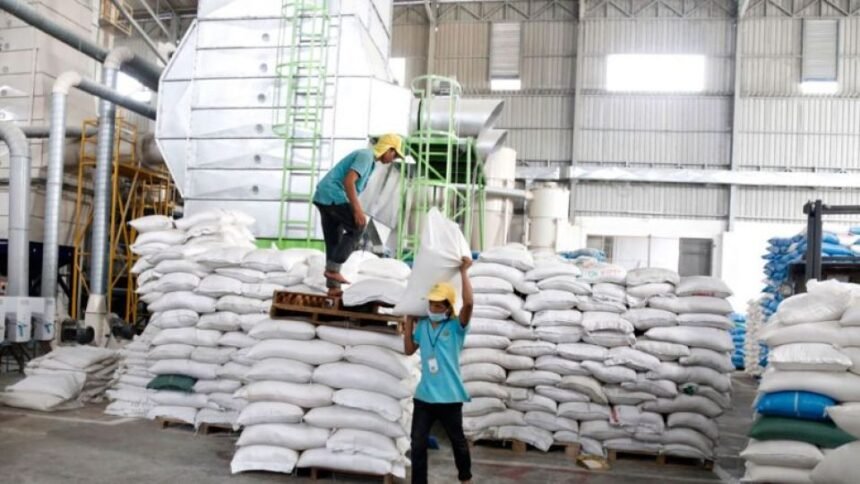
In and around Phnom Penh, investments in milling, storage, and transport infrastructure have strengthened links between farms and export hubs. Improved logistics have reduced losses and helped Cambodian rice meet international quality standards.
This progress mirrors broader agricultural diversification trends discussed in Sen Kra Ob-01: Cambodia’s Rising Star in Global Agriculture, showing how multiple crops are contributing to Cambodia’s growing agricultural credibility.
Cambodia’s Growing Role in Global Rice Markets
Cambodia’s export boom also reflects changing dynamics in global food trade. As importing countries seek reliable suppliers of premium rice, Cambodia has gained recognition for quality-focused production rather than mass volume.
This positioning allows Cambodia to compete alongside established exporters while maintaining a distinct identity. From a Cambodian perspective, international recognition of locally grown rice validates the efforts of farmers who have adapted to global standards while remaining closely tied to the land.
Infrastructure, Policy, and Export Readiness
The rise in rice exports has been supported by improvements in infrastructure and governance. Modern rice mills, better rural road connectivity, and streamlined export processes have strengthened the supply chain from field to port.
Government agencies, including the Ministry of Agriculture, Forestry and Fisheries, continue to support export readiness through certification, quality control, and farmer outreach programmes.
These agricultural gains align with broader economic developments outlined in Cambodia’s Economic Growth in 2025: Key Sectors Driving Progress, where agriculture remains a key contributor to national stability.
What the Export Boom Means for Farmers
At the village level, export growth can mean more stable demand and improved income prospects. When export channels function well, farmers gain greater confidence to invest in seeds, equipment, and land management.
However, challenges persist. Climate variability, water availability, and rising production costs continue to affect yields. The export boom highlights the importance of ensuring that growth remains inclusive and that smallholder farmers benefit alongside larger producers.
For many Cambodians, the success of rice exports is meaningful only if it strengthens rural resilience and preserves farming as a viable livelihood for future generations.
Sustainability and Climate Considerations
As Cambodia’s rice exports grow, sustainability has become increasingly important. Climate change poses risks through unpredictable rainfall, floods, and droughts, all of which directly affect rice production.
Efforts to promote climate-resilient farming, responsible water use, and soil conservation are now closely linked to export sustainability. Long-term success in global markets will depend on balancing productivity with environmental stewardship.
A Signal Beyond Trade Numbers
Cambodia’s rice export boom sends a broader message to global markets: the country is emerging as a reliable agricultural exporter rooted in quality and continuity. Beyond revenue, rice exports strengthen Cambodia’s trade reputation and support food security partnerships across regions.
For Cambodians, this moment reflects resilience—proof that a crop deeply tied to history and survival can also shape a confident economic future.
Cambodia’s record-high rice exports mark a significant chapter in the nation’s agricultural journey. Behind every shipment are farmers, millers, and communities whose connection to rice runs deep.
Seen through a Cambodian lens, the export boom is not only an economic milestone. It is a reflection of patience, adaptation, and a growing belief that Cambodian agriculture belongs confidently in global markets.
Also Read: Investment Predictions for Cambodia 2026: Confidence Built on Resilience and Continuity