• My Saves
  • My Feed
  • My Interests
  • Governing Body
  • From The Founder's Desk
  • Contact Us
The Better Cambodia
  • News
    NewsShow More
    Hun Manet displaced families
    Government Reaffirms Support as PM Hun Manet Visits Displaced Families

    Prime Minister Hun Manet met with over 1,500 displaced families in Banteay…

    By
    Sasha Jones
    Cambodia Germany cooperation
    Cambodia and Germany Agree to Deepen Cooperation in Labor, Social Protection and Vocational Training

    Cambodia and Germany agreed to deepen cooperation in labor, social protection and…

    By
    Sasha Jones
    Cambodia renewable energy
    $200M Wind Power Plant Approved in Mondulkiri to Boost Cambodia’s Renewable Energy Sector

    Cambodia’s government approved a $200 million investment for a 150 MW wind…

    By
    Sasha Jones
    Cambodia Pakistan trade cooperation
    Bilateral Trade Cooperation with Pakistan Strengthened Through New Agreements

    Cambodia and Pakistan signed three agreements to enhance bilateral trade cooperation and…

    By
    Sasha Jones
    Cambodia India MoU
    MoU Signed Between India and Cambodia for Kindergarten Project in Koh Kong

    Phnom Penh, Cambodia — Cambodia and India have signed a Memorandum of…

    By
    Sasha Jones
  • Editors Pick
    Editors PickShow More
    Lessons from Golda Meir And How Cambodia Can Turn Challenges Into Strength

    Golda Meir’s life was shaped long before she ever held political office.…

    By
    Surya Narayan
    Border War’s Hidden Bill: Thai Families Drown in Debt as Cambodia’s Displacement Swells

    The loudest sound of the Thailand–Cambodia conflict is still the shellfire along…

    By
    Surya Narayan
    Mixed Signals From Thailand Deepen Uncertainty Over Cambodia–Thailand Ceasefire

    Over the past several days, one thing has become clear along the…

    By
    Surya Narayan
    Cambodia Stands Firm: Defending the Motherland Amid Thai Aggression

    An Editorial as of 9 December 2025 When violence erupts along the…

    By
    Surya Narayan
    Why Policies Shape a Nation’s Future in a Service-Led Economy

    Every country reaches a moment when it must decide what kind of…

    By
    Surya Narayan
  • Stories
    StoriesShow More
    A tailor's hands using large scissors to cut white fabric for a traditional wedding dress.
    Around Orussey Market, Tailors Bloom on Every Street Corner

    Phnom Penh - Around Orussey Market, tailors bloom on every street corner. Walking through…

    By
    Pauline REINA
    Lea Sannier
    Every Corner Tells a Story: Life on the Streets of Phnom Penh

    Every corner of Phnom Penh is steeped in stories. They hide in…

    By
    Pauline REINA
    Lea Sannier
    Fisherman Life Along the Mekong

    If you wake up before dawn breaks in Phnom Penh, you will…

    By
    Pauline REINA
    The Timeless Tale of Vorvong and Sorvong: A Glimpse into Khmer Folklore

    The epic Khmer folklore of Vorvong and Sorvong stands out, weaving a…

    By
    Surya Narayan
    Empowering Cambodian Youth: Anjali House’s Mission to Shape Futures

    In the heart of Siem Reap, Anjali House, a community learning center…

    By
    Nadalena DeJulio
  • Business
    BusinessShow More
    India economic outlook 2026
    India’s Economic Outlook in 2026 and What It Signals for South Asian Integration

    India’s resilient economic outlook in 2026 sends important signals for South Asian…

    By
    Sasha Jones
    Cambodia clean real economy
    Building a Clean and Real Economy: What Cambodia’s Call for Sustainable Growth Means for the Future

    Cambodia is emphasising the need for a clean, real economy focused on…

    By
    Sasha Jones
    Elon Musk Davos tech leadership
    Davos Buzz: What Elon Musk’s Participation Signals About Tech & Global Leadership

    Elon Musk’s presence at Davos signals the rising role of technology in…

    By
    Sasha Jones
    Cambodia economic development programme
    Cambodia Launches New Economic Development Programme to Boost Growth

    The Royal Government of Cambodia has launched a comprehensive economic development programme…

    By
    Yash Paul
    Cambodia informal economy
    World Bank Briefs MISTI on Cambodia’s Informal Economy & Competitiveness Reforms

    The World Bank recently briefed the Ministry of Industry, Science, Technology &…

    By
    Yash Paul
  • Opinion Piece
    Opinion PieceShow More
    Cambodia’s banking sector shows resilience in 2025 as deposits surge and lending supports growth

    PHNOM PENH – If 2025 was a year of global hesitation, Cambodia’s…

    By
    Jas Sohl
    A horizontal image showing two contrasting scenes at a historic Cambodian temple gate, with one side dark and restrained and the other side bright and active with visitors, symbolising Cambodia’s tourism sector at a critical crossroads.
    Reframing Cambodia’s Tourism Strategy in an Era of Geopolitical Tension and Institutional Drift

    Cambodia today stands at a quiet but consequential crossroads. The country finds…

    By
    David Van
    The Elephant in the Room – The Cost of Avoiding What Everyone Knows
    The Elephant in the Room – The Cost of Avoiding What Everyone Knows

    There is a truth many people in Cambodia recognize, yet few are…

    By
    David Van
    A Province Finding Its Rhythm, And A Country Growing With Quiet Determination

    Progress does not always arrive through dramatic announcements or sudden change. Sometimes…

    By
    Samheng Boros
    Wastewater Treatment – The Lifeline of Sustainable Development

    In the 21st century, the world faces a paradox. While more than…

    By
    Jas Sohl
  • Press Release
    Press ReleaseShow More
    Over 100 ASEAN Women Entrepreneurs to Be Honoured at Prestigious Gala in Phnom Penh

    Phnom Penh, Cambodia will take centre stage on 21st November as over…

    By
    TBC
    TEDxPhnom Penh 2025 Inspires Over 530 Attendees with Powerful Stories of Resilience and Reinvention
    TEDxPhnom Penh 2025 Inspires Over 530 Attendees with Powerful Stories of Resilience and Reinvention

    Phnom Penh, Cambodia — The spirit of ideas worth spreading came alive…

    By
    TBC
    Green Miracle: Cambodian Youth Unite to Combat Single-Use Plastic
    Green Miracle: Cambodian Youth Unite to Combat Single-Use Plastic

    A youth-led initiative of UNICEF’s Generation Futures Program vows to raise awareness…

    By
    TBC
    Francophonie Village 2025
    Francophonie Village 2025: Siem Reap Comes Alive with Culture, Creativity, and Community

    This November, Siem Reap transforms into a vibrant cultural playground as the…

    By
    TBC
    TEDxPhnom Penh 2025
    TEDxPhnom Penh 2025: A Celebration of Ideas, Resilience, and Reinvention

    Phnom Penh, Cambodia — The world-renowned TEDx experience returns to the capital this…

    By
    TBC
  • Visit Cambodia
    Visit CambodiaShow More
    Kep to Koh Rong travel
    Kep to Koh Rong: From Quiet Shores to Island Vibes

    From Kep’s calm coastline to Koh Rong’s lively beaches, this journey shows…

    By
    Sasha Jones
    Cambodia visa free Chinese tourists
    Calls for Visa-Free Entry Intensify as Cambodia Eases Requirements for Chinese Visitors

    Cambodia has eased entry requirements for Chinese visitors, intensifying calls for visa-free…

    By
    Sasha Jones
    Phnom Penh to Kampot travel
    Phnom Penh to Kampot: A Riverside Escape That Bridges City and Countryside

    A short journey from Phnom Penh leads to Kampot, a riverside town…

    By
    Sasha Jones
    travel responsibly in Cambodia
    How to Travel Responsibly: A Cambodian Guide to Eco-Travel That Gives Back

    Responsible travel in Cambodia means staying local, hiring guides, reducing waste, and…

    By
    Sasha Jones
    Chi Phat ecotourism Cambodia
    Chi Phat: The Pioneer of Purpose in Cambodia’s Ecotourism Story

    Chi Phat has become Cambodia’s benchmark for community-based ecotourism, transforming from a…

    By
    Sasha Jones
  • History
    HistoryShow More
    Cambodia cave preservation guidelines
    New Guidelines Aim to Preserve Cambodia’s Natural Cave Heritage

    Cambodia has introduced new national guidelines to protect and sustainably manage its…

    By
    Yash Paul
    Cambodia sustainable cave management
    Preserving Cambodia’s Natural Heritage: New Guidelines for Sustainable Cave Management and Eco-Conservation

    Across Cambodia’s countryside, limestone caves rise quietly from the earth, holding stories…

    By
    Sasha Jones
    Victory over genocide day Cambodia
    Victory over Genocide Day in Cambodia: A Day of Memory, Survival, and Renewal

    Every year on January 7, Cambodia pauses—not in celebration, but in remembrance.…

    By
    Sasha Jones
    Sambor Prei Kuk: A Sacred City That Still Breathes Through Cambodia’s Forests

    There are places where history whispers gently, and Sambor Prei Kuk is…

    By
    Surya Narayan
    Srutavarman: The Legendary First King of Chenla

    Srutavarman (Old Khmer: ឝ្រុតវម៌្ម; Khmer: ស្រុតវរ្ម័ន, Shrutavarman) is remembered in Cambodian tradition…

    By
    Surya Narayan
  • 🔥
  • Invest In Cambodia
  • Unsung Heroes/ Impact
  • The Better Asia
  • Agriculture
  • Technology
  • Places to Visit
  • Sustainability
Font ResizerAa
The Better CambodiaThe Better Cambodia
Search
  • Home
  • Stories
  • News
  • Visit Cambodia
  • Startups
  • Cambodian Brands
  • Unsung Heroes/ Impact
  • Sustainability
  • Artisans of Cambodia
  • Invest In Cambodia
  • Guests Posts
  • The Better Asia
  • Governing Body
  • From The Founder’s Desk
  • Contact us
Have an existing account? Sign In
Follow US
  • My Saves
  • My Interests
  • My Feed
© 2026 TBC Media. All Rights Reserved.
The Better Cambodia > Blog > Science > How NASA’s Hotspot Mapping Works: What “Thermal Anomalies” Actually Mean
ScienceTechnology

How NASA’s Hotspot Mapping Works: What “Thermal Anomalies” Actually Mean

Sasha Jones
Last updated: February 15, 2026 5:06 pm
By
Sasha Jones
29 Views
Published: February 15, 2026
Share
9 Min Read
NASA hotspot mapping
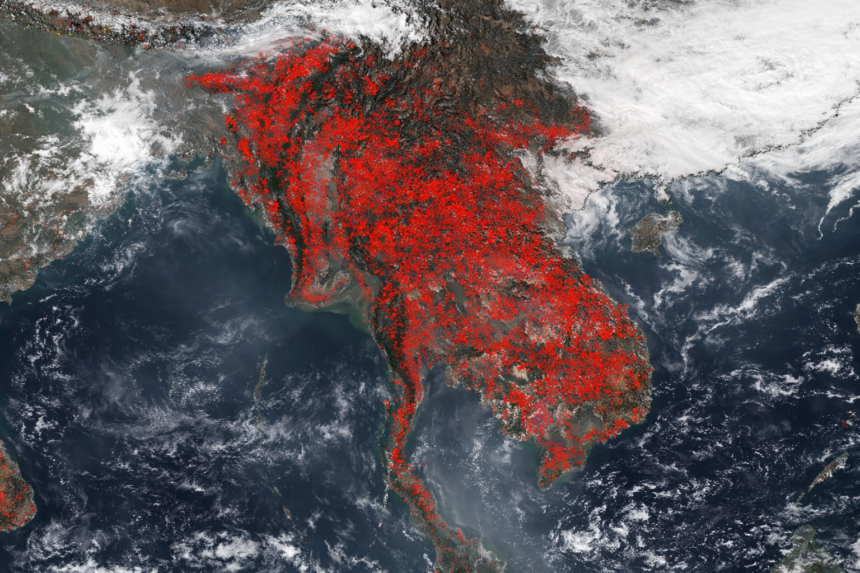
Satellite-based hotspot maps highlight thermal anomalies across forests and farmland, helping scientists and authorities monitor fires and unusual heat patterns from space.
SHARE

On many maps shared by environmental agencies, research groups, and even newsrooms, small red or orange dots often appear over forests, grasslands, or agricultural regions. These dots are commonly called “hotspots.” Behind them is a global satellite system, operated with support from NASA, that detects unusual heat on the Earth’s surface—what scientists refer to as “thermal anomalies.”

Contents
  • The Satellites Behind the Maps
  • What Causes a Thermal Anomaly?
  • From Data to Decision-Making
  • Why “Anomaly” Is the Key Word
  • The Cambodian Context: Forests, Farms, and Seasons
  • What Hotspot Maps Cannot Do
  • Why This Technology Matters in a Changing Climate
  • Reading the Map with Care

For countries like Cambodia, where forests, farms, and protected areas cover large parts of the landscape, these maps have become an important tool. They are used to monitor fires, track land-use changes, and support early warning systems during the dry season. But what do these “thermal anomalies” actually mean, and how does NASA’s hotspot mapping work in practice?

Seeing Heat from Space

NASA does not look for flames directly. Instead, its satellites observe the Earth in different wavelengths of light, including infrared, which is closely related to heat. When a satellite passes over a region, it measures the temperature of the land surface pixel by pixel.

Under normal conditions, each type of surface—forest, water, soil, or city—has a typical temperature range for a given time of day and season. A “thermal anomaly” is detected when a specific area appears significantly hotter than what would normally be expected for that location and moment.

- Advertisement -

In simple terms, the system is not saying, “There is definitely a fire here.” It is saying, “This spot is much hotter than its surroundings, and that difference is unusual enough to be flagged.”

The Satellites Behind the Maps

Several satellite instruments contribute to hotspot mapping, including sensors on NASA’s Terra and Aqua satellites and more recent Earth-observing platforms. One of the best-known systems is MODIS (Moderate Resolution Imaging Spectroradiometer), which scans the entire planet regularly and provides data used by scientists, governments, and international organisations.

These satellites orbit the Earth multiple times a day, allowing them to build a near-continuous picture of surface conditions. This frequent coverage is especially useful in regions like Southeast Asia, where weather, cloud cover, and seasonal changes can rapidly alter what is happening on the ground.

When the system detects a thermal anomaly, it records the location, time, and intensity of the heat signal. This information is then processed and displayed on maps that are publicly available.

What Causes a Thermal Anomaly?

In many cases, thermal anomalies are linked to fires. These can include:

  • Forest or grassland fires
  • Agricultural burning after harvest
  • Peatland or brush fires
  • Industrial heat sources in some locations

However, not every hotspot is a wildfire. Some thermal anomalies can come from factories, power plants, or even natural features that retain heat differently from their surroundings. This is why hotspot maps are best understood as indicators, not final confirmations.

For Cambodia, where controlled agricultural burning is still practiced in some areas and where forest protection is a national priority, this distinction matters. A hotspot may point to routine land management—or it may signal an unintended fire that needs attention.

From Data to Decision-Making

The real value of NASA’s hotspot mapping lies in how the information is used. Governments, environmental organisations, and researchers combine hotspot data with other sources, such as weather conditions, land-use maps, and field reports.

In practical terms, this helps to:

  • Identify areas at risk during the dry season
  • Support early response to potential fires
  • Monitor protected forests and conservation zones
  • Track long-term patterns in land use and climate impact

In Cambodia, where large forest landscapes still play a crucial role in biodiversity, water systems, and rural livelihoods, these tools support both conservation and planning. They do not replace ground patrols or local knowledge, but they add a wider, faster view of what may be happening across remote or hard-to-reach areas.

Why “Anomaly” Is the Key Word

The term “thermal anomaly” is carefully chosen. It does not claim certainty. It simply highlights a temperature reading that does not match the expected pattern.

This is important for understanding how to read hotspot maps. A cluster of anomalies over several days in the same area is more likely to indicate a sustained fire or repeated burning. A single, brief anomaly may turn out to be something temporary or non-hazardous.

For journalists, policymakers, and the public, this means hotspot maps should be seen as early signals, not final verdicts. They point to where attention may be needed, not to a complete explanation of what is happening on the ground.

The Cambodian Context: Forests, Farms, and Seasons

Cambodia’s climate follows clear wet and dry seasons, and this rhythm strongly influences how land is used. During the dry months, the risk of fire increases, especially in forest edges, grasslands, and agricultural areas.

Hotspot data becomes particularly relevant during these periods. It helps authorities and environmental groups focus resources, identify unusual patterns, and compare current conditions with previous years.

Over time, this historical data also allows researchers to study trends: Are certain regions seeing more frequent anomalies? Are fire seasons starting earlier or lasting longer? Are conservation efforts reducing hotspots in protected areas?

These questions are not only scientific. They are linked to agriculture, public health, tourism, and long-term environmental stability.

What Hotspot Maps Cannot Do

It is equally important to understand the limits of the system. Satellite sensors can be affected by cloud cover, smoke, or terrain. They also work at a certain resolution, meaning very small or short-lived fires might not always be detected.

Moreover, a hotspot does not describe the cause, scale, or impact of a heat source. Field verification is still essential to understand whether an anomaly represents a serious fire, controlled burning, or another heat-related activity.

In this sense, NASA’s hotspot mapping is best seen as a monitoring and awareness tool, not a replacement for local observation or response systems.

Why This Technology Matters in a Changing Climate

As climate patterns shift, many regions are experiencing longer dry seasons, higher temperatures, and more unpredictable weather. These conditions increase the importance of early detection and large-scale monitoring.

For Cambodia and its neighbours, satellite-based hotspot data supports regional cooperation, disaster preparedness, and environmental planning. It also helps connect local events—such as a forest fire in one province—to wider regional and global climate discussions.

From space, every country is part of the same system. The same satellites that monitor forests in the Cardamom Mountains also observe grasslands in Australia and peatlands in South America. This shared data creates a common reference point for understanding how the planet’s surface is changing.

Reading the Map with Care

When a hotspot map shows clusters of red or orange points, it can be visually striking. But the real meaning lies in how that information is interpreted, verified, and acted upon.

For Cambodia, these maps are not just images—they are tools that support forest protection, agricultural planning, and environmental awareness. They help turn distant satellite measurements into practical, ground-level decisions.

NASA’s hotspot mapping does not simply show fires. It shows thermal anomalies—places where heat behaves differently than expected. Behind each point is a complex system of satellites, sensors, and data analysis working to give the world a clearer, faster picture of what is happening on the Earth’s surface.

For Cambodia, this technology offers a way to watch over forests, farms, and remote landscapes from above, supporting both conservation and development in a time when understanding heat, climate, and land use has never been more important.

Also Read: Kep to Koh Rong: From Quiet Shores to Island Vibes
Share This Article
Facebook Whatsapp Whatsapp LinkedIn Telegram Email Copy Link Print
Previous Article Hun Manet displaced families Government Reaffirms Support as PM Hun Manet Visits Displaced Families
Next Article PM2.5 air pollution in Cambodia What PM2.5 Is and Why It Matters for Air Quality in Cambodia
Leave a Comment

Leave a Reply Cancel reply

Your email address will not be published. Required fields are marked *

- Advertisement -

You Might Also Like

Cambodia renewable energy
NewsSustainabilityTechnology

$200M Wind Power Plant Approved in Mondulkiri to Boost Cambodia’s Renewable Energy Sector

By
Sasha Jones
Social Media Algorithm Understanding for Content Creators: A Complete Guide
Technology

Social Media Algorithm Understanding for Content Creators: A Complete Guide

By
ravi
NewsTechnologyThe Better AsiaUnsung Heroes/ Impact

A group of students has transformed Khmer literature into a digital art platform.

By
Pisey Roeurm
Elon Musk Davos tech leadership
EconomyTechnology

Davos Buzz: What Elon Musk’s Participation Signals About Tech & Global Leadership

By
Sasha Jones
© 2026 TBC Media. All Rights Reserved.
  • Home
  • News
  • About Cambodia
    • Provinces of Cambodia
  • Tours
  • Things to Do
    • Adventure
    • Events
    • Festivals
    • Fun & Games
    • Landmarks
    • Markets
    • Museums
    • Parks
    • Shopping
    • Shows
    • Temples
    • Villages
    • Water Fun
    • Wildlife
    • Workshops
    • Zoos & Aquariums
  • Eat & Drink
    • Khmer Cuisine
    • Bars & Pubs
    • Cafés & Bakeries
    • Fine Dining
    • Street Food
  • Natural Attractions
    • Beaches
    • Botanical Sites
    • Caves
    • Cliffs & Rock Formations
    • Coral Reefs
    • Forests
    • Hot Springs
    • Islands
    • Lakes
    • Mountains
    • Parks
    • Rivers
    • Scenic Spots
    • Waterfalls
    • Wetlands
    • Wildlife Areas
  • Services
  • Travel Guide
  • Stays
    • Boutique Stays
    • Eco Lodges
    • Guesthouses
    • Homestays
    • Hotels
    • Resorts
No thanks.
Welcome Back!

Sign in to your account

Username or Email Address
Password

Lost your password?