For many years, the global cashew trade followed a fairly predictable path. A large share of raw cashew nuts came from African countries, while most of the processing happened elsewhere, particularly in India and Vietnam. Before reaching factories that shelled, graded, packed, and sold them to consumers worldwide, raw nuts travelled long distances.
That long-standing pattern is now slowly changing.
Several African governments have started questioning the logic of exporting raw commodities while importing finished products. Their goal is simple: keep more value within their economies. By encouraging domestic processing, they hope to create jobs, strengthen local industries, and improve export earnings.
Burkina Faso has already suspended exports of raw cashew nuts to guarantee supply for local processing units. Ghana has also announced plans to halt exports of raw cashew, shea, and rubber so that these resources can be processed domestically. Benin has introduced similar restrictions, though some volumes still move informally across borders, which raises concerns about the effectiveness of these measures in controlling the trade of raw cashew nuts. Tanzania has adopted a distinct strategy, mandating the trading of agricultural commodities, including cashews, via the Tanzania Mercantile Exchange.
Taken together, these steps point to a wider trend. Countries that produce raw cashews want to participate in the higher-value stages of the industry, such as processing and value addition, to increase their economic benefits and reduce dependency on foreign markets.
Why the Indian Cashew Industry Must Watch These Changes
India has been one of the world’s most important cashew processing hubs for decades. From Kerala to Karnataka and Goa, thousands of small and medium factories depend on the steady flow of raw cashew nuts.
But India produces only a limited quantity of raw cashews compared with its processing capacity. As a result, Indian processors have traditionally depended on imports, particularly from African countries.
If African governments continue restricting exports to strengthen their own processing industries, the global supply available for international buyers could become tighter. Prices may rise, and sourcing could become less predictable.
For Indian processors who operate on tight margins, this situation requires careful planning to diversify their sourcing strategies and mitigate risks associated with potential supply shortages. Relying too heavily on one region for raw material may no longer be the safest strategy.
This is where Southeast Asia, and especially Cambodia, begins to enter the conversation.
Cambodia’s Rising Cashew Production
Cambodia has quietly become one of the most significant cashew producers in the world. In recent years the country’s plantations have expanded rapidly, and annual production now approaches one million metric tonnes of raw cashew nuts.
This level of production places Cambodia among the leading producers globally.
Several factors support this growth. Cambodia’s tropical climate is ideal for cashew cultivation. Farmers have also adopted improved varieties such as M23, which are known for their large nut size and good kernel quality. These characteristics make Cambodian cashews particularly attractive for processors.
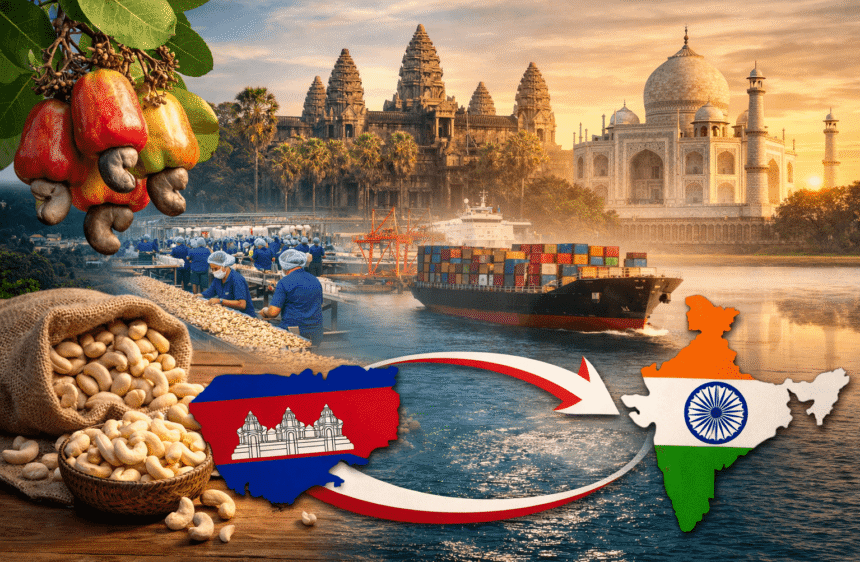
Another important factor is geography. Compared with shipments from West Africa, transporting raw cashews from Cambodia to India involves shorter distances and generally faster transit times. For processors located near ports such as Tuticorin, Mangalore, or Kochi, this logistical advantage can make supply chains easier to manage.
A New Opportunity for Indian Cashew Processors
For Indian cashew businesses, Cambodia represents more than just another sourcing country.
With production nearing one million metric tonnes annually, the country offers a reliable base of raw material. Indian processors can explore direct procurement arrangements with Cambodian suppliers, farmer groups, and aggregators. Establishing long-term sourcing relationships would allow processors to diversify their supply chains and reduce dependency on regions where export restrictions are increasing.
But the opportunity does not stop at procurement.
Indian companies have decades of expertise in cashew processing. Their knowledge of grading systems, kernel recovery, export standards, and global marketing is widely recognised. By bringing that experience to Cambodia, Indian processors could play a significant role in building a stronger processing ecosystem in the country.
Why Processing in Cambodia Could Make Sense
Setting up processing units in Cambodia could create advantages for both sides.
For Indian companies, processing closer to the source of raw material reduces the cost and complexity of transporting unprocessed nuts over long distances. Factories located near cashew-growing regions can operate more efficiently and maintain a stable supply of raw material.
For Cambodia, such investments would generate employment, strengthen rural economies, and help the country capture more value from its agricultural production.
Processed kernels could then be marketed in global markets, including India, the Middle East, Europe, and other Asian economies.
This kind of collaboration would transform the relationship from simple trade into a deeper partnership in value creation.
Competition and Other Challenges
Of course, Cambodia is not entering an empty field. Vietnam remains a dominant force in the global cashew industry. Over the years it has built highly efficient processing systems and strong export networks.
Cambodia will need to compete with Vietnam when it comes to attracting investment, building processing capacity, and developing export channels.
Infrastructure, workforce training, and supply chain organisation are also areas that will require continued development. Yet these challenges are typical whenever an agricultural sector begins moving toward value-added production.
With the right partnerships and long-term vision, they can be addressed, which may include collaboration between farmers, government agencies, and private sector stakeholders to enhance efficiency and productivity.
Looking Ahead for the Indian Cashew Industry
The global cashew trade is clearly evolving. African countries are seeking greater control over their raw materials, and traditional supply chains are beginning to shift, which may lead to increased competition for Indian processors and necessitate innovative approaches to sourcing and processing cashews.
Indian processors should view this moment not as a setback, but as an opportunity to reassess their strategy.
Cambodia’s rapidly expanding cashew production, which is approaching one million metric tonnes annually, offers a meaningful opportunity. By sourcing raw nuts from Cambodia and exploring investments in processing within the country, Indian businesses can create a more resilient supply chain.
In doing so, they would secure future supplies of premium cashews and help shape the next stage of growth in the global cashew industry.