Episode 3 of 6 | Cambodia Skills Development Roadmap Series
The Courage to Ask: “Who Is Still Outside the Door?”
A good policy asks, “What should we do?”
A great policy asks another, harder question: “Who is still left out?”
For years, many Cambodians quietly watched opportunities happen to other people. Young women who left school early. Youth in remote villages far from any training center. Workers laid off during crises, unsure how to start again. People with disabilities who were told, without words, that the system was not built for them.
The Ministry of Labour and Vocational Training (MLVT) decided that this could no longer be normal. If Cambodia is building a skills-based economy, then every Cambodian must have a way in.
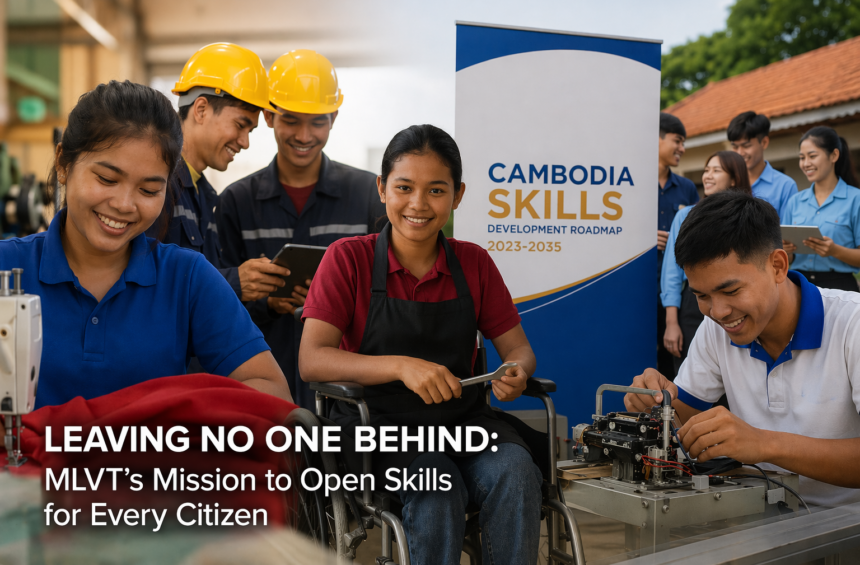
That belief is woven into the Skills Development Roadmap 2023–2035, most visibly in Pillar 2: Enhancing Branding and Outreach – not as a slogan, but as a structured commitment, with specific targets, counselling programs, apprenticeship frameworks, and outreach campaigns designed to bring every Cambodian into the skills economy.
Turning TVET into a Dream, Not a Last Resort
One of the boldest ideas in the roadmap is to rebrand Technical and Vocational Education and Training (TVET) so that it becomes a first choice, not a fallback.
The roadmap calls this by its proper name: branding. Not in a commercial sense, but in the deeper sense of national identity. The MLVT is developing a nationwide strategy to build “Cambodia Skills” as a recognised brand, one that carries pride, not stigma. This means national campaigns that showcase successful TVET graduates, career counselling that starts early in a student’s journey, and community outreach that challenges the quiet but persistent belief that academic pathways are superior to vocational ones.
Skill ambassadors; eminent figures who speak publicly about the value of technical training, are part of this strategy. So are province-level and community-level awareness programs that meet people where they are, in their language, addressing their specific hesitations.
MLVT wants parents to say to their children with pride: “University is one path. Skills training is another. Both are respectable. Both can lead you to a better life.” When a nation changes the way it talks about skills, it changes who feels allowed to pursue them.
Reaching the Margins: Women, Rural Youth, and Vulnerable Groups
Inclusive growth is not automatic. It has to be designed.
The roadmap places special emphasis on the groups who historically face the most barriers: women and girls who may be held back by social norms or safety concerns; rural youth who live far from any training institution; workers in low-skill employment who want to reskill but cannot afford to stop earning; and people with disabilities who are too often excluded by infrastructure, attitudes, or both.
Reaching these groups requires more than open doors; it requires actively going to where people are. The roadmap sets out concrete mechanisms for this. Counselling and guidance services are being established at provincial and community level, specifically targeting women and vulnerable groups. Targeted outreach programs are being designed with local NGOs who understand the specific hesitations and barriers in each community. And training providers are being required, through formal guidelines, to ensure their environments are gender-sensitive, safe, and genuinely welcoming.
The message running through every intervention is the same: opportunity should not depend on where you were born, what your gender is, or how much money your family has.
Skills That Fit Real Lives
Inclusiveness is not just about who is invited in; it is about how learning is structured once they arrive. A mother of three cannot easily commit to a two-year full-time program. A seasonal agricultural worker needs training that bends around the harvest. A young man in a border province needs a course he can reach.
The roadmap’s response is modular, flexible training design. Short courses with micro-certificates allow people to build skills in stages. Accessible program structures mean that someone can enter, pause when life demands it, and return without starting over. And critically, the roadmap defines clear pathways for upward mobility, so that a basic certificate at CQF Level 2 is not a ceiling, but a first step toward Level 3, Level 4, and beyond.
A young worker who completes a three-month foundational course should be able to see exactly where that course leads. Not a dead end, but a ladder from short course to certificate, from certificate to diploma, from diploma to the wider world of professional opportunity. This is how a single training moment becomes a lifelong journey.
Entrepreneurship: From Job Seekers to Job Creators
Leaving no one behind also means recognizing that not everyone wants to be an employee.
The roadmap calls for entrepreneurship to be woven into the TVET system, teaching young Cambodians how to start and sustain small businesses, manage finances, and turn technical skills into livelihoods.
Picture a young woman who learns tailoring and six months later opens a small shop in her village. A group of friends trained in refrigeration who pool their skills and form a small service team. A mechanic who, after years of employment, gains the knowledge and confidence to open his own garage.
When skills meet entrepreneurship, the impact multiplies: one trained person can create opportunities for many others.
Apprenticeships: Learning by Doing, Earning While Learning
For many, the biggest barrier to training is simple: “If I stop working to study, how will I live?”
That is why the roadmap places strong emphasis on apprenticeships and work-based learning and why it calls specifically for the expansion and formal amendment of apprenticeship guidelines to reach more industries and more people. These programs allow trainees to learn inside real workplaces, gain the hands-on experience that employers actually value, and begin building both income and professional networks while they are still in training.
This is especially powerful for youth from low-income families, who cannot afford to choose between earning and learning. With apprenticeships, they can do both.
A More Equal Cambodia, One Skill at a Time
Inclusion is not just a moral choice. It is a smart economic strategy.
A Cambodia where women, rural youth, and vulnerable citizens are fully skilled is a Cambodia with a stronger workforce, less poverty, more innovation and entrepreneurship, and deeper social stability and cohesion.
By opening the doors of skills training wide, MLVT is not just changing individual lives. It is reshaping the social fabric of the country, making it stronger, fairer, and more hopeful.
The Cambodia Skills Development Roadmap 2023–2035 measures its own success not just in enrollment numbers or certificates issued, but in whether the hardest-to-reach Cambodians finally have a genuine way in: the young woman in a remote district, the worker displaced by crisis, the person whom the old system quietly passed over. That is the true measure of this roadmap.