Cambodia and Thailand sign ceasefire deal, agree to border de-escalation and return to dialogue
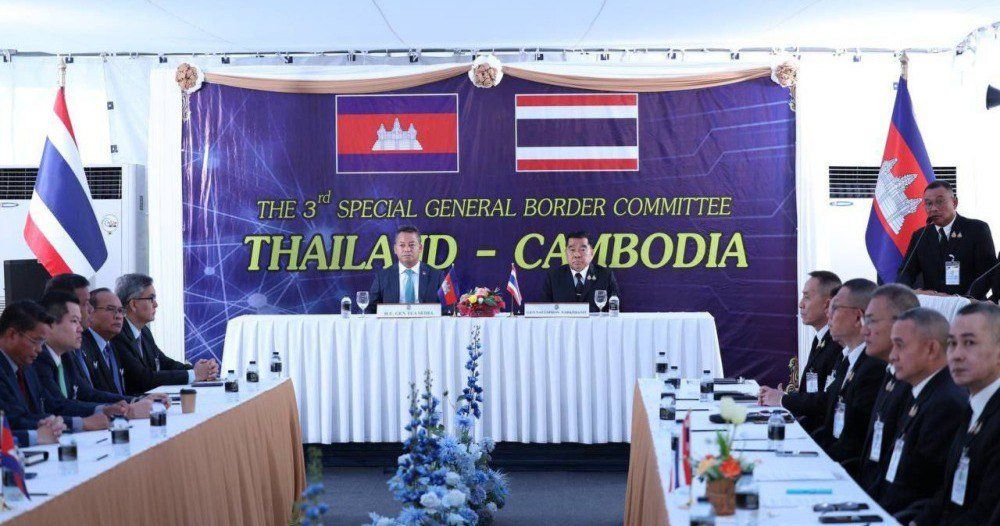
Cambodia and Thailand signed an immediate ceasefire and de-escalation agreement on Saturday following a meeting of the two countries’ General Border Committee (GBC) at the Prum–Ban Pak Kard international checkpoint, pledging to halt hostilities, protect civilians and restore stability along the shared frontier.
The agreement was co-signed by Cambodian Deputy Prime Minister and Minister of National Defence Gen Tea Seiha and Thai Defence Minister Gen Nattaphon Narkphanit, with the ASEAN Observer Team (AOT) attending as observers. The ceasefire comes into effect at 12:00 noon local time on December 27.
Both governments reaffirmed commitments made under the July 28 ceasefire arrangement and subsequent bilateral agreements, as well as decisions taken at earlier GBC and Joint Boundary Commission (JBC) meetings. The statement emphasized adherence to the UN Charter, the ASEAN Charter and the Treaty of Amity and Cooperation, and called for resolving disputes peacefully and with mutual respect.
The joint declaration follows weeks of clashes along the border that left more than 100 people dead and displaced over half a million civilians on both sides, according to earlier official briefings. The latest escalation had reignited in early December after a breakdown in a previously mediated truce.
Immediate ceasefire and halt to troop movements
Under the new arrangements, both sides agreed to:
- implement an immediate ceasefire covering all types of weapons and all sectors of the border,
- refrain from any offensive action, troop advances or patrols toward the other side’s positions, and
- maintain current deployments without reinforcement.
The agreement stresses that the measures do not prejudice future demarcation outcomes. Instead, both governments committed to tasking the Joint Boundary Commission to resume survey and demarcation work “at the earliest,” giving top priority to affected areas where civilians reside and ensuring safety for survey teams, including protection from landmines.
Both sides also agreed to allow displaced residents to return home “safely, in dignity and without obstruction,” once conditions permit.
Protection of civilians and ban on provocations
The statement includes a series of measures aimed at preventing renewed escalation, including commitments to:
- avoid any provocative action by land or air,
- refrain from constructing or expanding military infrastructure near the line of contact,
- prohibit the use of force against civilians or civilian objects, and
- avoid dissemination of misinformation or inflammatory content.
The document notes that such actions would endanger communities and undermine confidence-building efforts along the border.
Both governments reiterated their obligations under the Ottawa Convention banning anti-personnel mines, and agreed to advance joint humanitarian demining through the Joint Coordinating Task Force (JCTF), using agreed standard operating procedures.
The two sides also pledged to strengthen cooperation on cross-border crime prevention, including cyber scams and trafficking, under an existing action plan between the Cambodian National Police and the Royal Thai Police.
In line with the Kuala Lumpur Joint Declaration of October 26, the agreement further states that 18 Cambodian soldiers held in Thailand will be returned after the ceasefire is fully maintained for 72 hours.
ASEAN role in verification and communications
The ceasefire framework assigns a strengthened verification role to the ASEAN Observer Team, in consultation with the ASEAN Chair.
Border Coordination Units from both countries will manage ground-level incidents, support local de-escalation, and help prevent miscalculation, with ASEAN observers monitoring implementation.
Direct communication lines will be maintained between defence ministers and chiefs of defence forces to respond quickly to urgent developments. High-level representatives may meet if required to resolve issues that cannot be addressed locally.
The JCTF will coordinate demining notifications to local authorities to ensure operations proceed smoothly, while official media teams from both sides will hold regular dialogue to manage misinformation and enhance transparency in public communication.
Thailand confirms acceptance of key terms
Thai Defence Minister Gen Nattaphon said Cambodia had agreed to four main points discussed at a meeting in Kuala Lumpur earlier this year. On Friday, Thai Prime Minister Anutin Charnvirakul reiterated that Thailand would observe a 72-hour ceasefire, but would not agree to withdraw from positions secured during the recent clashes.
The signing took place shortly after reports of cross-border strikes earlier in the week, including an incident in Surin province that resulted in Thai military casualties. Cambodian authorities also confirmed the agreement following the meeting.
The joint statement, signed at 10:45 a.m., marks the latest effort to restore calm following a 20-day period of fighting that disrupted border trade, damaged infrastructure and forced widespread evacuations in several frontier provinces.
Return to dialogue and “sustainable peace”
Both countries said the new agreement represents a step toward rebuilding trust and returning to structured bilateral dialogue.
The statement underscores a shared determination to:
- “establish a true and sustainable peace,”
- restore normalcy along the border,
- resume cooperation through established mechanisms, and
- promote stability, security and prosperity for communities on both sides.
Cambodia and Thailand also reiterated their respect for sovereignty, territorial integrity and national identity, and committed to ensuring that the ceasefire and associated measures are fully and effectively implemented.
The agreement signals renewed diplomatic momentum following regional engagement through ASEAN, including the Special ASEAN Foreign Ministers’ Meeting held in Kuala Lumpur on December 22.
For communities along the border, the priority now shifts to stabilizing conditions, supporting returning families, and ensuring that humanitarian and security commitments under the agreement are upheld while both governments work toward longer-term demarcation and confidence-building.