In a country often celebrated for its ancient temples and lowland plains, there are places that quietly tell a different story—one of altitude, mist, and untouched wilderness. Khnang Phsa, rising to about 1,017 metres, is one such place. Located at the meeting point of Kampong Speu, Koh Kong, and Pursat provinces, this highland landscape is emerging as one of Cambodia’s most meaningful examples of community-led ecotourism.
- A Highland Landscape Few Have Seen
- The Journey as Part of the Experience
- At the Summit: Stillness and Scale
- Community-Led Ecotourism in Action
- Conservation, Culture, and Responsibility
- Khnang Phsa and the Future of Sustainable Tourism
- Where Nature Meets the Digital Future
- A Cambodian Perspective on Progress
Seen through Cambodian eyes, Khnang Phsa is not just a destination. It is a reminder that the country’s natural heritage extends far beyond well-known landmarks, offering space for reflection, resilience, and a slower connection to the land.
A Highland Landscape Few Have Seen
Just a few hours’ journey from Phnom Penh, Khnang Phsa feels like another world. The air grows cooler, the terrain more dramatic, and the horizon opens into sweeping ridgelines and dense jungle.
Unlike heavily developed tourist areas, Khnang Phsa remains largely untouched. Its grassland plateaus, forest trails, and mountain views reflect a Cambodia that many citizens themselves are still discovering. For those seeking quiet, altitude, and authenticity, the highlands offer a rare escape from the pace of urban life.
The Journey as Part of the Experience
Reaching Khnang Phsa is not about convenience—it is about transition. Visitors typically begin with a rustic tractor ride through farmland, a journey that reflects rural Cambodia’s rhythms. This is followed by a challenging yet rewarding trek of around 10 kilometres, passing through jungle paths and open grassland ridges.
The hike itself is central to the experience. It is physically demanding but deeply grounding, allowing travellers to reconnect with nature and with themselves. From a Cambodian perspective, this journey mirrors something familiar: progress that comes step by step, shaped by patience rather than speed.
At the Summit: Stillness and Scale
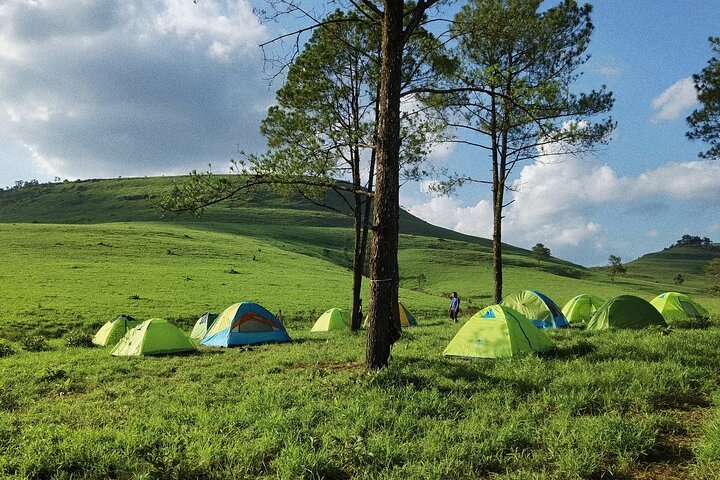
At the top of Khnang Phsa, the landscape opens dramatically. Wide skies, rolling hills, and distant forests stretch in every direction. Campsites are simple but thoughtfully arranged, offering clean water, rest huts, and even outdoor showers under the stars.
These facilities are not the result of large-scale development, but of careful community effort. The summit remains peaceful, designed to accommodate visitors without overwhelming the environment.
For many Cambodians, standing at this height carries emotional weight. It is a reminder of how much natural beauty still exists, quietly waiting to be respected rather than exploited.
Community-Led Ecotourism in Action
One of Khnang Phsa’s most defining features is its management by the Tang Bampong community. Local residents play a central role in guiding treks, maintaining trails, and protecting the environment.
This approach reflects a growing model in Cambodia: development that empowers communities rather than displacing them. Income from tourism supports local livelihoods while reinforcing conservation values.
From within Cambodia, this model matters deeply. It shows that progress does not always require large investors or heavy infrastructure—sometimes it begins with trust, cooperation, and local knowledge.
Conservation, Culture, and Responsibility
Khnang Phsa is not marketed as a luxury destination. Its appeal lies in simplicity and responsibility. Visitors are encouraged to minimise waste, respect wildlife, and understand the fragility of the ecosystem.
This balance between access and protection reflects Cambodia’s broader environmental conversation. As tourism grows, places like Khnang Phsa offer a blueprint for how nature and people can coexist without losing their identity.
Khnang Phsa and the Future of Sustainable Tourism
As Cambodia looks to diversify its tourism sector, highland ecotourism plays an increasingly important role. Destinations like Khnang Phsa attract travellers seeking meaningful experiences rather than mass tourism.
This shift supports longer stays, deeper engagement, and more evenly distributed economic benefits—especially in rural areas often left out of mainstream development.
Where Nature Meets the Digital Future
At first glance, Khnang Phsa may seem far removed from conversations about technology and artificial intelligence. Yet, this contrast highlights an important opportunity.
Cambodia’s future digital and AI capabilities can play a role in protecting places like Khnang Phsa. Satellite mapping, AI-assisted environmental monitoring, and data-driven tourism planning can help track trail erosion, visitor numbers, and ecosystem health.
For young Cambodians, learning to apply AI and digital tools to conservation and ecotourism creates a bridge between tradition and innovation. It allows technology to serve the real economy—supporting communities, nature, and long-term sustainability.
A Cambodian Perspective on Progress
From a Cambodian lens, Khnang Phsa represents something deeply reassuring. It shows that development can be thoughtful, that nature can be protected, and that communities can lead their own futures.
In a rapidly changing world, places like this offer not escape, but perspective—a reminder that progress is strongest when it remains connected to the land and the people who care for it.
Khnang Phsa stands quietly among Cambodia’s highlands, offering cool air, open skies, and a model of tourism rooted in respect and community. It is a place where effort is rewarded, where simplicity feels rich, and where Cambodia’s natural soul remains intact.
As the country moves toward a more digital and AI-enabled future, Khnang Phsa reminds us that innovation and preservation do not stand apart. When guided carefully, they can rise together—much like the trail that leads to this hidden highland haven.
Also Read: Cambodia Courts French Investors as Bilateral Trade Grows