3.36 million.
That’s the number of students who should be enrolled across Cambodia for the 2025-2026 academic year, from kindergarten through secondary school, according to the Ministry of Education, Youth and Sport.
3.36 million. Out of 7 million young people, under 18 years old. Among all of them, a few thousand are enrolled in some of the 100 international schools, mostly located in Phnom Penh. International curricula, multicultural environments, and multilingualism: these schools offer excellent programs and opportunities abroad. Although the expected impact on Cambodia’s development is strongly positive, there is one major underlying effect: the gradual loss of the importance of Cambodian language.
“If you want to be a doctor or a lawyer, you need to learn French. If you want to do business, you need to learn Chinese.”
This sentence, which one of our secondary students has probably repeated from his parents, illustrates the importance of language learning when choosing a life path.
The reality of the Cambodian education sector is that one second language, usually English, is not sufficient enough to pursue ambitious career pathways. This is clearly reflected in the almost one hundred international schools within the country. Not only are most of the programs delivered in English, usually following the British and Australian curriculum, but they also include French, Chinese, Korean, Japanese, and more languages in their program. Nowadays, more and more private and public schools start teaching English in kindergarten.
How important is language learning ?
Cambodia is a developing country, open, and, in some way, dependent on the rest of the world. In addition to the identity issues common to most colonized countries (such as the revalorization of the Basahar language in Indonesia, or the Tagalog language in the Philippines), Cambodia had to face a particularly severe rupture: a genocide. In contrast to its Asian neighbors, Cambodia has had to make far greater efforts to recover from its history. Much of the intellectual class that was once shaping Cambodian development fled or was killed during the Pol Pot regime. As a result, Cambodia needed external help to recover, which also contributed to the loss of Khmer identity and culture, including the language. A flagrant illustration: medical students who are required to learn French, because some words, such as those referring to specific bones or tissues, simply don’t exist in Khmer language (anymore?). The legal sector shows a similar influence. The Cambodian Constitution of 1993 was largely inspired by the French Constitution of 1858. That is not surprising, as Cambodia was under French protectorate for nearly a century. It is not uncommon to see elders and elites speaking French fluently.
However, French is no longer the main country’s second language. It comes after English and Mandarin. Who has never seen on the facade of a pharmacy, the French appellation pharmacie, written in French ? Or the facade of a museum ? A simple walk around the old airport or in cities like Sihanoukville is enough to notice the Chinese influence. Mandarin signs dominate restaurants, shops, and hostels, sometimes without Khmer translations.
Want to watch a movie ? Most of the films shown in Phnom Penh’s cinemas are in English, with Khmer subtitles. To remain informed and aware, Cambodians pursuing higher careers have no choice but to master those languages. The difficult truth is that language learning is not simply an advantage or a plus, but a sine qua non condition for higher education and impactful careers. Aware of this, parents who can afford it enroll their children in international schools and provide them with extra language classes. One of the direct and brutal consequences is that some Cambodian students no longer speak Khmer properly. It is increasingly common to see Khmer children, studying in international schools, using English for complex conversations and writing, while Khmer is reserved for daily life activities. Some even have difficulties reading and writing Khmer.
Strengthening Cultural Confidence
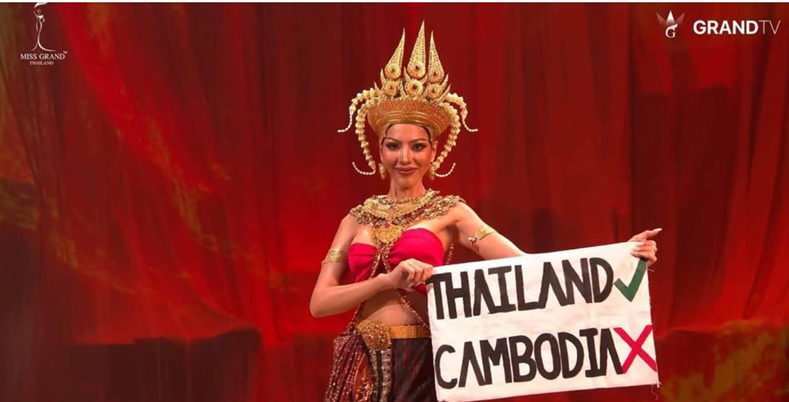
Recent events with Thailand have highlighted the importance of strengthening Cambodia’s cultural confidence. In both countries a noticeable rise in patriotism and national pride appeared and this context contributed to a tendency within Thailand’s strategy to downplay Khmer culture internationally.. Social media conversations have become more active on this topic, with discussions sometimes reflecting differing perspectives on cultural identity. A recent instance during Miss Grand Thailand 2026, where a contestant appeared on stage holding a sign claiming that Cambodia was wrong., drew attention and sparked debate online.
Such moments negatively serve as reminders of the importance of proactively sharing Cambodia’s history, traditions, and achievements with the world. By investing in cultural diplomacy, strengthening international communication, and encouraging respectful engagement, Cambodia can continue to elevate its cultural presence in the world.
Sources: Bc News
Why is Khmer language important ?
Because language is not only a tool for communication. Language is a marker of identity. It is a way for people to assert who they are and to say : “We are Khmer!” Whenever someone speaks Khmer in public announcements, produces content in Khmer, or chooses this language over others, they contribute to the country’s prestige.
Influence travel through language. Why do the member countries of the International Organization of La Francophonie (OIF in French) gather every two years? Officially, the organization aims to define cooperation and international policies, but its purpose is more than that. Language use reflects the influence of a country, and it affects more than just the words people speak; it shapes their minds, their habits, and even their souls. As a strong advocate for prioritizing Khmer language education, Prime Minister Hun Manet has promoted the inclusion of Khmer language and culture in private schools’ curricula, emphasizing that education should develop skills while preserving the nation’s identity, particularly its language, culture, and traditions. On December 2024, he stated :
“I would like to clarify that as long as the CPP leads, Khmer will remain the sole national language of Cambodia.”
A Moment to Reaffirm Cambodia’s Identity
Cambodia is a small country surrounded by cultural and economic influences. Therefore, it must constantly reaffirm its uniqueness. Initiatives have been taken to valorize Cambodian identity worldwide. For instance, the rapper VannDa performed during the Paris 2024 Olympic Games, showcasing Khmer culture on an international stage. Cambodia also hosts key international events, such as the 2023 Southeast Asian Games.
In November 2026, Phnom Penh will host the Francophonie Summit, bringing together heads of state from various member countries of the Organisation internationale de la Francophonie (OIF). This event offers a valuable opportunity: it is a chance to demonstrate that Cambodian students are not only capable of mastering foreign languages, but that the Khmer language is rich, culturally strong, and worthy of recognition.
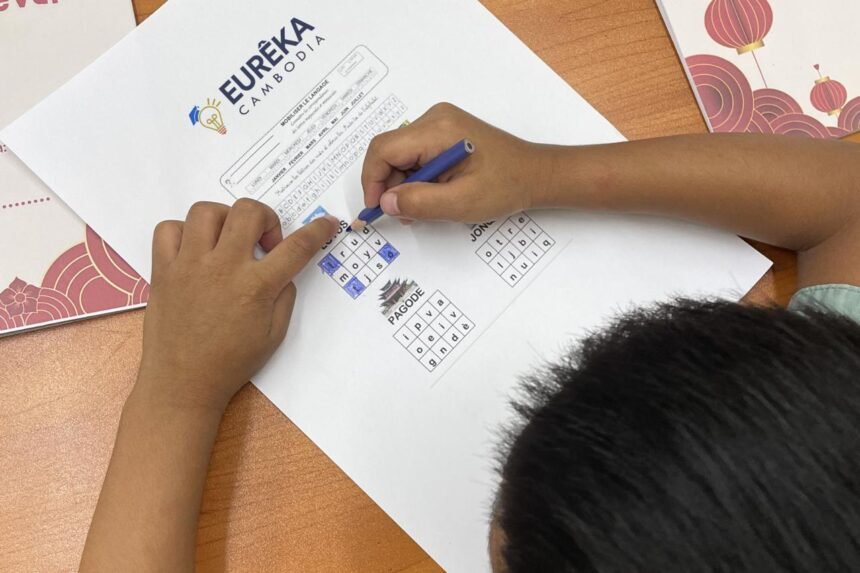
Finally, we are convinced that each of us can contribute individually to promoting the country. Every action matters. That is why our tutoring center places a strong emphasis on diversity, as well as on promoting Khmer culture among our students, regardless of their nationality or origin, whether they are Cambodian or from elsewhere.
Eurêka Cambodia
Olivia Hugues & Adrien Charrier