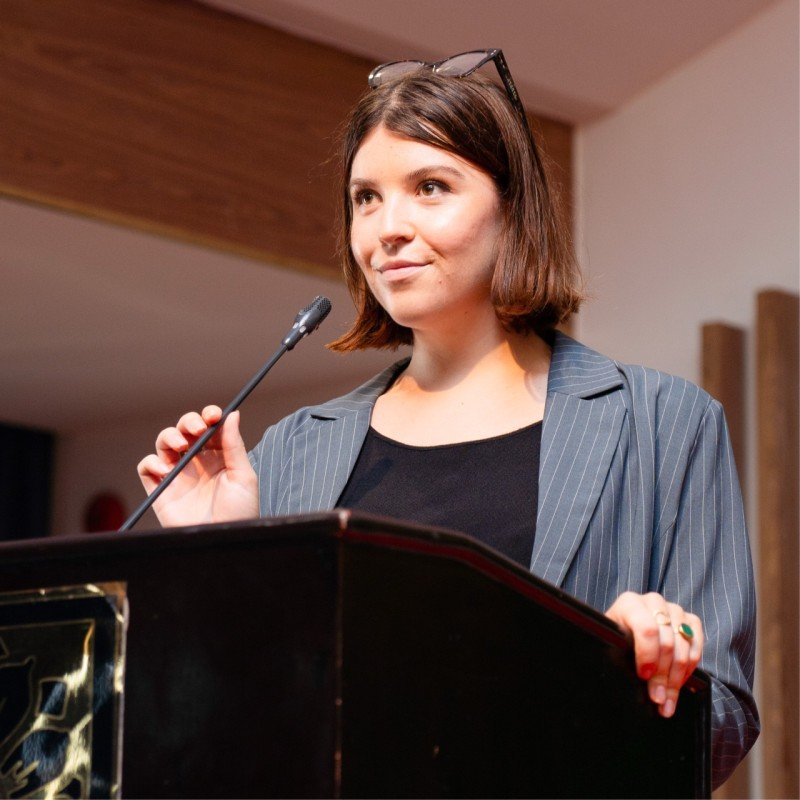
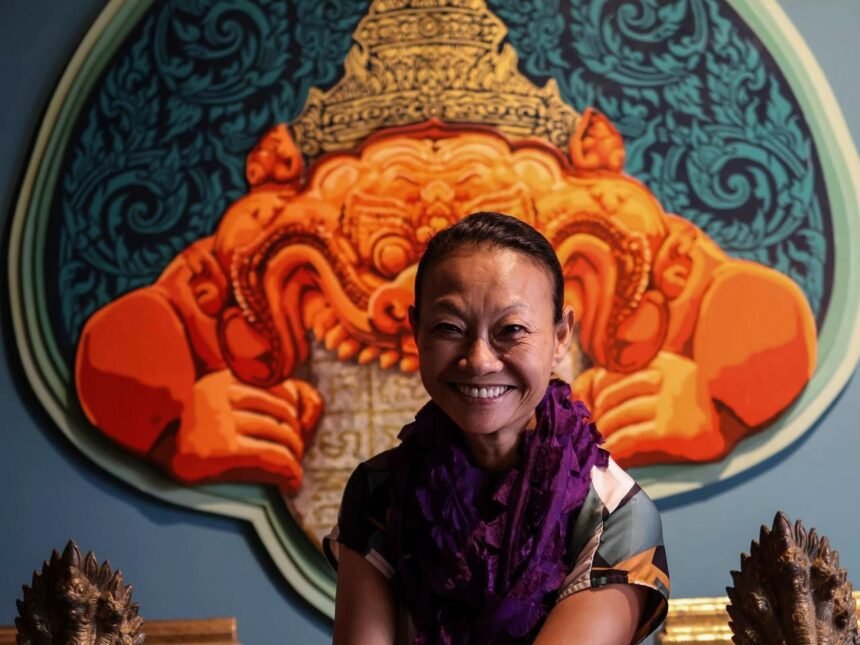
Some see words as the proper vehicle of transmission. Others struggle to bear verbal witness to the path that has shaped their lives. Dates and facts do not quite align with their inner sense of what was truly lived. Among them, those who are sensitive to aesthetics conceive of the visual as a form of sharing, distant, perhaps, yet sincere. Such is the case of the artist, so complete that it is difficult to confine him to a single title. Founder of Theam’s Gallery, his reputation in Cambodia no longer needs proving. His story did not reach us through his own words but through those of his sister, Maddy. In this article, we therefore invite you to step into Theam’s world, seen through Maddy’s eyes.Theam belongs to those for whom it is far easier to explain through images, colors, and carefully arranged textures. The gaze that rests upon his work becomes the keystone of its interpretation. And his message is this: to pay tribute to the Cambodian people, that silent, hardworking class whose knowledge and skills breathe life into the country.

More than artworks, he presents narratives. This storytelling is immediately perceptible within Theam’s Gallery. The space itself is built like a story, one that tells of Cambodia, and more precisely, of the Cambodian people. A way of returning history to those who make it. When one steps inside, a harmonious world unfolds, so seamless that one could almost lose oneself in it, as each element blends into the next to form a whole. Serenity is felt the moment you enter. It is both disconcerting and self-evident to think that a single person stands behind it, such is the complexity and fluidity of the creation. Theam chose to establish his gallery in one of Siem Reap’s earliest residential neighborhoods, for an obvious reason, to remain close to the temples. Maddy speaks of the way these temples became a driving force in her brother’s trajectory. And to understand that path, one must look back at his family history.
Born in Cambodia, Theam was forced to flee the country with his family during the Khmer Rouge regime. He was nine years old when he arrived in France, a land of exile naturally chosen by his parents. Very quickly, he developed a distinct taste and inclination for art. Within his largely business-oriented family, who showed no particular attachment to aesthetics, he appeared almost as an anomaly. Maddy describes this singularity as a “genetic error.” Why did her brother, not predestined for an artistic career, choose to embrace it alone, against and despite familial pressure? It was during adolescence that Theam’s sensitivity to art truly emerged. He chose to study interior architecture at the École Boulle, followed by fine arts in painting and sculpture. Curious, and already driven by the desire to become a complete artist. As soon as he finished his studies, he decided to spend one month in his native land, as a simple tourist. A transformative event that would forever alter the course of his life.

In the span of that month, he fell in love with the aesthetics and traditional art of Cambodia. The temples were a revelation, one that stirred something radical within him. He would not return to live in France. Cambodia was where he felt at home, and most especially among the temples. For his family, who had fled the country and remained shaped by its political instability, this decision felt like a tragedy. They struggled to believe in the path he was about to pursue. Maddy tells us she was the only one who truly supported the one she calls her “spiritual brother,” the one who opened the doors of art to her.
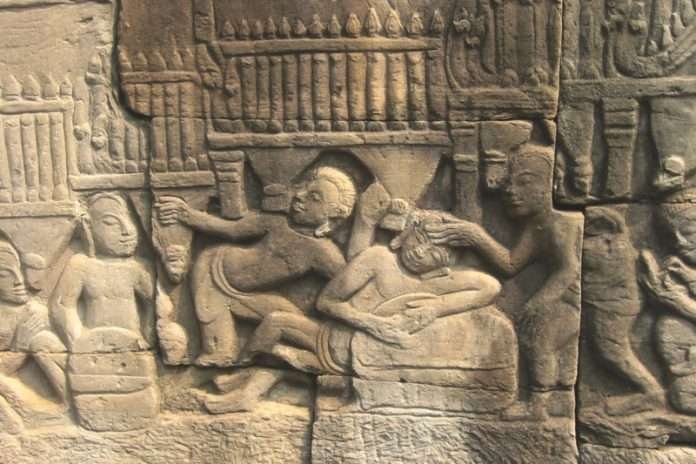
This period marked a revelation. For two and a half years, Theam went to the temples daily to study their representations. He sought not only to appreciate their aesthetic beauty but also the History they carried within them. He studied alone, yet accompanied by his books, patiently deciphering each motif. He immersed himself in traditional art with passion. Shortly after his arrival, he met the founder of what would become Artisans d’Angkor, who recruited him as Artistic Director. Theam was drawn to the project’s ambition, to revive Khmer cultural craftsmanship. He remained with them until 2010, when he chose to devote himself entirely to the development of his own gallery. The original idea was simply to open his home, Theam’s House, to the public, so that people could discover the home of a Khmer artist and designer.
It was at that moment that Maddy decided to move to Cambodia. Weary of her Parisian routine, she joined her brother with the intention of supporting him in the growth of his gallery. Their roles took shape naturally. Theam devoted his days to artistic creation for the gallery, as well as to passing on skills to artisans. Maddy took charge of the relational dimension of the project. Thanks to his experience at Artisans d’Angkor, Theam already benefited from a reputation established prior to the gallery’s opening, among expatriates and young Cambodians alike. This recognition provided a sense of relational security from the very beginning.

Doing what we believe in and love, working beyond yourself, this is what guides Theam’s path. His gallery seeks to offer an immersion into the daily lives of Cambodians while promoting traditional art. It stages fragments of everyday life, simple gestures, familiar scenes, giving visibility to those we too often look at without truly seeing. For what Theam finds regrettable, when some travel thousands of miles, is that they fail to take the time to engage with the people who give life to the country. Theam’s Gallery thus pays tribute to these anonymous figures, the silent pillars of Cambodian society.
When you open the gallery door, something slows down. The air feels cooler, the noise of the city recedes. Your eyes no longer quite know where to settle, as art envelops you, integrated into the walls, the floors, the vegetation. Sunlight filters through the leaves, casting shifting shadows on the ground, as if the place were breathing with the rhythm of the day. Voices soften. Footsteps slow, almost instinctively. Here, time does not impose itself, it allows itself to be tamed. And even before you understand what you are looking at, you feel. A sense of calm. Of respect. Of presence.

One of the collateral consequences of Covid-19 has been the rise of local tourism. Since 2020, Khmers have increasingly frequented cultural sites within their own country, a movement further amplified by the visibility offered by certain influencers. Theam’s Gallery fully embodies this dynamic. A living organism, it is constantly being transformed, repaired, expanded, and reimagined. Wood is replaced, spaces redesigned, artworks moved, reminding us that creation is a process in perpetual evolution. Yet the gallery is not limited to exhibiting the work of one artist, it is, above all, a place of transmission.
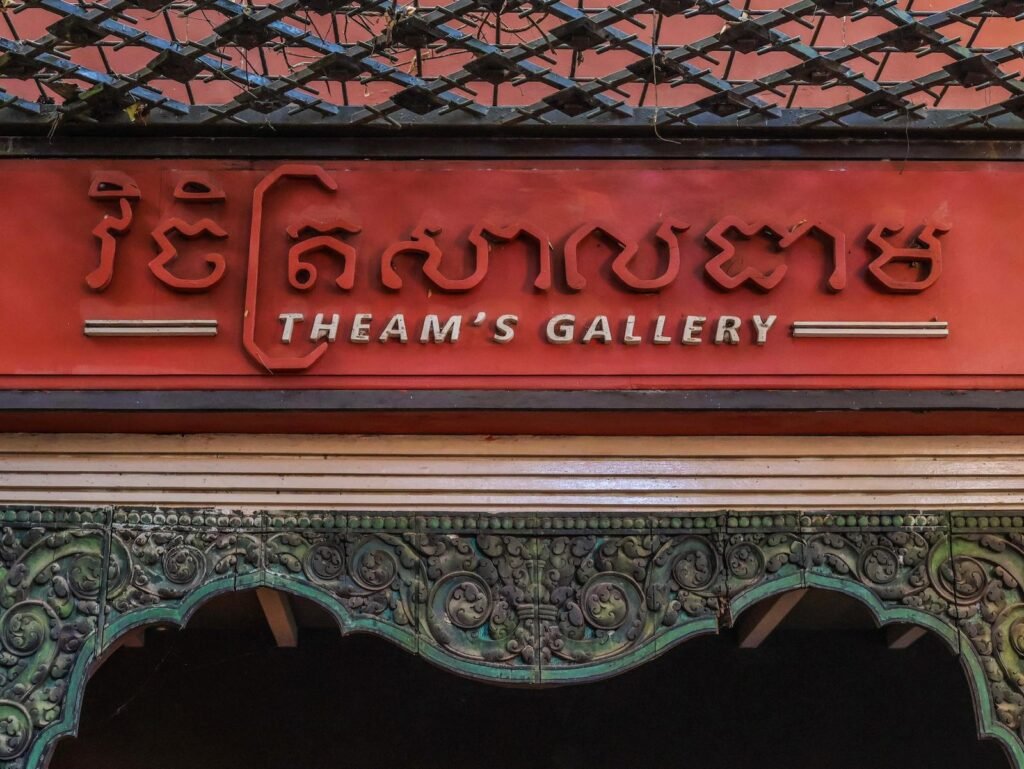
There, Theam directly trains his artisans, most of whom come from modest backgrounds and have no prior artistic education. Rice field workers, market vendors, homemakers, they discover within the gallery a craft they might otherwise never have accessed, caught as they are in the urgency of daily survival. By guiding them, sharing his knowledge, and supervising their work, Theam sustains a tradition while offering a tangible opportunity for emancipation. Transmission thus becomes an act that extends the very meaning of his work. Now an essential figure in Cambodian culture, his success bears witness to the sincerity with which he practices a profound art, driven by genuine ambition. In some ways, it stands as a quiet vindication before those who once doubted him, everyone except his sister, who supported him from the very beginning, and whose faith ultimately prevailed.
Thank you to Maddy for agreeing to share her brother’s journey with such gentleness and sincerity. Through her words, we understood that this gallery is not merely a place of art, but a story of bonds, of transmission, and of fidelity to oneself.
Also Read: International Collaboration in AI: What It Means for Cambodia