In the rich tapestry of Cambodian cultural history, few figures shine as brightly — or as poignantly — as Kong Nay. Born into a world of music and shaped by a life of extraordinary resilience, Kong Nay became the undisputed master of the Chapei Dang Veng, Cambodia’s ancient long-necked lute, earning the title the “Ray Charles of Cambodia.” He passed away in June 2024 at the age of 80, but his story endures — a story not just of musical brilliance, but of survival, cultural preservation, and the enduring power of the human spirit.
- Who Was Kong Nay?
- What Is the Chapei Dang Veng?
- Surviving the Khmer Rouge: A Miracle of Music
- A Musical Journey: From Kampot Boy to International Stage
- The Fukuoka Prize: Asia’s Highest Cultural Honour
- UNESCO Recognition: Chapei Dang Veng on the World Heritage List
- Kong Nay as Teacher: Building the Next Generation
- Bridging Tradition and Modernity: “Time to Rise”
- Selected Recordings and Musical Legacy
- Final Years and Passing
- Why Kong Nay Matters: A Cultural Legacy Beyond Music
- Frequently Asked Questions About Kong Nay
- Conclusion: A Legacy Etched in Song

Who Was Kong Nay?
Kong Nay was born on March 15, 1945, in Kampot Province, southwestern Cambodia — a region long known for its rich artistic traditions and connection to the Chapei instrument. He passed away on June 28, 2024, at his home in Kampong Trach District, Kampot Province, at the age of 80, leaving behind a legacy that will echo through generations of Cambodian artists and cultural custodians.
Blinded by smallpox at the age of four, Kong Nay’s early years could have easily been defined by limitation. Instead, they became the foundation of something extraordinary. Growing up in a deeply musical household — surrounded by relatives who were masters of traditional instruments, Buddhist chanting, religious manuscript copying, and classical poetry — Kong Nay absorbed the cultural wealth of Cambodia from childhood.
Rather than allowing his blindness to disempower him, he channeled it into an acute sensitivity to sound, rhythm, and language. He chose a path that offered both self-sufficiency and deep respect within his community: mastering the Chapei Dang Veng.
What Is the Chapei Dang Veng?
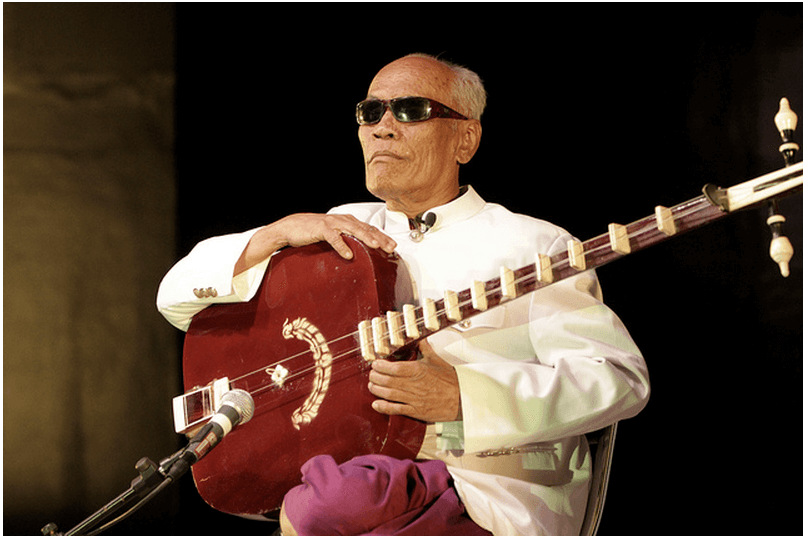
The Chapei Dang Veng (ចាប៉ីដងវែង) is a traditional Cambodian two-stringed long-necked lute — one of Southeast Asia’s most distinctive and expressive musical instruments. More than just an instrument, it is a vessel for storytelling, social commentary, satire, Buddhist wisdom, and improvised verse. A Chapei master does not merely play — they narrate, philosophize, entertain, and teach.
Performances typically involve the musician sitting for extended periods, plucking intricate rhythmic patterns from the lute while delivering improvised songs that weave together folk tales, moral lessons, humour, and sharp observations about everyday life. This demanding combination of musicianship and lyrical improvisation means that mastering the Chapei requires not just technical skill, but a deeply cultivated mind.
Historically, the Chapei Dang Veng was a fixture of Cambodian public life — heard at pagoda festivals, royal ceremonies, and village celebrations. By the mid-20th century, it had become inseparable from Khmer cultural identity. That identity, however, was nearly destroyed forever.
Surviving the Khmer Rouge: A Miracle of Music
Between 1975 and 1979, the Khmer Rouge’s brutal regime devastated Cambodia — and deliberately targeted its artists, musicians, and intellectuals. Traditional arts were labelled as symbols of the old order and suppressed with lethal intent. Many of Cambodia’s greatest Chapei masters perished during this dark chapter.
Kong Nay was among the very few who survived. His survival is considered nothing short of miraculous given the regime’s systematic persecution of cultural figures. After the fall of the Khmer Rouge, Kong Nay emerged as one of the last living bridges to Cambodia’s pre-war musical tradition — a responsibility he carried with immense dedication.
His music became, as cultural commentators have observed, “a bridge between ancient memory and modern resilience.” Every performance was not just entertainment; it was an act of reconstruction — stitching together the torn fabric of Cambodian cultural memory, one plucked string at a time.
“The Chapei is the conscience of the people written in music.” — Master Kong Nay
A Musical Journey: From Kampot Boy to International Stage
Early Training and Rapid Rise
Kong Nay began his formal study of the Chapei Dang Veng at the age of thirteen. Remarkably, just two years later, by the age of fifteen, he was already performing professionally — a testament to his extraordinary natural talent and the hours of dedication he poured into his craft. His popularity soared quickly, and he was affectionately given the nickname Kung “Handsome” Nay by his admirers.
The Art of Improvisation
While Kong Nay was celebrated for his performances of classical Cambodian poems — including works by the revered poet Phirum Ngoy — he became even more renowned for his breathtaking gift for improvisation. After nearly two decades of deep immersion in poetry and Cambodian oral literary tradition, he could compose and deliver verses spontaneously, adapting to his audience, the occasion, and the mood with effortless wit and wisdom.
This ability to improvise — to speak truth to audiences through clever rhyme and metaphor — made him far more than a musician. He was a griot, a storyteller, and a moral philosopher in the ancient Khmer tradition.
Royal Recognition and Government Honour
His national contributions did not go unrecognised. In 2007, Cambodian Prime Minister Hun Sen personally awarded Kong Nay the prestigious Gold Grand Cross of Cambodia Cultural Reputation — one of the highest cultural honours the Cambodian state can bestow. He was also designated as one of 17 artists named as “Intangible Treasures” by the Royal Government of Cambodia, a programme designed to ensure the nation’s greatest living cultural custodians are supported and celebrated.
International Stages and Global Recognition
Kong Nay’s reputation extended far beyond Cambodia’s borders. He performed at some of the world’s most prestigious world music events, including:
- WOMAD (World of Music, Arts and Dance), Wiltshire, UK — 2007
- WOMAD New Zealand, New Plymouth — 2008
- WOMADelaide, Adelaide, Australia — 2008
- World Chamber Music #4, Tokyo, Japan — 2009
These performances introduced global audiences to the haunting beauty of the Chapei Dang Veng and positioned Kong Nay as an ambassador of Cambodian culture on the world stage.
The Fukuoka Prize: Asia’s Highest Cultural Honour
In 2017, Kong Nay was awarded the renowned Fukuoka Prize for Arts and Culture — a Japanese award considered one of Asia’s most prestigious cultural recognitions, given to individuals who have made outstanding contributions to the preservation and development of Asian culture. Only three prizes are awarded globally each year, making Kong Nay’s selection an extraordinary honour for both him and for Cambodia.
UNESCO Recognition: Chapei Dang Veng on the World Heritage List
In 2016, the Chapei Dang Veng was inscribed on UNESCO’s List of Intangible Cultural Heritage in Need of Urgent Safeguarding — a global acknowledgment that this art form was at risk of disappearing and required immediate international attention and support.
The inscription was a watershed moment. In recognition of Kong Nay’s central role in keeping the art alive, Prime Minister Hun Sen welcomed Chapei artists of all generations to the Peace Palace in a special celebration honouring their contributions to Cambodian arts and culture.
The UNESCO listing catalysed a wave of new energy around the Chapei. With support from the Ministry of Culture and Fine Arts (MCFA) and civil society organisations like Cambodian Living Arts (CLA), transmission programmes were launched across multiple provinces including Kampong Thom, Siem Reap, and Takeo. The number of Chapei musicians across Cambodia more than doubled from 126 to over 300 between 2017 and 2020.
Kong Nay as Teacher: Building the Next Generation
After the UNESCO recognition, Kong Nay embraced the role of teacher with the same commitment he had brought to performance. He went on to train approximately 30 singers, including two American nationals who discovered the Chapei only after learning of the UNESCO listing — a remarkable illustration of how international recognition can reconnect a diaspora and attract new admirers across the world.
Among his most celebrated students is Pich Sarath, who began lessons with Kong Nay in 2003, started performing in 2007, and is now the Director of the Community of Living Chapei (CLC). Sarath has gone on to teach over 200 students himself, running Chapei classes online for learners in Japan, South Korea, Australia, the United States, and China — proving that this ancient Cambodian art form now has a genuinely global reach.
Bridging Tradition and Modernity: “Time to Rise”
Perhaps one of the most striking testaments to Kong Nay’s enduring cultural relevance came in March 2021, when Cambodian hip-hop star VannDa featured the elderly master in his groundbreaking track “Time to Rise.” The song blended modern Cambodian rap with Kong Nay’s live Chapei Dang Veng performance — an extraordinary collision of the ancient and the contemporary.
The result was a cultural phenomenon. “Time to Rise” amassed over 117 million views on YouTube, introducing a global younger generation to the Chapei Dang Veng and demonstrating that traditional Cambodian music could be not just preserved, but revitalised and made relevant for the 21st century. For many young Cambodians — at home and in the diaspora — the song was their first meaningful encounter with their own intangible cultural heritage.
Selected Recordings and Musical Legacy
Kong Nay’s recorded output documents one of the most important musical voices in modern Southeast Asian history:
- Master Kong Nai — with DENGUE FEVER, from the Sleepwalking through the Mekong OST, released on M80 Records (2009)
- 3 Songs For Human Rights — with The Cambodian Space Project, released by Bophana Audiovisual Resource Center (2012)
- Time To Rise — featuring VannDa, released by Baramey Production (2021)
- Master of Chapei Dong Veng: Kong Nay — recorded at Pich Makot Pagoda, Kandal Province (2015, released via Bandcamp)
Final Years and Passing
In his later years, Kong Nay retired to his home in Kampong Trach District, Kampot Province, with his wife. Health challenges — including hip problems and diabetes — made it increasingly difficult for him to perform. A Chapei performance requires sitting for more than an hour at a stretch, and he acknowledged with characteristic grace that his body could no longer sustain the demands.
In May 2022, Kong Nay was hospitalised in Kampot for high blood pressure, diabetes, and lung problems. His son, Samphors, noted that he might not perform again.
On June 28, 2024, Kong Nay passed away peacefully at his home in Kampong Trach District. He was 80 years old. Prime Minister Hun Manet and Senate President Hun Sen both expressed their condolences publicly, and tributes poured in from across Cambodia and the international cultural community.
The nonprofit Cambodian Living Arts captured his significance simply: “For almost eight decades, when talking about the long chapei instrument, one would think of a great artist who was nicknamed the master, Kong Nay.”
Why Kong Nay Matters: A Cultural Legacy Beyond Music
Kong Nay’s life was not simply the story of a musician. It was a story of what it means to carry a culture — to be the human vessel through which centuries of oral tradition, poetic wisdom, and national identity are transmitted forward across generations, even through genocide, displacement, and modernisation.
He demonstrated that disability need not define destiny, that culture can survive catastrophe, and that a single committed artist can help save an entire art form from extinction. His work inspired government policy, international recognition, NGO programmes, and millions of YouTube viewers in equal measure.
Today, the Chapei Dang Veng lives on — in the hands of Pich Sarath and hundreds of apprentices, in the curricula being lobbied for inclusion in Cambodian schools, in online classes reaching students across Asia and beyond, and in the digital memory of VannDa’s viral anthem. Every note played is, in part, an echo of Kong Nay.
Frequently Asked Questions About Kong Nay
What instrument did Kong Nay play?
Kong Nay played the Chapei Dang Veng, a traditional Cambodian two-stringed long-necked lute. It is one of Cambodia’s most iconic traditional instruments, used for improvised storytelling, satire, and Buddhist moral instruction.
Why is Kong Nay called the “Ray Charles of Cambodia”?
Kong Nay earned this nickname because, like Ray Charles, he was a blind musician of extraordinary talent who achieved legendary status in his country’s musical heritage.
Did Kong Nay survive the Khmer Rouge?
Yes. Kong Nay was one of the very few Chapei masters to survive the Khmer Rouge regime (1975–1979), which systematically destroyed Cambodia’s artistic and intellectual communities. His survival allowed him to become the primary custodian and transmitter of Chapei tradition into the modern era.
What awards did Kong Nay receive?
Kong Nay received the Gold Grand Cross of Cambodia Cultural Reputation from Prime Minister Hun Sen in 2007, the prestigious Fukuoka Arts and Culture Prize in 2017, and was designated as one of Cambodia’s official Intangible Treasures by the Royal Government of Cambodia.
When did Kong Nay pass away?
Kong Nay passed away on June 28, 2024, at his home in Kampong Trach District, Kampot Province, Cambodia. He was 80 years old.
Is Chapei Dang Veng a UNESCO heritage?
Yes. In 2016, the Chapei Dang Veng was inscribed on UNESCO’s List of Intangible Cultural Heritage in Need of Urgent Safeguarding, bringing international attention and resources to preserving this unique Cambodian art form.
Conclusion: A Legacy Etched in Song
Kong Nay did not merely play music. He was music — the conscience of Cambodia written in melody and verse. From a blind boy in Kampot who learned to find beauty through sound, to a white-haired elder whose chapei strings vibrated across global stages, his journey traced the arc of an entire nation’s cultural memory.
Cambodia is richer for having had him. The world of music is richer for having heard him. And as long as a single Chapei string is plucked anywhere on earth — in a village pagoda, a Phnom Penh concert hall, or a YouTube video watched by a young Cambodian in California — Kong Nay’s spirit continues to perform.