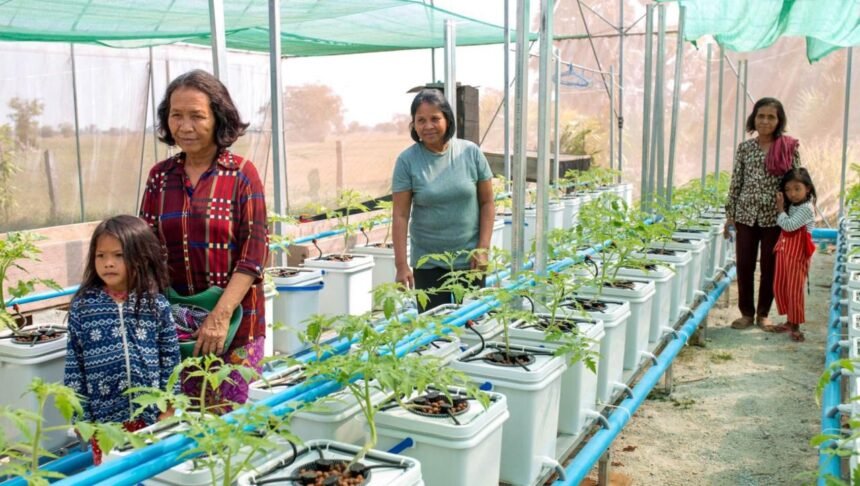
On the outskirts of Siem Reap, far from the postcard temples, a quiet revolution has been taking shape. Not a startup buzzword, but a system built around fish, plants, and water—designed to work with Cambodia. It’s called aquaponics, and for more than a decade, Community First Initiatives has been adapting it to Cambodian soil-less realities.
A system that closes the loop
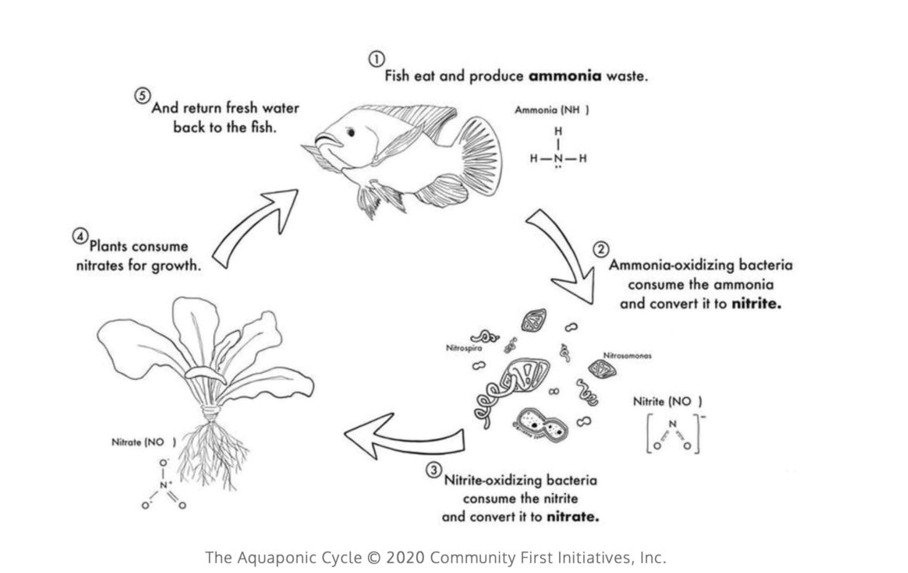
Aquaponics combines two familiar practices: aquaculture (raising fish) with hydroponics (growing plants in water without soil). What makes it different is the way they depend on each other.
Fish produce waste. Bacteria convert that waste into nutrients. Plants absorb those nutrients and clean the water, which flows back to the fish tanks. Nothing is wasted. Nothing is discharged into the environment. The water keeps circulating. The result is a system that uses a fraction of the water required by conventional farming, produces both protein and vegetables, and doesn’t rely on chemical fertilizers or pesticides.
Concretely, the main advantages of aquaponics system are:
- 90% less water than conventional agriculture (water recirculates rather than draining away)
- Zero synthetic fertilizers—the fish provide all plant nutrition naturally
- No agricultural runoff—nothing enters the environment
- Year-round production regardless of seasons when combined with climate control
- Dual protein + vegetable output from a single system
In a country where water access is fragile and inputs are expensive, that matters. Community First follows the FAO’s small-scale aquaponics guidelines, but they’ve spent years adapting the designs to local conditions.
Why Cambodia needed something different
Cambodia’s food challenges aren’t always visible, but they’re deeply structural. Nearly a third of children under five suffer from stunting. Almost half of women experience anemia. In rural areas, families depend heavily on rice monoculture, leaving them exposed to climate shocks and price fluctuations.
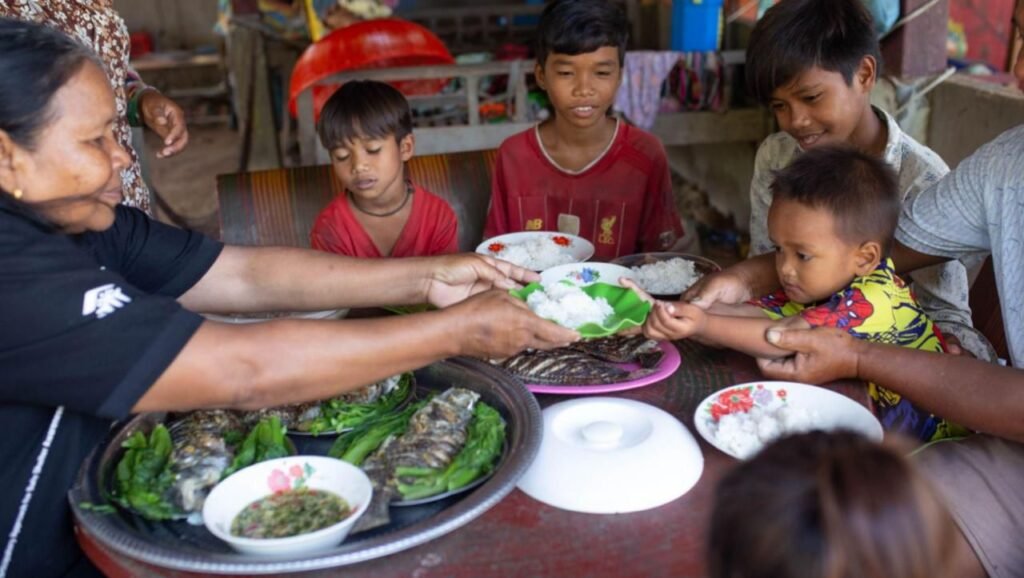
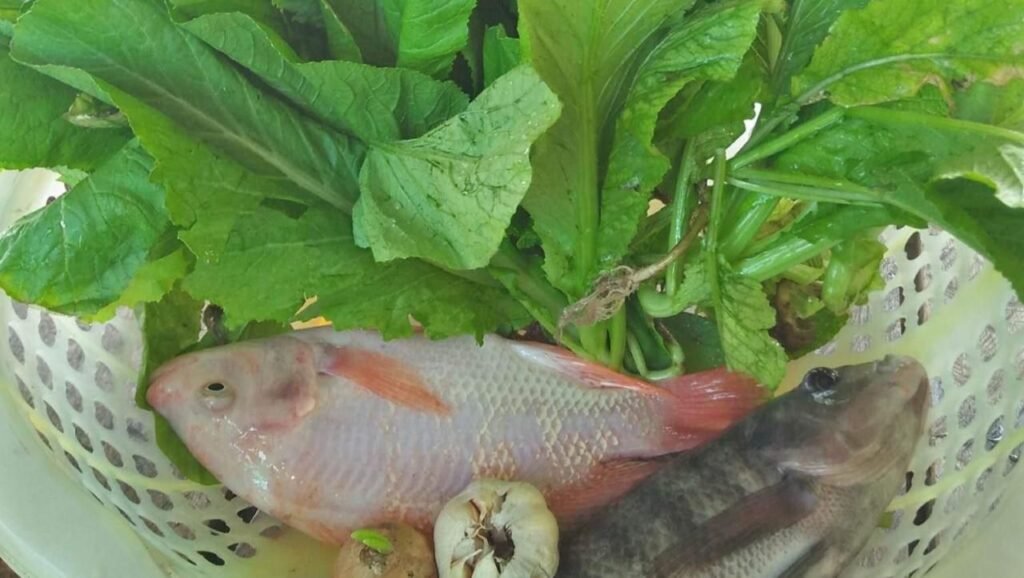
At the same time, fresh vegetables are often imported from neighboring countries. Many urban consumers worry about pesticide residues, yet local alternatives remain limited. Aquaponics produces what Cambodian diets are missing—clean vegetables and fish—using what Cambodia already has: knowledge of fish, family labor, and a strong culture of sharing.
Aquaponics offers a unique advantage by combining resource efficiency, climate resilience, and economic viability in a single system for Cambodia. It uses up to 90% less water than conventional farming, requires no arable land, and operates with low energy needs—making it well suited to Cambodia’s constraints. Because production is off-soil and recirculates water, it is resilient to both droughts and floods and allows for year-round harvesting regardless of monsoon cycles.
Economically, aquaponics produces both fish and vegetables from the same system, enabling continuous harvests and access to higher-value markets seeking pesticide-free produce. Unlike traditional farming or hydroponics, it does not rely on imported fertilizers or chemicals. Instead, it functions as a self-sustaining ecosystem that can be managed by trained families with minimal external inputs, allowing subsistence farmers to transition into stable, market-oriented producers.
Not one project, but many entry points
One of the things that makes Community First’s approach unusual is that it isn’t designed for a single type of beneficiary. A rural family might start with a small household system to supplement income and nutrition. A school might use aquaponics to teach students about biology and sustainability. An entrepreneur might invest in a climate-controlled greenhouse to supply restaurants in Siem Reap. Or, you? Indeed, you might use your own aquaponics system at home, to produce your tomatoes or basil in the center of Phnom Penh.
The methodology is the same. Same designs. Same training. Same logic. That consistency is intentional. It’s what allows knowledge to circulate between communities instead of staying locked in pilot projects.
Creation, diffusion, propagation
Community First’s strategic logic borrows from an unexpected source1952 paper by mathematician Alan Turing called “The Chemical Basis of Morphogenesis.” Turing described how complex patterns emerge naturally from simple, uniform conditions—how a homogeneous system, given the right dynamics, differentiates into something structured and alive.
Pierre and his team apply this thinking to social change. Their model has three phases:
Creation happens at the laboratory level—inventing, testing, and refining aquaponic systems in a controlled environment. This is where designs are proven before they reach a single village.
Diffusion occurs through education. The Sen Sok Farm School trains farmers, but also trainers—people who will carry the methodology back to their own communities. Knowledge doesn’t stay centralized; it spreads.
Propagation is what happens when trained farmers teach their neighbors, when systems replicate peer-to-peer without ongoing intervention from Community First. The goal isn’t dependency—it’s disappearance. If the model works, it should eventually run without them.
This is why the methodology stays consistent across scales. A household system and a commercial greenhouse follow the same principles because they’re part of the same diffusion logic. What changes is context, not design.
Reference: Turing, A.M. (1952). “The Chemical Basis of Morphogenesis.” Philosophical Transactions of the Royal Society of London. Series B, Biological Sciences, 237(641)
From development work to aquaponics
Pierre’s path to aquaponics wasn’t planned. When Community First began its work in Cambodia in 2008, the focus was on connecting resourced communities with those facing urgent needs. But in village after village, the same pattern appeared: families working hard, yet unable to move beyond subsistence. Traditional agriculture wasn’t breaking the cycle. Through FAO research and development networks, Pierre and his co-founder, Romain Rak, discovered aquaponics. What caught their attention wasn’t just efficiency—it was cultural fit.
Indeed, fish are central to Khmer cuisine. Women often manage fish sales. Systems could be built with locally available materials. Water could be reused rather than pumped away. Over the next ten years, they refined designs, tested fish species, adjusted plant varieties, and built training programs in Khmer for farmers with little formal education.
Ready to scale — but missing one thing
Today, Community First operates a training farm and school in Sen Sok, Siem Reap Province. Dozens of families already use household systems. Government partnerships are in place. The model works. What’s missing is scale—and credibility in the eyes of banks.
Cambodian financial institutions don’t lend to aquaponic farmers, not because they doubt the idea, but because they lack data. No track record. No verified performance numbers. To change that, Community First is planning its first commercial-scale, climate-controlled aquaponics greenhouse. The goal isn’t just production—it’s to build a solid database.
“Once you can show real numbers, financing becomes possible,” Pierre explains. “Not just for us, but for farmers across the country.”
Skepticism, trust, and small victories
Of course, not everyone is convinced right away. Some farmers have seen development projects come and go. Others worry about cost or risk—especially the idea of losing fish.
Those concerns are valid. That’s why training focuses heavily on water quality, early warning signs, and ongoing support. And why Community First has stayed present in the same communities for years, not months.
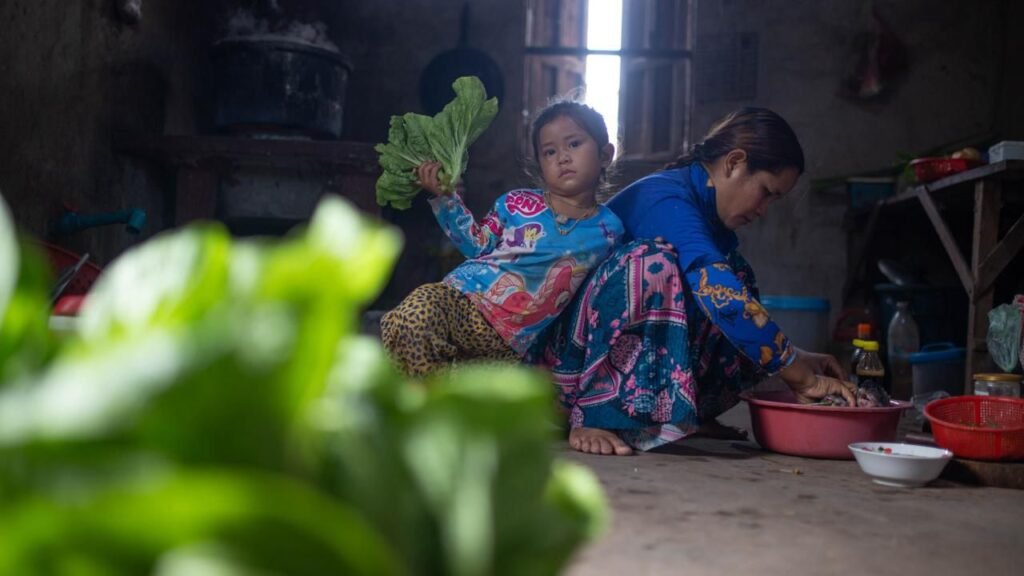
What surprised the team most was who took the lead. Women often run the systems. It wasn’t something planned. It just made sense culturally.
A Cambodian solution, with regional echoes
For Pierre, the long-term vision goes beyond Cambodia. Countries like Laos, Myanmar, Vietnam, and Bangladesh face similar constraints—water stress, climate volatility, nutrition gaps.
If it works here, it can work elsewhere.
But first, it has to work visibly, measurably, and sustainably at home. Quietly, in a greenhouse outside Siem Reap, fish and vegetables are already doing their part.
To discover more about aquaponics system of We Are Community First
Also Read: 455-Hectare Special Economic Zone Proposed in Kampong Speu, Cambodia