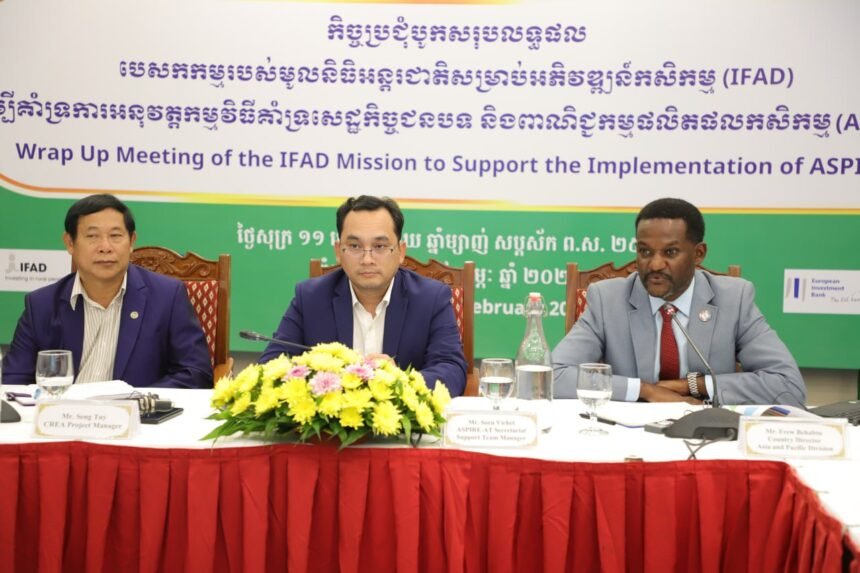
Phnom Penh — A strategic partnership under the Agriculture Services Programme for an Inclusive Rural Economy and Agricultural Trade (ASPIRE-AT) is enabling measurable progress in reducing trade barriers for Cambodia’s rural smallholders, according to the programme’s most recent Implementation Support Mission held on 15 February 2026. The initiative marks a coordinated effort among the Royal Government of Cambodia, the International Fund for Agricultural Development (IFAD), the European Investment Bank (EIB), the European Union Delegation (EUD), and key national institutions including the Agriculture and Rural Development Bank (ARDB), SME Bank, and the Credit Guarantee Corporation of Cambodia (CGCC).
The mission reported significant strides in linking organized rural producers to structured domestic and export markets. Through targeted brokerage and value-chain mobilization, ASPIRE-AT facilitated commercial agreements between producer organizations and buyers valued at around USD 35 million, supporting improved market access by enhancing grading, aggregation, and quality compliance mechanisms.
In parallel, approximately 40 small and medium enterprises (SMEs) received support, with two accessing loans totaling roughly USD 600,000, strengthening their capacity to scale trade activities and source from rural producers. Regular monitoring of actual trade volumes remains an essential measure to ensure that contractual values translate into sustained commercial outcomes.
A notable focus of the mission was strengthening export pathways by addressing regulatory and sanitary barriers. Sanitary and Phytosanitary (SPS) protocols have been developed for tropical fruits including durian, pineapple, and jackfruit, targeting export markets such as China and Japan. These protocols are critical for compliance and access to higher-value markets, building on the success of Cambodia’s first durian export shipment.
The programme’s integrated approach — combining market linkages, access to finance, and SPS reform — systematically lowers structural obstacles for organized rural producers. Efforts to enhance inclusive financing have reached smallholders, including women, who represent approximately 45 percent of borrowers, reinforcing meaningful participation in productive investment.
With additional IFAD financing approved in late 2025 to scale up the Modern Agricultural Cooperative model, the ASPIRE-AT mission emphasized the need to expedite implementation and front-load key operational steps. This restructuring aims to accelerate investment readiness, strengthen governance, and expand access to finance, further enabling rural smallholders to compete effectively in both domestic and international value chains.
Also Read: Cambodia and Laos Military Leaders Reaffirm Defense Cooperation in 70th Anniversary Year