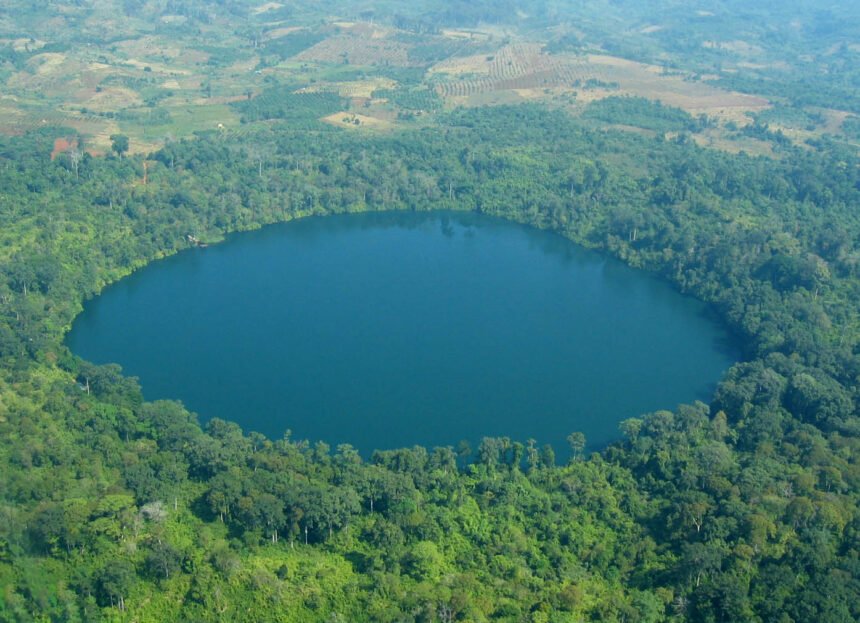
In Cambodia’s far northeast, where red earth roads cut through forests and traditions remain deeply rooted, Yeak Laom Lake lies quietly within a ring of ancient jungle. To many Cambodians, this lake is not simply a scenic landmark—it is a place of memory, respect, and balance between people and nature. Formed thousands of years ago in a volcanic crater, Yeak Laom stands today as one of the country’s most remarkable natural wonders and a symbol of community-led conservation.
Seen from a Cambodian perspective, Yeak Laom is not about spectacle. It is about stillness, continuity, and the quiet strength of nature preserved through care rather than control.
A Lake Born of Fire, Preserved by Forest
Yeak Laom Lake was formed by a volcanic eruption estimated to have occurred around 4,000 years ago. What remains is a near-perfect circular crater filled with deep, jade-green water, surrounded by dense forest. The lake is believed to be around 48 metres deep, with exceptionally clear water due to limited disturbance and careful management.
Located just outside Banlung in Ratanakiri, Yeak Laom feels worlds away from Cambodia’s busy cities. The air is cooler, the forest thicker, and the pace slower. For many visitors—Cambodians and foreigners alike—the first sight of the lake brings a sense of calm that is difficult to explain.
Sacred Waters and Living Traditions
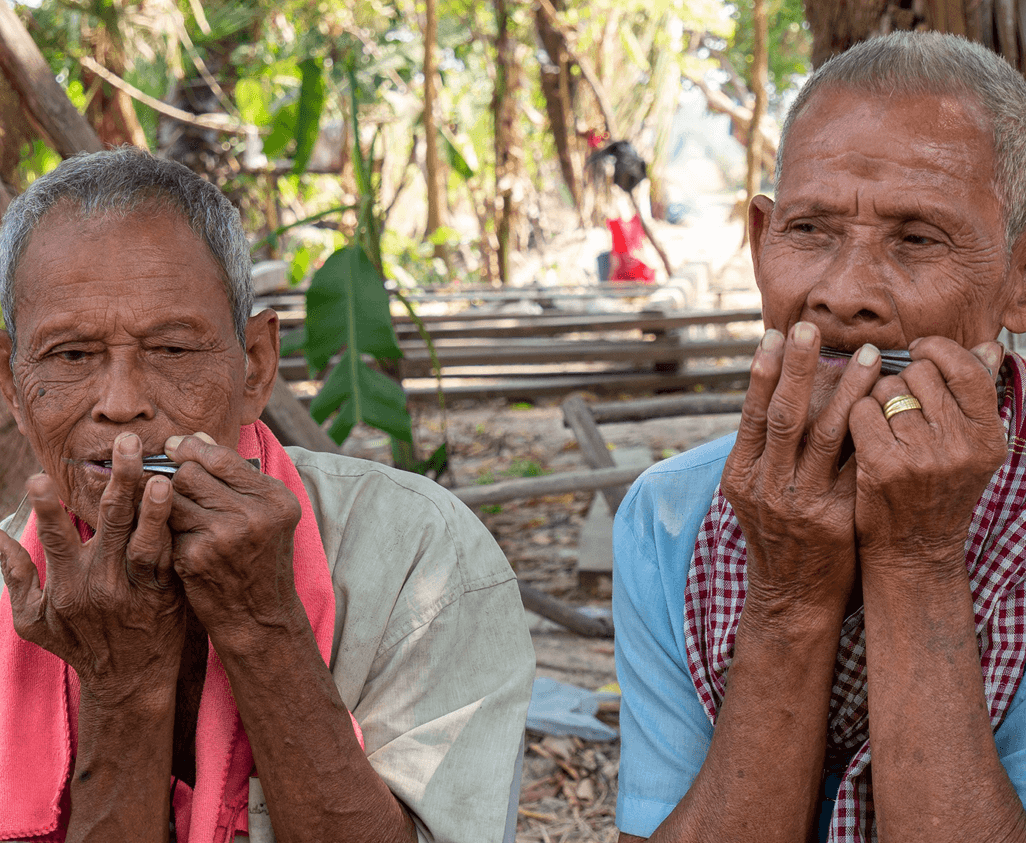
For the indigenous Tampuan people, Yeak Laom is sacred. The lake is closely tied to local spiritual beliefs, ceremonies, and ancestral stories. This relationship has shaped how the site is protected and shared.
Swimming in the lake is allowed, but it is approached with respect. Visitors are reminded that this is not just a recreational space, but a living cultural landscape. This blend of access and reverence reflects something deeply Cambodian: progress that does not erase tradition.
From within Cambodia, Yeak Laom is often seen as an example of how cultural identity and environmental protection can exist together without conflict.
Community-Led Ecotourism in Practice
One of Yeak Laom’s defining strengths is its management model. The site is overseen by a local indigenous community committee, with entrance fees supporting conservation, maintenance, and livelihoods.
Local guides lead forest walks around the lake, sharing knowledge about medicinal plants, wildlife, and Tampuan customs. Small vendors sell handicrafts and refreshments, keeping economic benefits within the community.
This approach has made Yeak Laom a reference point for sustainable tourism in Cambodia—showing that protection does not require exclusion, but participation.
The Surroundings: Ratanakiri’s Wild Heart
Beyond the lake itself, the surrounding Ratanakiri region offers waterfalls, forests, and villages where traditional lifestyles remain strong. Trekking routes lead to hidden cascades and remote communities, while eco-lodges near Banlung provide simple, low-impact accommodation.
The landscape here is not polished. Roads can be rough, mobile signals uneven, and comforts basic. Yet for many Cambodians, this rawness is precisely what makes the region special. It represents a Cambodia that has not been rushed or reshaped beyond recognition.
Why Yeak Laom Matters in Today’s Cambodia
As tourism grows and development accelerates, Yeak Laom serves as a reminder of what careful stewardship can achieve. The lake has avoided over-commercialisation, large resorts, and excessive infrastructure—choices made deliberately to preserve its character.
From a Cambodian viewpoint, this restraint is meaningful. It reflects lessons learned over time: that natural beauty, once lost, cannot be rebuilt, and that communities must remain central to conservation.
Nature, Data, and the Future of Protection
At first glance, Yeak Laom seems untouched by modern technology. Yet the future of places like this may increasingly depend on smart, invisible tools.
Satellite imagery, environmental sensors, and AI-based monitoring can help track changes in water quality, forest cover, and visitor impact without disturbing the site. These technologies allow early intervention when ecosystems are stressed.
For Cambodia, this represents an opportunity to combine tradition with innovation—using advanced tools to protect ancient landscapes.
A Place That Teaches Balance
From a Cambodian lens, Yeak Laom Lake is not only beautiful—it is instructive. It shows how patience, respect, and community leadership can preserve something fragile for generations.
It reminds visitors that not all development needs to be visible, and that silence, shade, and clean water are forms of wealth worth protecting.
Yeak Laom Lake stands as one of Cambodia’s most powerful natural symbols—a volcanic wonder shaped by fire, softened by time, and protected by people. In its still waters and surrounding forest lies a vision of Cambodia’s future: rooted in tradition, guided by community, and supported by thoughtful innovation.
As Cambodia moves toward a more digital and AI-enabled era, places like Yeak Laom remind us why progress must always serve something deeper—the land, the culture, and the generations yet to come.
Also Read: Cambodia’s banking sector shows resilience in 2025 as deposits surge and lending supports growth