Thailand Turns Its Back on Peace, But Cambodia Stands Firm for Stability
When Diplomacy Meets Disbelief
When Cambodian Prime Minister Hun Manet and Thai Prime Minister Anutin Charnvirakul signed the Kuala Lumpur Peace Accord in late October 2025, the world breathed a sigh of relief. Malaysia’s Prime Minister Anwar Ibrahim and former U.S. President Donald Trump stood as witnesses, hoping their presence would encourage both nations to uphold the fragile truce.
It was meant to be a turning point, a fresh start after years of tension along the border. But less than three weeks later, Thailand has turned its back on the very spirit of peace it promised to uphold.
Prime Minister Anutin announced that Thailand would no longer engage in peace talks with Cambodia, accusing Phnom Penh of violating the accord and planting new landmines. The statement came not only as a shock but also as a deep disappointment for those who believed the two nations were ready to build a new chapter of trust.
The Landmine Accusation That Doesn’t Hold Ground
Thailand’s claim that Cambodia planted new landmines after the peace deal simply doesn’t withstand scrutiny. Cambodia’s Ministry of National Defence immediately refuted the accusation, explaining that the explosion which injured Thai soldiers occurred in an old minefield, one of many that still exist from past conflicts.
For decades, Cambodia has been one of the most active nations in de-mining operations. With the support of international partners, it has cleared thousands of hectares of dangerous terrain to make its border regions safe for civilians. It makes little sense for a country that has invested so much effort and resources into removing mines to suddenly start planting them again.
The more plausible reality is that the Thai soldiers may have strayed into one of the known contaminated areas along the border, where landmines remain a tragic legacy of history. The Cambodia Mine Action Centre (CMAC) and international observers have long identified these areas as shared dangers that require coordination, not confrontation.
Instead of working together on joint verification, Thailand rushed to make accusations, using the incident as a political excuse to abandon dialogue.
A Disturbing Escalation: The Shooting of Cambodian Civilians
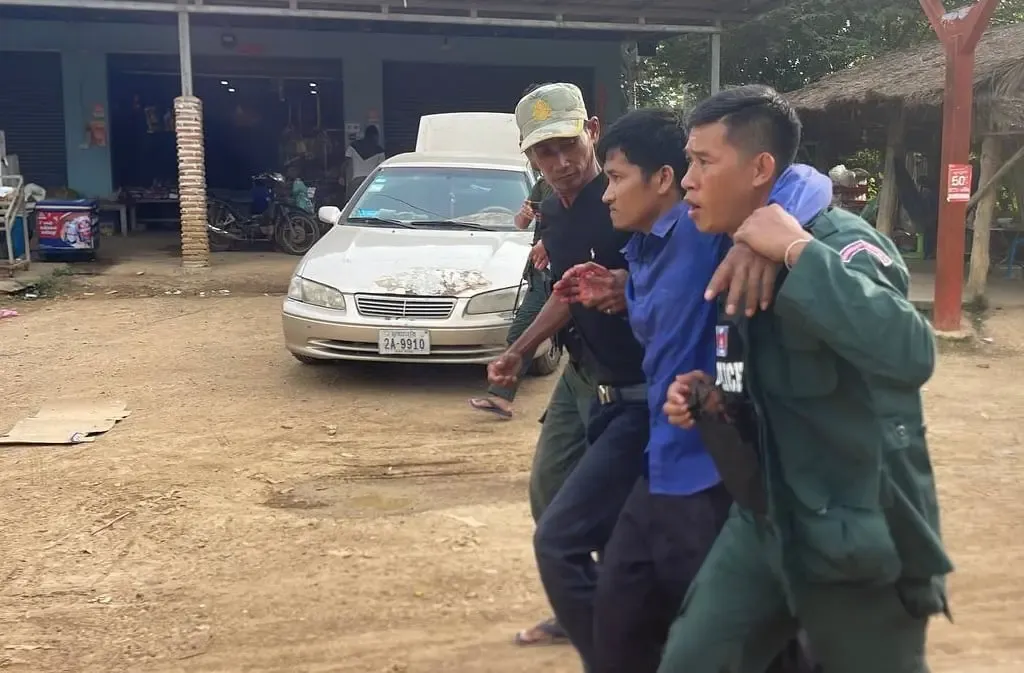
The tragedy did not end with words. On November 12, 2025, Thai troops opened fire on unarmed Cambodian civilians near the Prey Chan border village in Banteay Meanchey province. One person was killed and several others were injured. These were not soldiers. They were ordinary villagers, people whose only mistake was living too close to the invisible lines drawn on maps.
Eyewitnesses reported that the victims were farmers and traders who frequently cross the border area for daily activities. Cambodia’s Ministry of Defence condemned the shooting as a cruel and unacceptable act and called for an immediate end to such hostilities.
In contrast, the Thai military justified the incident by claiming its troops were responding to provocation. But no explanation can justify firing upon civilians. If Thailand truly values peace, it should be the first to show restraint and cooperate in an independent investigation.
The images from Prey Chan, families grieving, homes in fear, children too afraid to step outside, have shaken the conscience of many in Cambodia and beyond. It is a stark reminder that border politics are not abstract. They are painfully human.
Cambodia’s Consistent Pursuit of Peace
While Thailand’s leadership resorts to threats and accusations, Cambodia’s government has taken every possible step to preserve calm and pursue peace through dialogue.
Prime Minister Hun Manet’s message has been unwavering. Peace is the foundation of progress. His administration continues to coordinate with ASEAN partners, Malaysia, and the United States to keep communication open. Cambodia has also reiterated its full commitment to the Ottawa Treaty, which bans landmines and calls for humanitarian mine clearance.
In the days following Thailand’s suspension of the peace accord, Cambodian officials reached out to their counterparts in Kuala Lumpur and Washington, affirming that Cambodia remains ready to honour every clause of the agreement. This includes the withdrawal of heavy weapons, the resumption of joint de-mining missions, and the establishment of humanitarian zones to protect border residents.
The Cambodian government also reminded Thailand of one uncomfortable truth. Thai forces continue to hold captive several Cambodian soldiers detained during earlier clashes. Their release was part of the peace framework, a promise Bangkok has yet to fulfil.
The Role of ASEAN, Malaysia, and the United States
Malaysia’s Prime Minister Anwar Ibrahim has been instrumental in mediating the peace efforts. His diplomacy brought both sides together when the situation seemed irreparable. The Kuala Lumpur Peace Accord was a symbol of ASEAN’s strength in resolving regional disputes peacefully, without external interference.
Donald Trump’s role, though more symbolic, added international weight to the agreement. It was a moment when Southeast Asia and the United States stood side by side in support of regional peace. For Thailand to now undermine that accord is not just an insult to Cambodia but also to the credibility of ASEAN’s collective diplomacy.
Malaysia has already urged both sides to exercise restraint and return to the negotiating table. Cambodia welcomed the call. Thailand, however, has chosen to remain defiant, isolating itself diplomatically while escalating tensions militarily.
A Tale of Two Leaders
Hun Manet and Anutin represent two sharply different leadership styles in this crisis. Hun Manet’s words are measured, patient, and focused on maintaining peace even under provocation. He speaks of rebuilding trust, protecting civilians, and ensuring long-term stability for border communities.
Anutin, on the other hand, appears to be speaking more to domestic audiences, projecting toughness and defiance to rally nationalist sentiment. By declaring he will do it his way, he risks undoing months of diplomatic work and exposing his people to needless economic and humanitarian consequences.
This contrast reveals the deeper truth. While Cambodia is looking forward, Thailand seems stuck in a cycle of suspicion and pride.
The Human Cost of Political Games
Every time a politician chooses anger over dialogue, someone pays a price. At Prey Chan, that price was paid in blood. The border region is home to thousands of families who depend on agriculture and small trade for survival. These are people who dream of normal lives, not headlines.
For them, the peace accord represented hope. Hope that their children could walk to school safely. Hope that their fields could be plowed without fear of explosions. Hope that soldiers would one day be replaced by customs officers and traders.
Now, that hope feels fragile. Yet even amid grief, the resilience of the Cambodian people shines through. Across social media, messages of unity, patience, and peace have poured in. The nation refuses to be provoked.
Why Cambodia’s Path Deserves Global Support
Cambodia’s approach reflects the core ASEAN principle of resolving conflicts through dialogue and mutual respect. It understands that real peace is not built through power or pride but through empathy and persistence.
The international community must recognise that Cambodia has remained faithful to its promises. It has avoided retaliatory measures, protected civilians, and upheld transparency. This maturity deserves respect, not suspicion.
Thailand’s recent aggression, from suspending peace talks to shooting civilians, is a reminder of how fragile peace can be when leadership is driven by emotion rather than reason.
A Call to Return to Reason
It is time for Thailand to step back from the edge. Cambodia’s door remains open. The framework for peace still exists. All it takes is political will.
The two nations share more than a border. They share history, culture, and trade. Their destinies are intertwined. The world does not need another conflict. It needs leaders who can rise above pride to protect people, not provoke pain.
As Hun Manet continues to stand firm on the side of peace, Cambodia reminds the region that strength lies not in firing bullets, but in extending a hand again and again until peace finally takes root.