What If the Best Is Yet to Come?
Imagine waking up one morning and realizing that the country you love, the one that has already survived the unimaginable, is quietly, steadily, becoming something remarkable.
No dramatic announcement. No single headline. Just thousands of young hands learning new trades. Thousands of families watching their children walk toward futures that feel, for the first time, genuinely within reach.
That morning isn’t coming. It’s already here.
Cambodia is in the middle of one of the most ambitious human development journeys in Southeast Asia and most of the world hasn’t noticed yet. But the people living it? They feel it in their bones.
The Country That Earned Its Momentum
Let’s start with a number that deserves to be said out loud: 7.7%.
That was Cambodia’s average annual economic growth rate over three consecutive decades. Not a fluke quarter. Not a lucky year. Three decades of climbing hard, deliberate, and real. So impressive that the World Bank ranked it among the top eight growth records on the entire planet in 2015.
For a nation that had to rebuild itself from near-total ruin, that number is not just a statistic. It is a testament to the spirit of an entire people.
But here is the thing about momentum, it only matters if you direct it. Cambodia’s leaders understood something that many fast-growing economies learn too late: growth powered by cheap labor has a ceiling. To break through it, you need something no factory can manufacture on its own. You need skilled people.
That realization became a roadmap.
A Promise Written in Policy
In March 2023, the Royal Government of Cambodia did something quietly historic. It published the Cambodia Skills Development Roadmap 2023–2035, a strategic blueprint developed by the Ministry of Labour and Vocational Training, co-led with the Ministry of Economy and Finance, and backed by the Asian Development Bank.
Roadmaps are common. But the vision statement inside this one stopped us in our tracks. Read it slowly:
“To ensure that every citizen has at least one skill in life, has a better job, has dignity, and has a higher living standard.”
Dignity. That word doesn’t usually live inside government policy documents. But there it is, placed deliberately, sitting right next to “better job” and “higher living standard”. Because the people who wrote this understood something important: skills aren’t just about economics. They are about how a person feels when they wake up in the morning, knowing they have something to offer the world.
That is a promise worth believing in.
Five Pillars Holding Up a New Cambodia
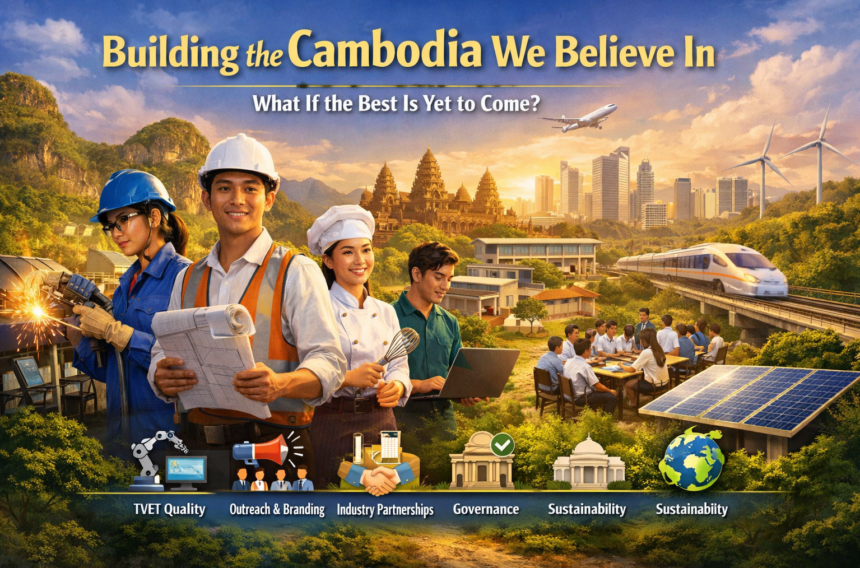
The roadmap is built on five strategic pillars, each one targeting a real, human challenge that stands between a Cambodian and the career they deserve:
- Strengthening TVET Quality. Modernizing training centers, empowering teachers, and designing courses built around the industries of today and tomorrow, including green economy jobs and Industry 4.0 technologies
- Enhancing Branding and Outreach. Flipping the narrative so that vocational training is seen not as a consolation prize, but as a launchpad; actively reaching women, rural youth, and those who have historically been overlooked
- Industry-Relevant TVET. Pulling real businesses into the classroom, so that the gap between “what schools teach” and “what jobs need” closes permanently
- Governance and Leadership. Creating a system that is honest, transparent, and data-driven; one that checks its own progress every quarter and isn’t afraid to adjust
- Funding and Sustainability. Diversifying investment so this movement outlasts any single budget cycle, drawing in NGOs, international partners, and the private sector as true co-investors in Cambodia’s human capital
These five pillars don’t stand alone. They lean on each other, by design. That’s what makes this different from programs that looked good on paper but fell apart in practice.
The People This Is Really For
Numbers and pillars are important. But the soul of this roadmap lives in the people it is designed to reach.
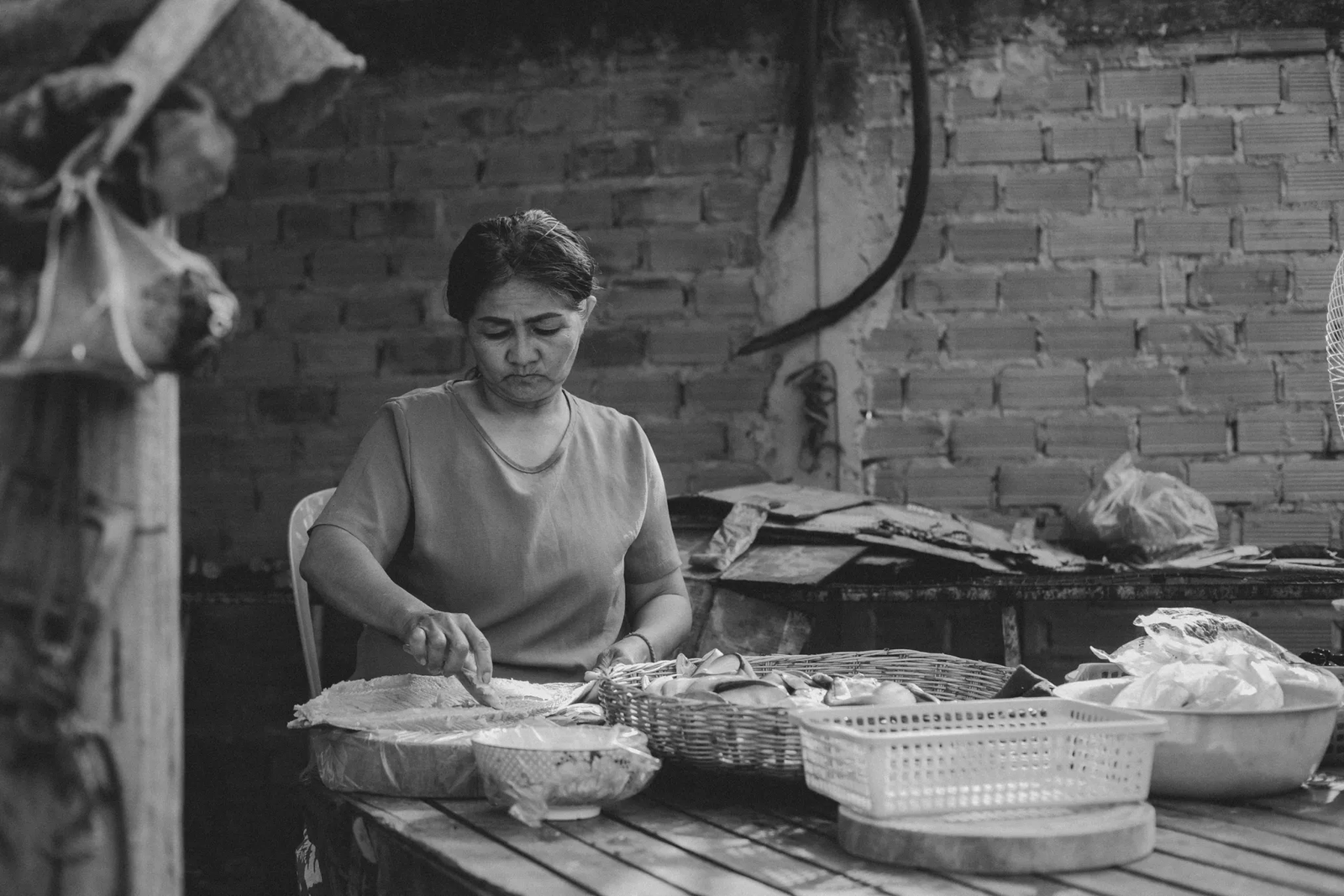
The 19-year-old in Kampong Cham who wants to be an electrician but has no training center nearby, she is in this plan. The factory worker in Kandal, who has been doing the same job for eight years and wants to move up, is in this plan. The young woman with a disability in a rural district who has never been offered a structured skills program, she is in this plan too.
The roadmap’s insistence on inclusiveness is not a footnote. It is a feature.
Apprenticeship programs, provincial counseling centers, flexible modular training that fits real lives, all of it is designed around the simple belief that no one gets left behind.
A Bridge Across Three Decades
This roadmap is not the final destination; it is a deliberate bridge toward Cambodia’s Vision 2030 and 2050, when the country aims to stand among high-income nations. The architecture is precise: 26 concrete goals, 27 key performance indicators, and 75 specific interventions, every one of them tracked, reported, and reviewed.
The National Training Board will check progress quarterly and annually, recalibrating where needed. This is not a plan that gets signed, framed, and forgotten. It is a living commitment, held accountable by design.
Why This Series Exists
Over the next five episodes, we go deeper, one pillar at a time, one story at a time. We will meet the teachers being retrained, the industries becoming classroom partners, the young entrepreneurs discovering that their best idea was always inside them, and the communities that are quietly being transformed, one certified skill at a time.
Cambodia has already proven to the world that it can endure anything.
Now it is proving something even more powerful, that it can build something extraordinary, on purpose, for everyone.
The Cambodia we believe in isn’t a dream. It’s a roadmap. And it’s already underway.
Next — Episode 2: “The Quality Revolution: How Cambodia Is Reinventing What It Means to Teach and to Learn”