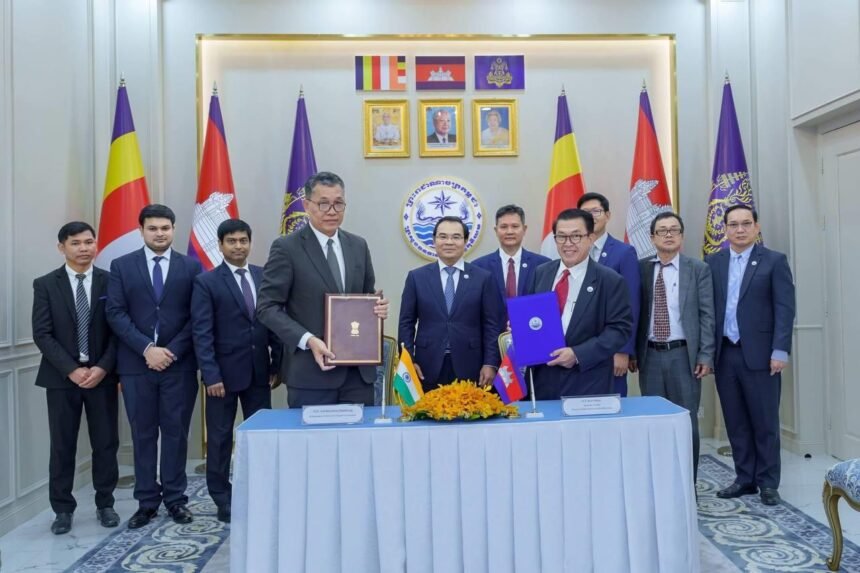
PHNOM PENH, Cambodia — In a strategic move to enhance climate resilience in Cambodia’s primary tourism gateway, the Government of India and the Royal Government of Cambodia signed a Memorandum of Understanding (MoU) on Monday, February 2, 2026. The agreement facilitates a Quick Impact Project (QIP) aimed at “Enhancing Weather and Climate Monitoring Capacity” in Siem Reap Province.
The MoU was signed by H.E. Vanlalvawna Bawitlung, Ambassador of India to Cambodia, and H.E. Bun Hean, Secretary of State for the Ministry of Water Resources and Meteorology (MOWRAM), in the presence of Minister H.E. Thor Chetha. This initiative further solidifies the India and Cambodia strengthen cooperation in trade, security, and heritage efforts that have defined recent bilateral relations.
Modernizing Meteorological Infrastructure in Siem Reap
As extreme weather and regional connectivity become central themes for Southeast Asian policymakers in 2026, this project provides Cambodia with the technical tools necessary for high-precision environmental tracking. The initiative is funded by India with a grant of approximately $99,255.
Key Technical Deliverables:
- Automatic Weather Stations (AWS): Installation of two state-of-the-art stations located in Puok District and Siem Reap town.
- Lightning Detection Sensors: Integration of advanced sensors to mitigate the risks of lightning strikes, a critical concern for the region’s open-air heritage sites.
- Capacity Building: A comprehensive technical training program for Cambodian meteorological personnel, reflecting the growing role of technology in Cambodia’s development.
Impact on Tourism, Heritage, and Agriculture
Siem Reap serves as the custodian of the Angkor Wat temple complex and is a vital economic hub. The deployment of real-time monitoring systems is expected to have a multi-sectoral impact:
- Safety for Visitors: Real-time early warning systems will provide crucial alerts for millions of tourists. This aligns with Cambodia’s shift toward sustainable tourism practices and improved visitor management.
- Agricultural Security: Local farmers will gain access to precise district-level data. Such innovations in agriculture are essential for protecting livelihoods against unpredictable monsoons.
- Heritage Preservation: Improved climate data assists in monitoring environmental factors that affect ancient stone structures, supporting the national goal of preserving Cambodia’s natural and cultural heritage.
India’s ‘Act East’ and Mekong–Ganga Cooperation
This project is the latest milestone under India’s Act East Policy, which continues to foster deep sustainable development in the Mekong countries. India currently implements 10 Quick Impact Projects annually in Cambodia, recently completing similar social infrastructure such as the new science library in Ratanak Mondul.
Quick Impact Projects (QIP) at a Glance:
| Status | Project Count |
| Total Sanctioned | 68 |
| Successfully Completed | 49 |
| Currently Under Implementation | 19 |
The partnership underscores India’s role as a key development ally, focusing on projects that yield high visibility and immediate benefits for local populations while supporting Cambodia’s journey toward a clean and real economy.