A Small University Project Reflects a Much Bigger Story for Cambodia
In a country increasingly looking to add more value to its agricultural sector, a group of Cambodian university students and researchers may have quietly created something far bigger than a new beverage.
At the Agricultural and Nutrition Research Center of Preak Leap National Institute of Agriculture, young Cambodian researchers have developed a locally made cashew milk product using Cambodian-grown cashew nuts. The product, now being test-marketed in Phnom Penh, reflects a growing movement inside Cambodia’s education and agricultural sectors — one that is focused not just on growing crops, but on transforming them into higher-value products made proudly inside the Kingdom.
For many years, Cambodia’s agricultural success was largely measured by how much raw produce the country exported. Today, however, a new generation of Cambodian students, researchers, entrepreneurs, and policymakers is beginning to ask a different question: How can Cambodia keep more value inside the country itself?
The Khmer cashew milk project offers one possible answer.
Cambodian Students Turn Local Cashews Into a Consumer Product
The cashew milk was researched and developed by students and researchers at the Agricultural and Nutrition Research Center of Preak Leap National Institute of Agriculture with financial and technical support from Dr. Thun Vathana, Second Vice President of the Senate, alongside support from the university.
The product is currently being sold on a trial basis at Farm Kafe Prek Leap and the National University of Management while awaiting official registration.
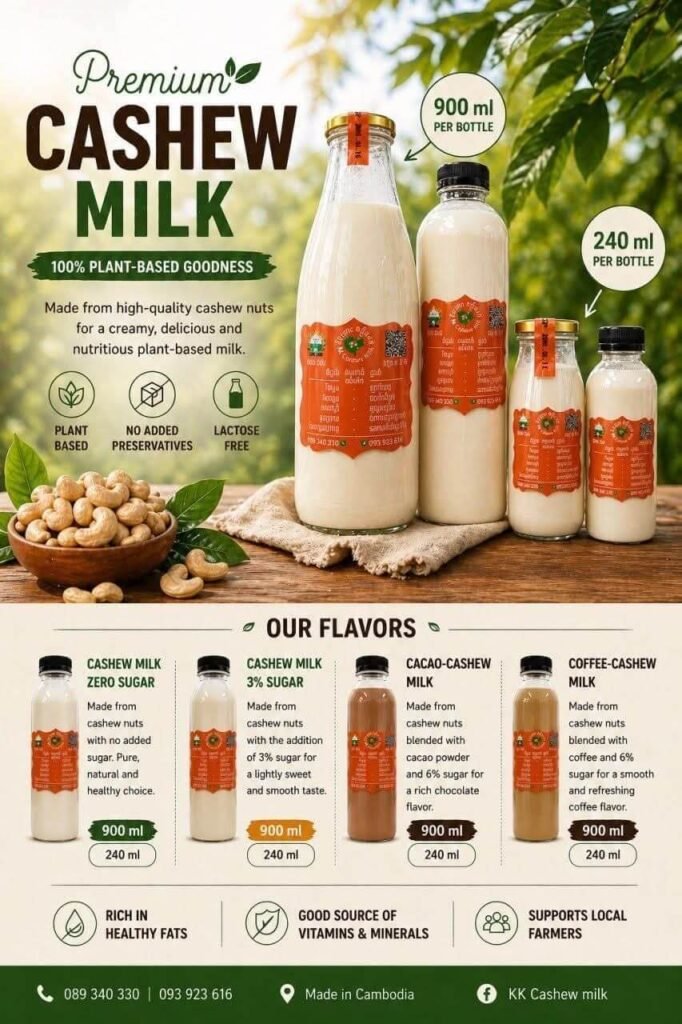
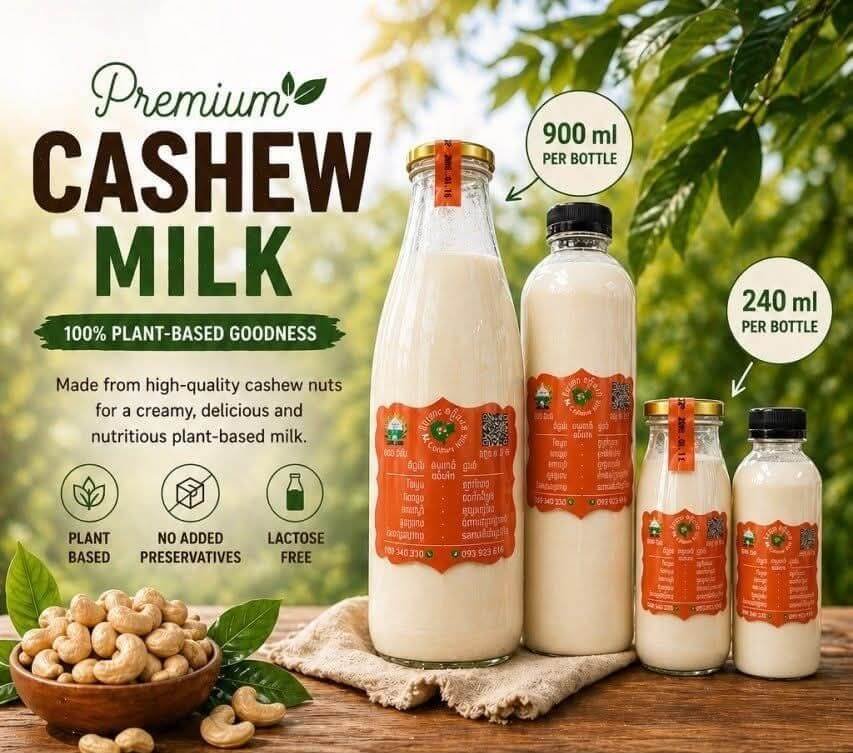
Made entirely from Cambodian cashews without preservatives, the milk is available in four flavors: unsweetened cream, sweetened, cocoa, and cashew latte.
Researchers involved in the project say the beverage was created not only as a healthier plant-based alternative, but also as a way to showcase the potential of Cambodian agricultural products when combined with research, innovation, and local food processing.
The team highlighted several nutritional benefits associated with cashews, including support for heart health, brain function, and bone strength. They also noted that the product may be suitable for elderly consumers and people who are unable to consume dairy milk.
What makes the initiative particularly meaningful is that it has been developed locally by Cambodian students and researchers using Cambodian ingredients for Cambodian consumers.
That sense of local ownership matters.
In many developing agricultural economies, raw crops are exported abroad, processed elsewhere, and then sometimes re-imported as finished consumer goods at significantly higher prices. Cambodia, like many countries rich in agricultural resources, has long faced that challenge.
Projects like this suggest the country may slowly be beginning to change that pattern.
Cambodia’s Cashew Industry Is Growing Rapidly
The timing of the initiative is important because Cambodia’s cashew sector has been expanding at remarkable speed.
Today, Cambodia is recognized as the world’s second-largest cashew grower, producing nearly one million tonnes of raw cashew nuts annually. Across provinces such as Kampong Thom, Kratie, Mondulkiri, Ratanakiri, and Preah Vihear, cashew farming has become an increasingly important source of income for rural communities.
Industry estimates show that Cambodia generated approximately US$1.5 billion from cashew exports in 2025, marking a 27 percent increase compared to 2024.
Yet despite these impressive numbers, much of Cambodia’s cashew production still leaves the country in raw form.
That means a significant portion of the higher-value activities — processing, packaging, branding, manufacturing, and retailing — often happens elsewhere.
For Cambodia, this creates both a challenge and an enormous opportunity.
Agricultural experts have long argued that countries earn far greater economic benefits when they process and manufacture products locally rather than exporting raw commodities alone. The difference between selling raw cashews and selling finished consumer products made from cashews can be substantial.
This is why projects such as Khmer cashew milk are attracting attention far beyond university laboratories.
Why Value-Added Agriculture Matters
Value-added agriculture is not simply about producing new products. It is about creating stronger local industries, higher-skilled jobs, and more resilient economies.
When agricultural goods are processed domestically, countries often create opportunities across an entire ecosystem — from food science and manufacturing to logistics, branding, retail, and exports.
For Cambodian farmers, stronger domestic processing industries could eventually create more stable demand and potentially better long-term earning opportunities.
For consumers, locally produced food products can help reduce dependence on imports while supporting homegrown businesses.
For students and researchers, it creates an environment where innovation has visible economic and social impact.
Cambodia’s government and private sector have increasingly emphasized agro-industrial development in recent years. There has been growing encouragement for investments in food processing, local manufacturing, agricultural technology, and innovation-led industries.
The cashew milk initiative fits naturally into that broader national direction.
Cambodian Youth Are Becoming Part of the Country’s Economic Transformation
One of the most encouraging aspects of the project is the role played by young Cambodians themselves.
Across Cambodia, universities are increasingly becoming spaces where students are experimenting with practical solutions connected to agriculture, nutrition, sustainability, and local manufacturing.
This represents a meaningful shift.
For years, many people associated innovation primarily with foreign companies or imported technologies. Today, however, Cambodian students are increasingly participating in research and product development that directly connects to the country’s own natural resources and market opportunities.
The students behind the cashew milk project are part of a generation growing up in a Cambodia that is changing rapidly.
They are more connected to global trends, more exposed to entrepreneurship and technology, and increasingly aware that agriculture can extend far beyond farming alone.
Agriculture today includes branding, processing, packaging, food science, health products, digital marketing, and export development.
The ability to combine agriculture with innovation may become one of Cambodia’s most important economic strengths over the coming decade.
Cambodia Could Become More Than a Raw Cashew Exporter
Globally, demand for plant-based food products continues to rise steadily.
Consumers around the world are increasingly looking for dairy alternatives, healthier beverages, natural ingredients, and sustainable food products. Cashew milk is part of that broader trend.
While countries such as the United States, Australia, and parts of Europe have already seen strong growth in plant-based beverages, Southeast Asia is also becoming an increasingly important market.
Cambodia may be particularly well positioned to benefit from this shift because of its abundant cashew production.
Industry observers believe the Kingdom has the potential to grow not only as a major exporter of raw cashews, but also as a producer of premium cashew-based products including beverages, snacks, cooking oils, nut butters, health foods, and specialty consumer brands.
That transition will not happen overnight.
Building globally competitive food-processing industries requires investment, quality standards, research capabilities, supply chain development, branding expertise, and regulatory support.
But every industry begins somewhere.
And often, meaningful change starts with small research projects that eventually inspire larger commercial ecosystems.
Building Confidence in Cambodian-Made Products
There is also something psychologically important about products like Khmer cashew milk.
They help build confidence in the idea that Cambodia can produce sophisticated consumer goods locally rather than relying entirely on imports.
That confidence matters for young entrepreneurs, students, manufacturers, and consumers alike.
For years, Cambodia has been known internationally for its agricultural potential. Increasingly, the country now wants to be known for what it can create from that potential.
This includes not only growing world-class crops, but transforming them into finished products with Cambodian identity and Cambodian value creation attached to them.
The cashew milk initiative reflects that ambition in a very tangible way.
A Glimpse Into Cambodia’s Agricultural Future
Today, the product is still in its early stages, being tested in local markets while awaiting official registration.
But its significance goes beyond a single beverage.
It represents the growing intersection between Cambodian education, agriculture, innovation, and manufacturing. It highlights what can happen when universities, researchers, and young people are encouraged to experiment with local resources and real-world market opportunities.
Most importantly, it reflects a country beginning to move further up the agricultural value chain.
Cambodia already has the land, the farmers, and the raw materials. Increasingly, it is also developing the researchers, innovators, and entrepreneurs needed to transform those resources into higher-value industries.
Small innovations developed inside Cambodian universities today may one day help shape the future of the Kingdom’s food-processing economy — creating new industries, stronger local brands, and greater opportunities for the next generation of Cambodians.