Cambodia has launched a landmark five-year initiative to build a nationwide multi-hazard early warning system, as officials warn that unchecked climate change could shrink the country’s gross domestic product (GDP) by up to 10 per cent by 2050. The “Advancing Early Warning for All” (EW4ALL) project — funded by the Green Climate Fund (GCF) and co-led by the United Nations Development Programme (UNDP) — was formally unveiled in Siem Reap on 2–3 June 2026.
- Why Cambodia Needs Stronger Disaster Early Warning Systems
- What Is the EW4ALL Project and Who Is Behind It?
- Key Features of the New Early Warning Programme
- Four Provinces Prioritised for Initial Implementation
- Government and International Partners Speak at the Siem Reap Launch
- Alignment with Cambodia’s National Climate Commitments
- Significance for Southeast Asia’s Climate Agenda
- Frequently Asked Questions
Why Cambodia Needs Stronger Disaster Early Warning Systems
Cambodia has long ranked among the world’s most climate-vulnerable nations. According to the 2020 Global Climate Risk Index, the Kingdom placed 12th globally among countries most exposed to climate-related impacts. Rising temperatures, erratic monsoons, flash floods, prolonged droughts and increasingly intense storms threaten agriculture, food security and the livelihoods of millions, particularly in rural communities far from major urban centres.
The consequences are measurable. Around 15 per cent of Cambodia’s total population and 16 per cent of its agricultural land sit within flood-prone zones. Without intervention, climate models project that by 2040, roughly 180,000 additional people will be at risk from extreme river flooding every year.
Existing infrastructure has struggled to close the gap between meteorological forecasting and community-level action. While national agencies can generate predictions, translating those warnings into timely, understandable and actionable information for remote villages — many of which house Indigenous peoples, persons with disabilities and other marginalised groups — has remained a persistent challenge.
Cambodia’s broader climate resilience ambitions are outlined in the country’s long-term development blueprint, which identifies green economic development and climate resilience as core pillars of sustainable growth.
What Is the EW4ALL Project and Who Is Behind It?
The EW4ALL project is a five-year programme running from 2026 to 2030. It is led by three Cambodian government institutions — the National Committee for Disaster Management (NCDM), the Ministry of Environment and the Ministry of Water Resources and Meteorology — and implemented in partnership with UNDP Cambodia with financing from the GCF.
Cambodia is one of only seven countries selected worldwide to participate in the broader UN Secretary-General’s Early Warnings for All campaign, alongside Antigua and Barbuda, Chad, Ecuador, Ethiopia, Fiji and Somalia. The campaign’s goal is to ensure every person on Earth is protected by an effective early warning system by 2027.
The initiative builds directly on Cambodia’s national Early Warnings for All roadmap, which the government launched in November 2025 to set out a structured strategy for advancing disaster warning capabilities across the Kingdom.
Key Features of the New Early Warning Programme
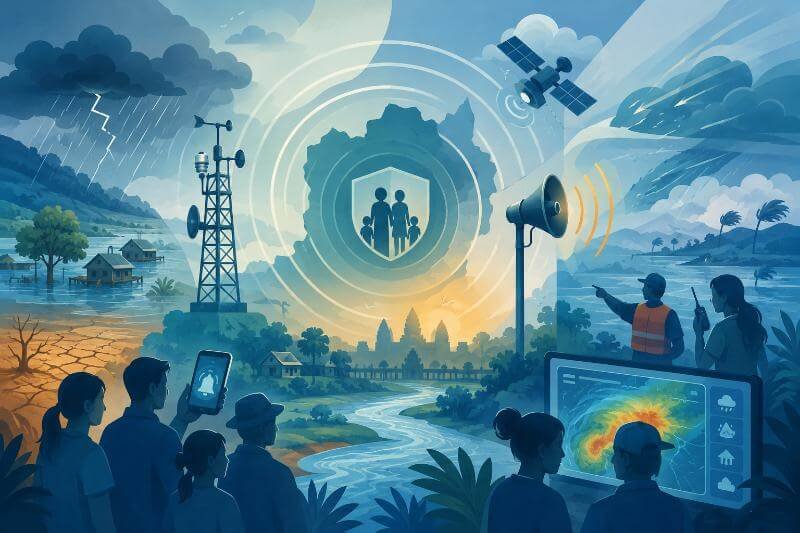
The project is designed around what disaster management experts call an “end-to-end” approach — meaning it addresses every link in the warning chain rather than just one component. According to UNDP Cambodia, the programme will focus on five interconnected areas.
First, hazard monitoring: expanding and modernising the networks of weather stations, river gauges and remote sensing instruments that feed real-time data into national forecasting systems. Second, weather and climate forecasting: upgrading the modelling capabilities of the Ministry of Water Resources and Meteorology so predictions become faster and more localised. Third, warning dissemination: building reliable channels — including mobile, radio and community loudspeaker systems — to deliver alerts to the last mile. Fourth, risk communication: ensuring that warnings are produced in local languages, accessible formats and culturally appropriate content so that communities can act on them. Fifth, community preparedness: training local leaders and vulnerable groups to understand warnings and respond appropriately before disasters strike.
Four Provinces Prioritised for Initial Implementation
Implementation will first target four provinces identified as highly vulnerable to climate-related hazards: Ratanakiri, Kratie, Stung Treng and Banteay Meanchey. These provinces regularly experience severe flooding along Mekong tributaries, seasonal droughts and erratic rainfall patterns that disrupt rice cultivation and push communities into food insecurity.
The selection reflects a broader recognition that while Phnom Penh and larger urban centres have some adaptive infrastructure, provincial communities — particularly those in the northeast — face acute exposure with limited coping capacity. Indigenous communities in Ratanakiri, for example, depend heavily on forest-based livelihoods highly sensitive to both floods and droughts.
This geographic focus is consistent with Cambodia’s ambition to advance climate adaptation alongside broader economic growth, recognising that rural resilience is inseparable from national development.
Government and International Partners Speak at the Siem Reap Launch
NCDM First Vice-President Kun Kim framed the initiative as a strategic investment for the entire country. “The Royal Government of Cambodia acknowledges that strengthening the EW4ALL system is vital to protecting people’s lives, livelihoods and national development achievements from increasing climate risks and disasters,” he said at the Siem Reap ceremony. Kim confirmed that the NCDM, as lead institution for the national EW4ALL roadmap, would deepen coordination across ministries, local authorities and development partners to build a more effective multi-hazard warning architecture.
Hemant Mandal, GCF Regional Director for Asia Pacific, described the regional context driving investment. “Across Cambodia, communities are facing growing risks from floods, droughts and shifting rainfall patterns that affect livelihoods and food security,” he said. “Early warning systems are therefore essential for protecting lives, livelihoods and development gains.” Mandal added that stronger institutions and information systems would allow people to prepare before threats escalate into full disasters.
Environment Minister Eang Sophalleth noted the accelerating pattern of extreme events. “Timely and reliable early warning systems are essential to ensure that vulnerable communities can anticipate, prepare for and respond effectively to these hazards,” he said.
UNDP Resident Representative Enrico Gaveglia stressed the importance of coordination as development finance globally becomes more fragmented. “Through the EW4ALL initiative, UNDP will focus on maximising investments of national institutions and partners to ensure that timely, accurate and actionable early warnings reach every person in Cambodia,” he said.
Professor Oeurng Chantha, Undersecretary of State at the Ministry of Water Resources and Meteorology, outlined the technical dimension. “Reliable early warnings reaching communities across the four target provinces will enable better preparedness, reduce risks and support climate-resilient development for Cambodia,” he said, pointing to plans to modernise weather observation networks and expand forecasting capacity.
Alignment with Cambodia’s National Climate Commitments
The EW4ALL project is positioned as a delivery mechanism for several of Cambodia’s existing climate policy frameworks. These include the Cambodia Climate Change Strategic Plan 2024–2033, the updated Nationally Determined Contribution (NDC) submitted to the UNFCCC in 2025 and the country’s Long-Term Strategy for Carbon Neutrality 2050.
On the clean energy side, Cambodia has already signalled its commitment to a lower-carbon future: the government’s approval of six clean-energy plants, spanning solar projects across Prey Veng, Pursat, Svay Rieng and Kampong Chhnang provinces and hydropower in Koh Kong, demonstrates that mitigation and adaptation are advancing in parallel.
The EW4ALL project also serves as a cost-effective complement to those investments: climate economists consistently find that every dollar spent on early warning systems saves between four and ten dollars in disaster losses, making such programmes among the highest-return climate investments available to developing nations.
Significance for Southeast Asia’s Climate Agenda
As climate pressures intensify across Southeast Asia, Cambodia’s participation in the global EW4ALL campaign carries regional significance. Many lower-income ASEAN nations face a similar paradox: improving forecast technology at the national level while struggling to ensure warnings reach those who most need them — smallholder farmers, fishing communities and ethnic minorities in border provinces.
Officials say the five-year timeline will allow for meaningful capacity-building at the community level, not just technology procurement. The programme’s emphasis on “last-mile” communication — ensuring messages are understandable, accessible and trusted by the people who receive them — reflects lessons from earlier disaster management efforts in the region where technical systems outpaced social infrastructure.
For Cambodia, where agriculture remains the backbone of rural livelihoods and where the Mekong basin’s hydrology is being reshaped by upstream dam construction and changing precipitation patterns, the stakes of getting early warning right extend well beyond disaster response. They reach into food sovereignty, rural poverty reduction and the long-term trajectory of a country working to move up the development ladder.
The success of the EW4ALL initiative — measured in warnings issued, communities reached and lives protected — may ultimately prove as consequential for Cambodia’s development story as any single infrastructure project or economic reform of this decade.
Frequently Asked Questions
What is the EW4ALL project in Cambodia?
The EW4ALL (Early Warnings for All) project is a five-year programme from 2026 to 2030, led by Cambodia’s NCDM with UNDP and funded by the Green Climate Fund. It aims to build an end-to-end multi-hazard early warning system — covering hazard monitoring, forecasting, warning dissemination, risk communication and community preparedness — across four highly vulnerable provinces: Ratanakiri, Kratie, Stung Treng and Banteay Meanchey.
How much could climate change cost Cambodia’s economy by 2050?
Government officials and development partners warn that unmitigated climate change could reduce Cambodia’s GDP by up to 10 per cent by 2050. A separate AI-powered disaster risk assessment puts the range at 3% to 9.4% of GDP, depending on the adaptation measures adopted.
Which provinces will the EW4ALL project target first?
The programme will initially focus on Ratanakiri, Kratie, Stung Treng and Banteay Meanchey — four provinces that frequently experience flooding, droughts and extreme weather events threatening agriculture, livelihoods and community infrastructure.
Is Cambodia the only country in the UN’s Early Warnings for All campaign?
No. Cambodia is one of seven countries selected globally, alongside Antigua and Barbuda, Chad, Ecuador, Ethiopia, Fiji and Somalia. The UN Secretary-General’s campaign aims to ensure every person on Earth is protected by an effective early warning system by 2027.
Who is funding Cambodia’s new early warning system?
The project is funded by the Green Climate Fund (GCF) and implemented in partnership with UNDP Cambodia. Government leadership comes from the NCDM, the Ministry of Environment and the Ministry of Water Resources and Meteorology.
For the full project overview, visit the UNDP Cambodia official website.