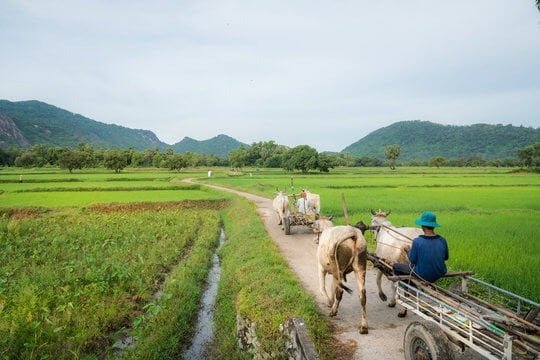
There is a quiet revolution happening in Cambodia’s countryside. Fields once known for local harvests are now feeding global markets, and investors are beginning to notice. The Kingdom’s agricultural story is no longer about survival or small-scale farming. It is about transformation, scaling, and ambition.
In 2024, agriculture made up roughly twenty-two percent of Cambodia’s GDP, earning close to 4.8 billion dollars from exports. Those numbers are impressive for a nation that has spent the last decade moving from subsistence farming to a more diversified, export-oriented economy. The change is visible everywhere. Farmers are using better irrigation, rural cooperatives are forming, and international buyers are lining up for Cambodian crops.
The New Face of Cambodian Agriculture
Travel through the fertile plains of Kampong Thom or the pepper farms of Kampot and you can sense the confidence. Young farmers are replacing old tools with new technology. They are connecting with export markets and learning what quality standards mean. Between January and September 2024, agricultural exports jumped by more than fifty percent compared to the same period a year earlier.
Such growth is not a coincidence. It reflects years of investment in better infrastructure, smarter farming, and government support. Cambodia’s agricultural sector is no longer a slow-moving rural industry. It has become one of the country’s most dynamic growth engines.
Why Investors Are Paying Attention
For investors, Cambodia offers something that is becoming rare in Southeast Asia: high potential combined with low saturation. Land is still affordable, labour is young and trainable, and the government has built a clear framework for foreign investment.
The country has joined several regional and bilateral trade agreements, including the Regional Comprehensive Economic Partnership and free trade pacts with China and Korea. Together they open access to more than two billion consumers. Cambodia’s natural advantage is just as strong. The soil is rich, rainfall is reliable, and the climate allows multiple harvests a year. That gives investors stability and room to scale up production.
Cashew: A Billion-Dollar Opening
Among all crops, cashew stands out as the quiet giant. In 2024, Cambodia exported around eight hundred thousand tonnes of raw cashew nuts worth over one billion US dollars. The surprising part is that almost all of it left the country unprocessed.
That gap between raw export and finished product is a golden opportunity. Investors who establish modern processing units for shelling, roasting and packaging could double the value of exported goods while creating local jobs. Demand for organic and fair-trade cashews is climbing fast, especially in Europe and North America. Cambodia has the climate and labour to meet it, but it needs investors to build the facilities.
Cassava and Sweet Potato: Building the Industrial Base
Cassava is the backbone of Cambodia’s farming landscape. The country produces well over fourteen million tonnes a year, much of which is used for animal feed and starch. Investors with experience in ethanol or food-grade starch can find strong margins here.
Sweet potato is another crop on the rise. With global consumption growing by about one percent every year and a market value above forty billion dollars, it fits perfectly with the world’s shift toward healthier food. Cambodian farmers already export to Thailand and the Netherlands, and more processing units could easily multiply those numbers.
Mango and Banana: Fruits with Global Appeal
Cambodian mangoes, especially the Keo Romeat variety, have developed a loyal following in China, Japan and Korea. Between 2017 and 2024 exports increased by more than two hundred percent. Investors are now setting up drying plants and snack factories to ride the global wave of healthy, natural fruit products.
Bananas tell a similar story. Over a five-year period exports rose by nearly two thousand percent, turning Cambodia into a notable supplier for China. Even during the pandemic, shipments kept increasing. That reliability is what international buyers look for.
Rice and Grains: Tradition Meets Modernisation
Rice remains Cambodia’s signature crop. The fragrant Phka Romduol variety has been recognised several times as one of the best-tasting in the world. In 2024, rice exports brought in nearly half a billion US dollars, while paddy rice added another one and a half billion.
What Cambodia now needs is modern milling, packaging, and branding. Too much of Cambodia’s premium rice finds its way onto other countries’ shelves. Investors who focus on brand development and distribution can help Cambodia claim its rightful place on global supermarket shelves.
Pepper and Spices: Small Volume, High Value
Kampot pepper has a story that sells itself. It is the only pepper in the world with a geographical indication that guarantees its origin. That exclusivity allows farmers to command premium prices in Europe and the United States.
The spice category, which includes chili and sesame, is also gaining ground. Exports to France, Canada, and Japan are steadily rising. These may be niche products, but their profit margins are often higher than large-scale commodities.
Dairy: Cambodia’s New Frontier
Dairy farming in Cambodia is still young but growing fast. Local producers of milk and yoghurt have already captured fifteen percent of the domestic market. The expanding middle class and the spread of modern retail chains are driving up demand. Investors who bring technology in cold-chain logistics or processing can shape this industry from the ground up.
A Strategic Location for Regional Trade
Geography works in Cambodia’s favour. It sits between two agricultural powerhouses, Thailand and Vietnam, and has easy access to both land and sea routes. The ports at Sihanoukville and Phnom Penh are expanding, and export procedures have become faster and more transparent.
Membership in regional trade frameworks ensures that Cambodian goods move through preferential tariffs to major Asian markets. For importers, that means reliability and cost efficiency. For investors, it means lower logistics risk and smoother export planning.
Opportunities for Investors and Importers
For investors, Cambodia offers a combination of affordability, openness and growth that is hard to find elsewhere. The government encourages partnerships in processing, logistics and agritech. Whether it is a rice-milling plant, a cashew-shelling facility or a fruit-drying factory, the incentives are in place.
Importers can also benefit directly. Cambodia provides a consistent supply of high-quality agricultural goods at competitive prices. By working with local cooperatives or processors, buyers can secure long-term contracts and help build sustainable value chains.
The Moment to Act
Cambodia’s agrifood transformation is still young, but the direction is clear. In just five years, the country has gone from exporting raw materials to aspiring toward full value-added production. The momentum is unmistakable and early movers stand to gain the most.
Agriculture has always been Cambodia’s backbone. Now it is becoming the bridge to a modern, export-driven future. Investors who step in today will not just earn returns, they will help write the next chapter of Cambodia’s growth story.
For anyone seeking a place where opportunity meets authenticity, Cambodia’s farms and fields are calling. The world is hungry for traceable, ethical and high-quality food. Cambodia is ready to deliver it