PHNOM PENH — Toyota Tsusho Manufacturing (Cambodia) has successfully achieved a monumental industrial milestone, officially launching the assembly and production of its next-generation pickup truck, the new Toyota Hilux Travo. Crucially, the entire model transition and production line operations were executed fully by skilled Cambodian engineers and technicians.
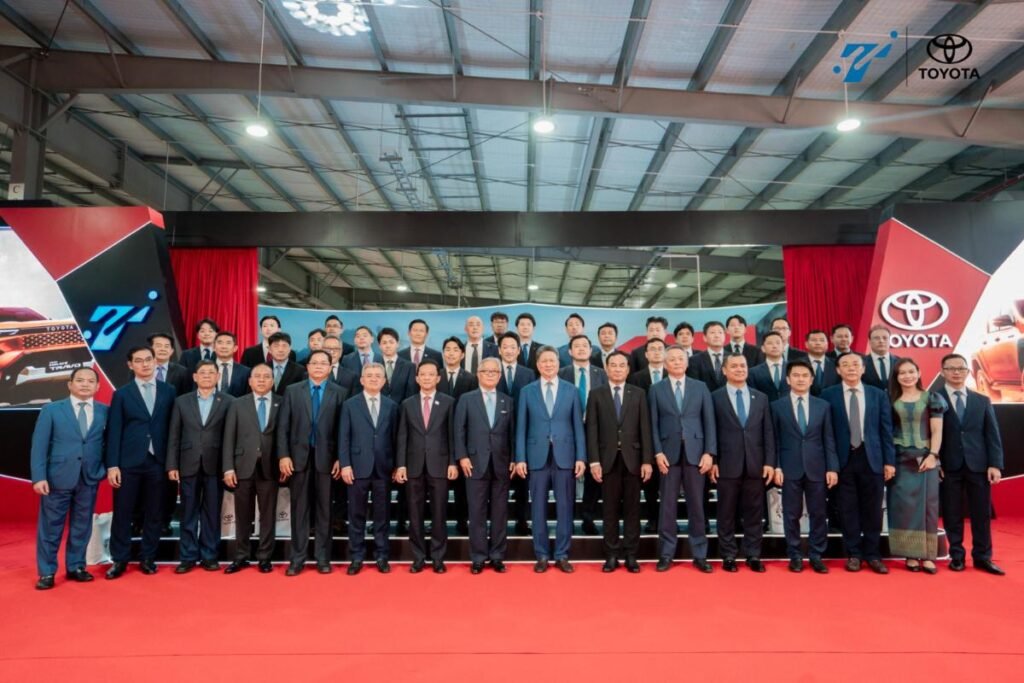
The high-profile inauguration ceremony took place on Thursday morning, July 2, 2026, at the state-of-the-art assembly plant located within the Royal Group Phnom Penh Special Economic Zone (PPSEZ), an industrial hub owned by Neak Oknha Kith Meng.

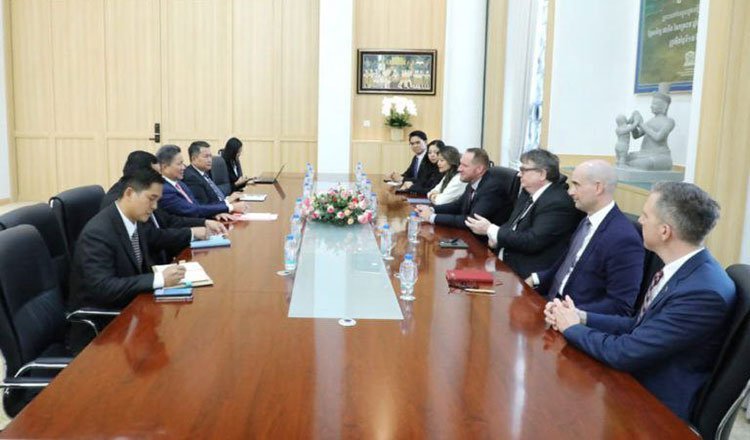
The landmark event was presided over by Deputy Prime Minister Sun Chanthol, First Vice Chairman of the Council for the Development of Cambodia (CDC), and Ueno Atsushi, the Ambassador of Japan to Cambodia. Other top attendees included Hem Vanndy, Minister of Industry, Science, Technology and Innovation, alongside key institutional officials and manufacturing executives.
National Workforce Masters Advanced Automotive Technology
The launch represents a profound technical evolution for the Kingdom’s industrial workforce. When Toyota first opened its Cambodian assembly plant in May 2024 under the presidency of Prime Minister Hun Manet, a team of roughly 20 Japanese experts was required to oversee production foundations and ensure strict adherence to safety standards.
However, with the transition to the new Hilux Travo, the dynamic shifted entirely. Only two to three Japanese experts were needed for final oversight, as the core manufacturing, calibration, and assembly pipelines were run independently by young Cambodian professionals.
Deputy Prime Minister Sun Chanthol highly commended this progress, stating that the successful deployment proves Cambodian laborers are fully capable of mastering advanced, heavy-duty automotive technologies when paired with structured training frameworks. He described Toyota’s footprint as a strategic investment model that goes far beyond a standard factory setup, acting as a crucial driver for:
- Ecosystem Development: Catalyzing a localized automotive value chain.
- Human Capital Training: Upgrading the technical capacity of the local workforce.
- Long-Term Economic Partnership: Reinforcing deep industrial connections between Japan and Cambodia.
Aligning with Cambodia’s National Automotive Policy 2024–2030
Minister Hem Vanndy emphasized that Toyota’s expanding vehicle lineup demonstrates robust corporate confidence in Cambodia’s political stability and investment climate. Furthermore, this operational milestone directly aligns with the Royal Government’s Pentagonal Strategy – Phase I and the National Automotive Development Policy 2024–2030. These long-term policies are specifically engineered to anchor Cambodia as a vital, integrated hub within the broader regional automotive supply chain.
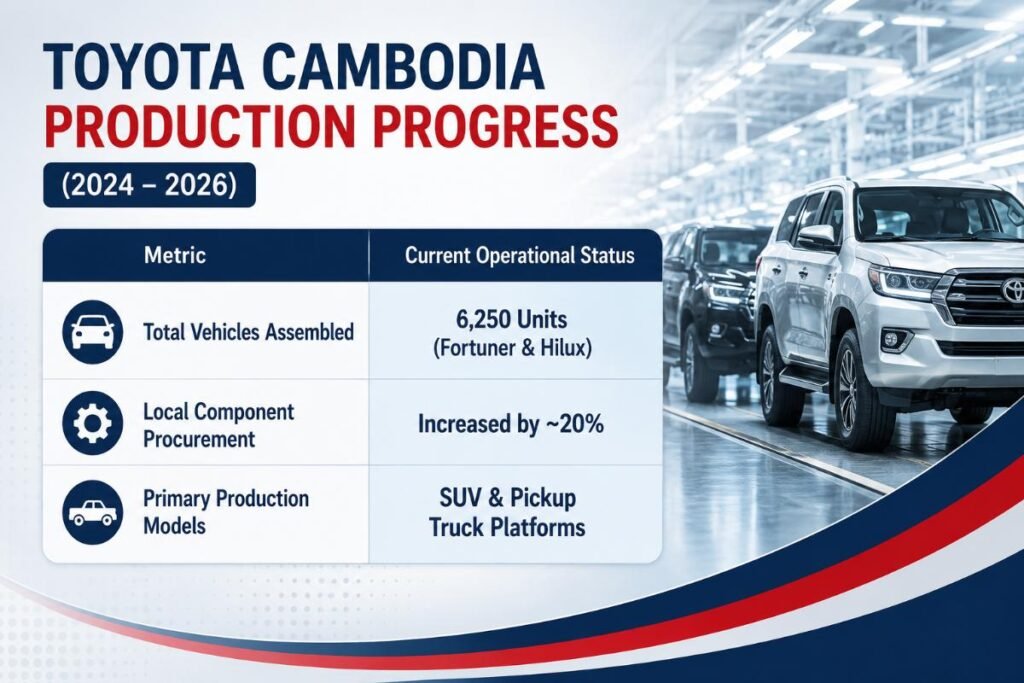
Since initiating operations slightly over two years ago, Toyota Tsusho Manufacturing has built a cumulative total of 6,250 vehicles in the country, maintaining steady output for both the Toyota Fortuner SUV and the standard Hilux pickup truck lines.
Boosting the Local Ecosystem and Domestic Value Addition
A major positive indicator for Cambodia’s manufacturing landscape is Toyota’s systemic effort to increase the procurement of locally sourced automotive parts and sub-components by approximately 20 percent. This shift is generating broader economic multipliers, fostering domestic value addition, and stimulating the growth of secondary supporting industries across the capital.
Guided by the corporate philosophy “From Our Hands, For Our Homeland,” Toyota Cambodia aims to scale its output further while establishing a complete automotive ecosystem. By supporting high-skilled local employment and creating vehicles engineered specifically for domestic road and terrain conditions, the newly introduced Hilux Travo is positioned to become an iconic symbol of Cambodia’s ongoing industrial modernization.