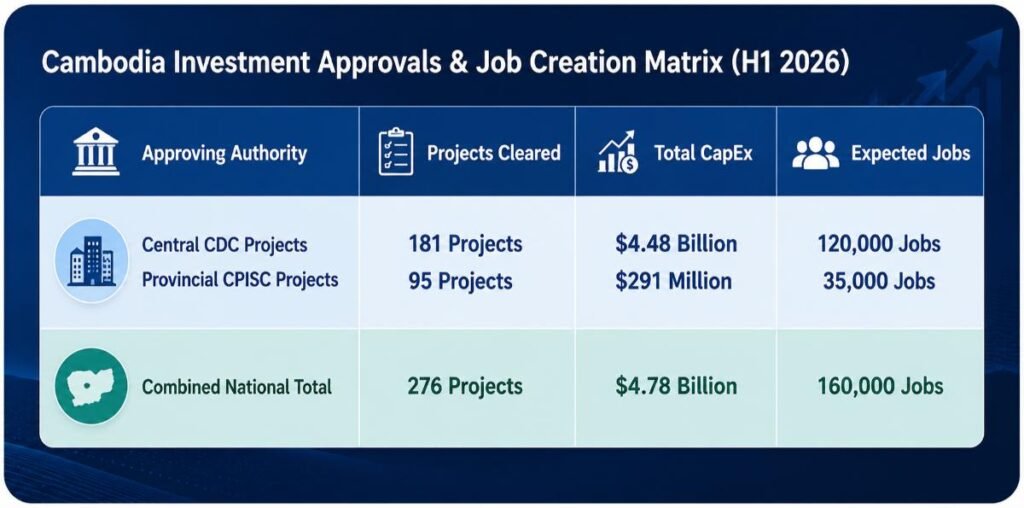
PHNOM PENH, CAMBODIA — Cambodia’s economic expansion has reached a major milestone. The country secured $4.7 billion in fixed-asset investment projects during the first half of 2026. According to an official press release issued by the Council for the Development of Cambodia (CDC), the government endorsed a total of 276 investment projects between January and June 2026.
This massive influx of capital is expected to generate approximately 160,000 new job opportunities across the country, accelerating Cambodia’s post-pandemic economic transition.
Dual-Tier Approval System Accelerates National Development
The successful registration of these 276 investment projects was managed through a coordinated effort between national and regional authorities. The projects were approved by both the central Council for the Development of Cambodia (CDC) and various Capital-Provincial Investment Sub-Committees (CPISCs).
The investment breakdown illustrates the scale of both large-scale industrial projects and smaller regional developments:
- The CDC (Central Level): Approved 181 projects representing $4.4 billion in investment capital. These core projects are projected to create 120,000 jobs.
- Outside Special Economic Zones (SEZs): 105 projects
- New SEZ Development: 7 projects
- Within Existing SEZs: 69 projects
- The CPISCs (Provincial Level): Registered 95 projects totaling $291 million in investment. These localized developments are projected to secure 35,000 jobs in outlying provinces.
Diversified Industries and Key Foreign Investors
The newly approved ventures span an incredibly diverse range of high-value sectors. Key industries targeted by the capital injection include:
- Green Energy: Development of wind, solar, and biomass power plants.
- Advanced Manufacturing: An electric vehicle (EV) assembly plant, a motorcycle factory, and a dedicated car tire manufacturing facility.
- Hospitality & Agriculture: A luxury five-star hotel and a modern animal farm.
Once again, China remains Cambodia’s top foreign investor, contributing 35.7% of the total registered investment capital. However, the country continues to successfully diversify its funding sources. Other leading origins of foreign direct investment (FDI) for H1 2026 include Singapore, Malaysia, the Netherlands, and the British Virgin Islands.
Trade Agreements Serving as Critical Drivers
Cambodian officials attribute this major investment surge directly to the country’s active participation in regional and bilateral trade frameworks. Penn Sovicheat, Secretary of State and Spokesperson for the Ministry of Commerce, emphasized that trade agreements are essential catalysts.
“The Regional Comprehensive Economic Partnership (RCEP) and Cambodia’s bilateral free trade agreements (FTAs) with China, South Korea, and the United Arab Emirates serve as critical drivers for foreign capital,” Sovicheat told Xinhua.
He added that these fresh investments are vital because they bring much-needed technology, capital, and sustainable career paths to the domestic workforce. With a strong regulatory environment and favorable tariff frameworks, Cambodia is quickly solidifying its status as a key industrial hub in Southeast Asia.
Also Read, PM Hun Manet Set for Strategic Working Visit to China