KAMPONG THOM — Japan’s Cooperation Center for Petroleum and Sustainable Energy (JCCP) and Top Planning Japan Co., Ltd. (TPJ) are exploring investment opportunities in cashew nut shell liquid (CNSL) extraction and biochar production in Cambodia.
The proposed initiatives aim to help Cambodia capture greater value from agricultural by-products and strengthen domestic processing capabilities.
Kampong Thom Demonstration Project
The investment framework was discussed during a meeting between Uon Silot, President of the Cashew Nut Association of Cambodia (CAC), and a Japanese delegation led by Dr. Kazuo Okamura at the CAC headquarters in Kampong Thom province.
Key elements of the pilot initiative include:
- Pilot Processing Facility: A demonstration extraction project is scheduled to begin operations at the Mirarth factory in Kampong Thom by December 2026.
- Second Domestic Facility: Upon implementation, the project would mark Cambodia’s second CNSL processing operation, following an existing medium-scale plant established by a Chinese enterprise in the province.
- Energy Security Applications: Researchers are studying potential fuel applications, including an 80% CNSL and 20% diesel blend as an alternative fuel source to lower reliance on imported petroleum.
Technological Efficiency and Value-Chain Upgrades
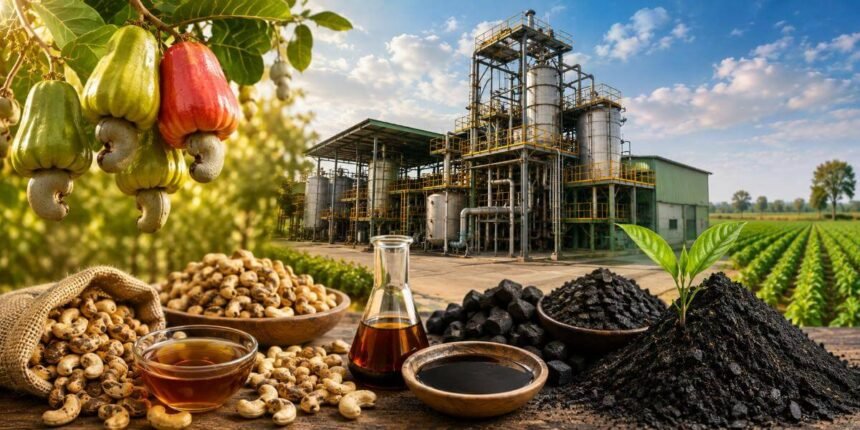
According to JCCP, the proprietary Japanese extraction technology operates across two processing stages, compared to conventional systems that require up to five stages. The compact design reduces electricity consumption, footprint requirements, and odor emissions.
Beyond liquid extraction, converting residual shells into agricultural biochar yields a product with up to 90% carbon content, significantly higher than the 50% carbon content found in rice-husk charcoal. When applied to farmland, cashew biochar enhances soil health, water retention, and nutrient absorption.
CAC President Uon Silot confirmed that three enterprises are currently planning domestic CNSL production—comprising Japan’s TPJ and two undisclosed Vietnamese firms—supporting the government’s broader strategy to transition the sector from raw nut exports to high-value agro-industrial processing.
Also Read, Cambodia Upgrades Regulatory Framework to Strengthen Business Climate and Foreign Investment