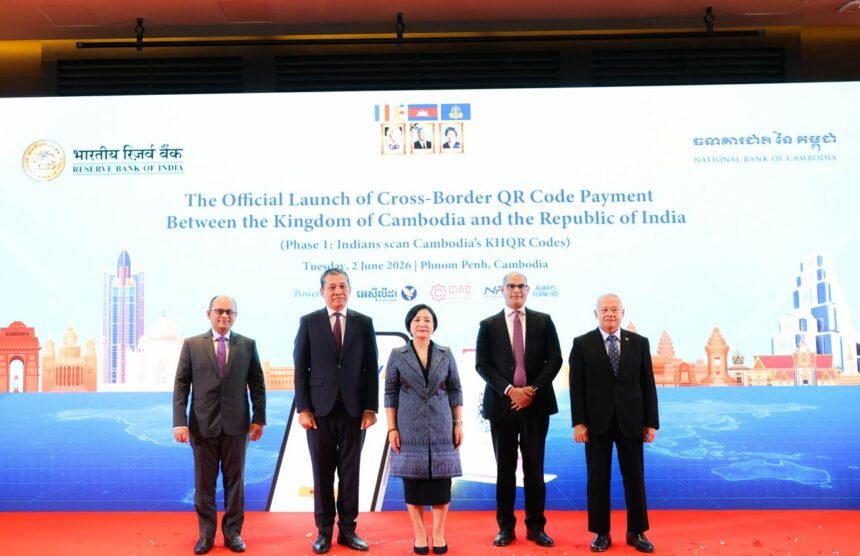
Indian tourists visiting Cambodia can now pay for goods and services using UPI-enabled apps — the same payment tools they use at home — following the official launch of Phase 1 of the Cambodia–India cross-border QR payment system on June 3, 2026.
- What Was Launched — and Why It Matters
- Quotes from Key Leaders
- A “Digital Corridor” Between Cambodia and India
- What This Means for Cambodian Merchants and Indian Visitors
- ACLEDA Bank: Cambodia’s Largest Commercial Bank by Deposits
- Broader Context: Cambodia’s Expanding Cross-Border Payment Network
- Frequently Asked Questions
The launch ceremony, held at the Rosewood Hotel in Phnom Penh, was presided over by H.E. Dr. Chea Serey, Governor of the National Bank of Cambodia, and a representative from the Reserve Bank of India, marking a significant milestone in the bilateral digital infrastructure between the two nations.
What Was Launched — and Why It Matters
ACLEDA Bank Plc., Cambodia’s first publicly listed commercial bank, in partnership with NPCI International Payments Limited (NIPL) — the overseas arm of India’s National Payments Corporation — has officially launched Phase 1 of the initiative, branded as “Indians Scan Cambodia’s KHQR Code.”
Under the new arrangement, Indian travellers can open any UPI (Unified Payments Interface)-enabled application — including PhonePe, Google Pay, Paytm, or any UPI-linked bank app — and scan merchant QR codes across ACLEDA’s nationwide KHQR merchant network. Payments are processed instantly, securely, and without requiring currency exchange at the point of sale.
The integration covers merchants across tourist destinations, restaurants, retail shops, and a wide range of other businesses throughout Cambodia.
Quotes from Key Leaders
Dr. In Channy, President & Group Managing Director of ACLEDA Bank, described the launch as a landmark in the bank’s digital transformation roadmap:
“By integrating the payment gateways of Cambodia and India, we are removing transactional friction and foreign exchange volatility for travellers. This synergy empowers local merchants by providing direct access to a high-velocity digital market, optimizing liquidity management, and enhancing operational throughput via secure, real-time settlement protocols.”
Ritesh Shukla, MD & CEO of NPCI International, said the initiative reflects India’s broader ambition to extend UPI’s reach to global markets:
“Enabling UPI acceptance in Cambodia marks a significant milestone in this journey. It ensures that Indian travellers enjoy a familiar, secure and seamless payment experience abroad, while Cambodian merchants gain access to millions of digital-first consumers.”
A “Digital Corridor” Between Cambodia and India
Officials described the integration not merely as a technical upgrade but as the establishment of a modern “Digital Corridor” between the two countries — one designed to strengthen tourism and trade links while reducing friction for everyday users on both sides.
ACLEDA Bank has offered cross-border QR payment services since 2020. This new India linkage is the latest expansion of that network, which already spans multiple ASEAN countries and partner nations.
Cambodia’s KHQR system, operated through the National Bank of Cambodia’s Bakong payment infrastructure, was introduced in 2022 to create a single universal QR code compatible with any mobile banking app operating within the Bakong network. The India integration builds on this foundation, connecting Cambodia’s payment ecosystem directly with UPI — the world’s largest retail fast-payment system by transaction volume.
This is especially significant given the rapidly growing number of Indian tourists visiting Southeast Asia. For Cambodian merchants, access to UPI means tapping into a user base that processes hundreds of millions of transactions daily.
What This Means for Cambodian Merchants and Indian Visitors
For Indian tourists, the change is immediate and practical: no need to carry large amounts of cash, locate currency exchange counters, or worry about whether foreign cards are accepted. Their UPI app works just as it does at home.
For Cambodian merchants already registered on the KHQR network, no additional hardware or setup is required. Their existing QR codes will now accept UPI payments from Indian visitors, expanding their potential customer base without any friction.
Phase 1 covers inbound payments — Indians scanning Cambodian KHQR codes. A subsequent phase is expected to enable Cambodian users to make outbound payments in India, completing the bilateral payment loop.
ACLEDA Bank: Cambodia’s Largest Commercial Bank by Deposits
As of March 2026, ACLEDA Bank holds US$11.85 billion in total assets and US$9.28 billion in total savings deposits, serving more than 6.20 million customers nationwide. The bank operates through more than 790,000 business partners and has nearly 4.89 million subscribers on its ACLEDA Super App.
The bank has four subsidiaries: ACLEDA University of Business Co., Ltd.; ACLEDA Securities Plc.; ACLEDA Bank Lao Ltd.; and ACLEDA MFI Myanmar Co., Ltd., along with a representative office in Myanmar.
Broader Context: Cambodia’s Expanding Cross-Border Payment Network
Cambodia has been steadily building out its cross-border payment infrastructure over the past several years. The country has existing QR payment integrations with Thailand (PromptPay), Vietnam, Laos, and China’s UnionPay, as well as Alipay+ — which covers over a dozen international payment apps across Asia and Europe.
The India–Cambodia corridor is the newest addition to this expanding network, and one of the most strategically significant, given the scale of India’s digital payments market and the rapid growth of Indian outbound tourism.
As we reported in early 2024, the groundwork for this launch had been in development for some time. Read our earlier coverage: Cambodia and India Set to Launch Cross-Border QR Payment System.
For further context on how Cambodia has been expanding digital payment access for international tourists, see our coverage of the Alipay+ integration: Cambodia Enhances Tourism Experience with Alipay+ QR Payment Integration.
For the latest on UPI’s international expansion, the Reserve Bank of India maintains updated information on cross-border payment connectivity initiatives.
Frequently Asked Questions
Can Indian tourists use Google Pay or PhonePe in Cambodia?
Yes. Any UPI-enabled app — including Google Pay, PhonePe, and bank-linked UPI apps — can now be used to scan KHQR merchant codes across Cambodia, following the ACLEDA–NPCI International cross-border payment launch in June 2026.
Do Cambodian merchants need to do anything to accept UPI payments from Indians?
No additional setup is required. Merchants already registered on the KHQR network will automatically be able to accept UPI payments from Indian travellers.
What is KHQR?
KHQR is Cambodia’s universal QR code payment standard, launched in 2022 by the National Bank of Cambodia and operated through the Bakong payment platform. It allows any Bakong-member mobile banking app to receive payments via a single QR code, simplifying transactions for both consumers and merchants.
Which organisations are running this cross-border payment initiative?
On the Cambodian side, ACLEDA Bank Plc. is the implementing bank. On the Indian side, NPCI International Payments Limited (NIPL) — the international arm of the National Payments Corporation of India — is the partner driving the integration.
Is this only for tourists, or can businesses use it too?
While Phase 1 is primarily aimed at enabling Indian tourists to make payments in Cambodia, the initiative is designed to also stimulate trade and business activity between the two countries over time.