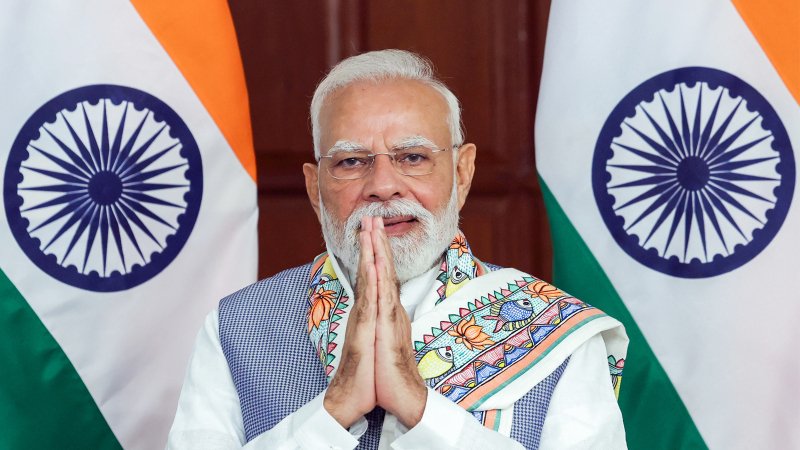
On 7 October 2026, Narendra Modi Ji completes 25 years since he first became the head of the government, when he took oath as the Chief Minister of Gujarat in 2001. Twenty-five years later, he continues to serve as the Prime Minister of India. For me, this milestone is an opportunity to look back at the journey of a person who has spent a large part of his life in public service.
Narendra Damodardas Modi was born on 17 September 1950 in Vadnagar, Gujarat, in a simple family. Rising from humble origins, he made his mark in the hearts of the people through his volunteer and community work, and later through his political work. He joined the Bharatiya Janata Party in 1987 and worked at various levels. These years of organizational work gave him the opportunity to travel widely, meet ordinary people and understand their aspirations and concerns.
His political life changed significantly in 2001, when he became the Chief Minister of Gujarat. He remained in that position for more than 12 years. Gujarat during those years saw major attention to roads, electricity, water, agriculture, industry and investment. His experience in Gujarat eventually took him to national politics. In 2014, Narendra Modi Ji became the Prime Minister of India after the BJP won a majority in the Lok Sabha. He was re-elected in 2019 and, following the 2024 general election, took oath for a third consecutive term. One phrase that became closely associated with his approach to governance was “Sabka Saath, Sabka Vikas, Sabka Vishwas, Sabka Prayas”, meaning collective effort and development with the participation and trust of all. Another phrase that has become part of his public message is “Viksit Bharat”, reflecting the vision of a developed India.
Digital India and a Changing India
One of the changes I find particularly interesting during this period is the way technology has become part of everyday life in India. When Digital India was launched in 2015, the objective was to make government services more accessible through technology. Over the years, digital payments, Aadhaar, online government services, Direct Benefit Transfers and platforms such as DigiLocker and UMANG have become part of daily life for millions of Indians. The growth of UPI has been particularly remarkable, making small and large digital payments simple and convenient. Modi Ji has often described technology as a tool for improving the “Ease of Living” of ordinary citizens. In 2026, reflecting on 11 years of Digital India, he said that technology had helped redefine governance, empower citizens and strengthen the foundation of a developed and self-reliant India. For me, Digital India is one of the clearest examples of how an idea that started as a government programme has become part of everyday Indian life.
Kashi: A Special Chapter
An important part of Narendra Modi Ji’s political journey has been his relationship with Kashi or Varanasi. He chose Varanasi as his parliamentary constituency in 2014 and has represented the city since then. Varanasi is not an ordinary Indian city. It is one of the world’s oldest living cities, where India’s ancient traditions and modern life exist side by side. Over the past decade, the city has seen major changes in roads, railway connectivity, airport facilities, tourism, healthcare, education, sanitation and urban infrastructure. The development of Kashi Vishwanath Corridor, improvements to the ghats, new roads and flyovers, railway projects and other public facilities have changed many parts of the city. What I find particularly interesting is the attempt to combine modern development with the preservation of Kashi’s cultural and spiritual identity.
India’s Growing Role in the World
Another important part of the last 25 years has been India’s growing presence on the global stage. As Prime Minister, Modi Ji has traveled extensively and developed relationships with countries across Asia, Europe, the Middle East, Africa and the USA. India’s role in the G20, the promotion of Yoga, the International Solar Alliance and India’s engagement with the Global South have all contributed to a more visible international role for the country. I also feel that India’s response to the needs of developing countries has become an important part of its international image. India has increasingly shared its experience in areas such as digital public infrastructure, healthcare, technology and development with countries of the Global South. Modi Ji has described India’s approach as one in which “Digital Public Infrastructure should be a bridge, not a barrier.” In recent years, he has also spoken of India not merely participating in the global order, but contributing to shaping it. His phrase “India First” has been used to describe the country’s foreign-policy approach, while his frequent message of Vasudhaiva Kutumbakam reflects India’s broader civilization outlook.
A Journey of Public Service
There are many slogans and phrases associated with Narendra Modi Ji’s public life. “Sabka Saath, Sabka Vikas”, “Make in India”, “Aatmanirbhar Bharat”, “Digital India”, “Viksit Bharat” and “One Earth, One Family, One Future” are some that have become familiar not only in India but also outside the country. But behind these slogans is a much longer journey. On completing 25 years as the head of the government, Modi Ji expressed his feelings in simple words: “To serve our beloved nation is the highest honour, a duty that fills me with gratitude and purpose.” For me, that is perhaps the most appropriate way to look at his 25 years of public life.
His journey is not only about elections or positions. It is also a story of India’s own transformation during the same period. India has become more connected, more digital and more confident in its engagement with the world. At the same time, its ancient traditions and cultural identity continue to remain an important part of its national character. Perhaps nowhere is this combination more visible than in Kashi, where ancient temples and ghats exist alongside new roads, digital services, modern infrastructure and growing tourism.
Looking Ahead
Twenty-five years of public service is a significant milestone for any political leader. For Narendra Modi Ji, it represents a journey from Vadnagar to Varanasi to Delhi, while India’s own journey has continued from a changing economy to a more digitally connected and globally engaged nation. As I reflect on these 25 years, I believe the most important part is not simply where the journey has reached, but where India goes from here. The aspirations of India’s young population, the strength of its democratic institutions, its technological capabilities, its cultural heritage and its growing relationship with the world will shape the coming decades. Narendra Modi Ji’s 25 years in public service therefore provide an opportunity not only to look back, but also to look forward. Whether viewed through the lens of political longevity or national transformation, the Modi era has undeniably redefined the rhythm of modern India, leaving an indelible blueprint for generations to come.
Also Read, Cambodia Advances 10-Year TVET Policy Amid Rising Demand for Skilled Workers