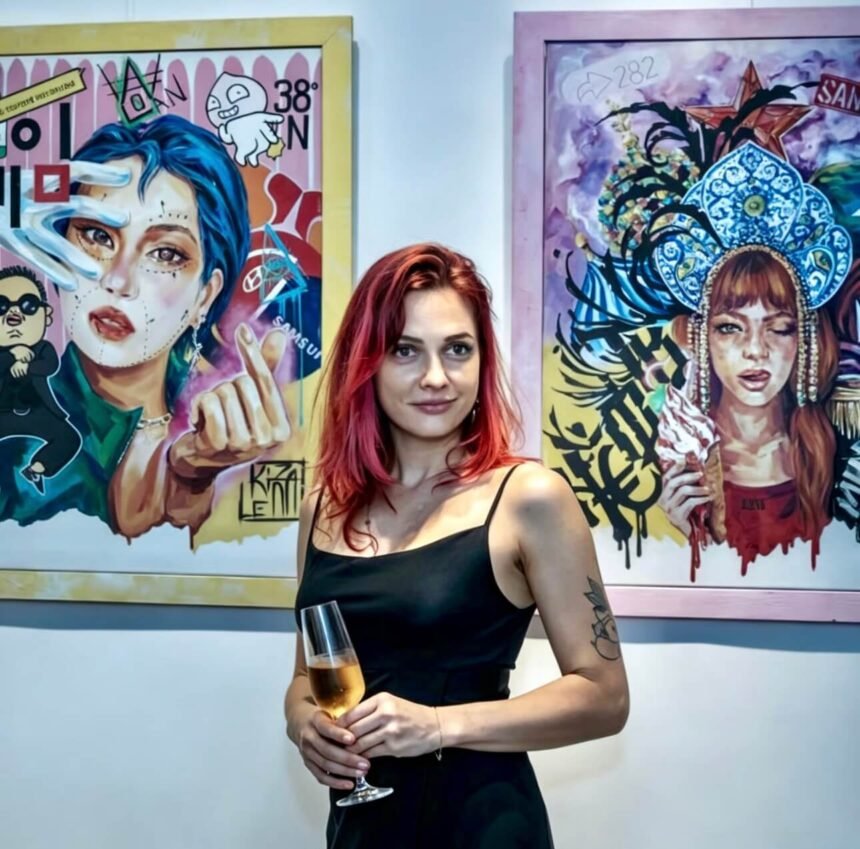
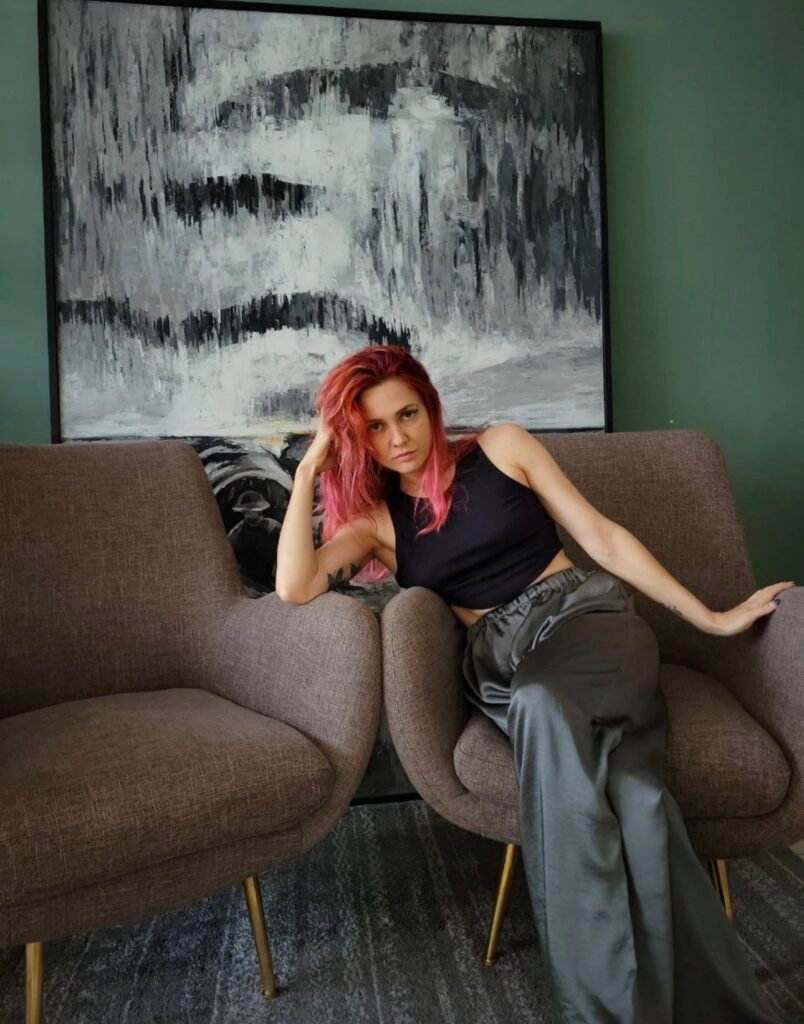
Some artists talk about “finding” art later in life. For Lena Kinza, it was never really a discovery, it was simply there from the beginning. Born in Russia and now based in Cambodia, she has built a life around images, symbols, and color, turning her personal story into a quiet but steady artistic voice.
- Growing up with art in the room
- A new life—and a new start—in Cambodia
- Bright colors, serious questions
- Symbols instead of speeches
- The quiet struggle behind the scenes
- A simple rule: get better every day
- Why Cambodia feels like the right place
- When painting becomes a way to heal
- Exhibitions, series, and tattoos
- Staying real in a market-driven art world
Lena works in many forms: paintings on canvas, large murals, and even tattoos. What connects all of these is not a single style, but a way of looking at the world. Her work is bright, layered, and often beautiful at first glance, but underneath the surface she is asking serious questions about modern life, honesty, and what it means to stay true to yourself.
Growing up with art in the room
Lena grew up in a creative home. Both of her parents worked in different creative fields, so imagination and making things were simply part of everyday life. As a child she was drawn to drawing in a very natural way. No one had to push her; she would pick up a pencil and stay absorbed for hours.
Today, when she looks at those early drawings, she still sees something “real” in them, an honesty that went beyond typical children’s sketches. That feeling of recognition matters to her. It is a reminder that even as a child she already had a certain way of seeing the world. Because of this, she says she always knew she wanted to dedicate her life to visual art, and she followed that intuition into years of formal training at art school and university.
But study came with a price. The discipline, the constant criticism, the pressure to perform, all of that slowly pushed her away from the simple pleasure of creating. After graduation she did something surprising: she stopped making art for a while. The love was still there, but the joy had been buried under expectations.
A new life—and a new start—in Cambodia
The turning point came when Lena moved to Cambodia. She did not arrive with a grand plan to “restart” her artistic career. Instead, the change in environment began to quietly shift her perspective. Cambodia’s cultural diversity, the mix of local and international communities, and the more relaxed social structures gave her a sense of mental space she had been missing.
Compared with the more rigid frameworks she knew from Europe, Cambodia felt more open and unfiltered. There was room to breathe, to observe, to simply live. In this space, her visual language slowly returned, not as an obligation, but as a natural response to what she was seeing around her.
She started with small works that reflected daily life and social structures. Over time, those pieces grew into larger paintings and then into murals on walls. As she painted more, ideas multiplied. Exhibitions and collaborations followed, including shows at venues such as Sra’Art Gallery and The Plantation in Phnom Penh.
Bright colors, serious questions
At first glance, many of Lena’s paintings are simply enjoyable to look at: strong colors, clean lines, clear shapes. But she is not interested in beauty for its own sake. She is deeply curious about where society is heading, how people are changing, and how we handle power, freedom, and truth in our everyday lives.
What makes her approach unusual is how she deals with heavy topics. She does not use horror, shock, or bleak imagery to talk about what worries her. Instead, she uses contrast. She wraps sharp social commentary in bright colors and appealing compositions. At first, the viewer enjoys the image; only later, if they take time to look more closely, do the questions and tensions begin to appear.
For Lena, this is important. She believes art should not only be seen but also thought about. A painting, for her, is not just a picture; it is a starting point for reflection.
Symbols instead of speeches
Lena often says that the real strength of art is that it does not rely on direct statements. She rarely wants to “explain” everything in words. Instead, she uses symbols and visual metaphors. Each painting becomes a kind of puzzle that the viewer is invited to solve in their own way.
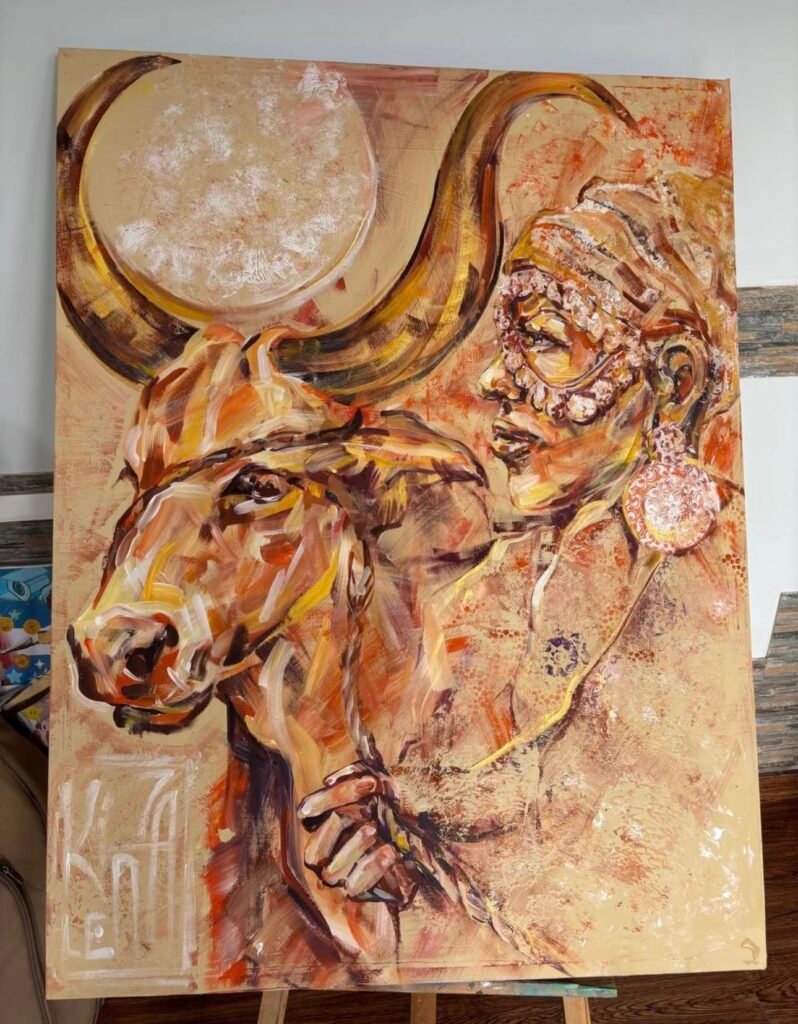
She knows different people will read these symbols differently. An art historian might think about references and context; someone with no art background might respond purely on feeling. She likes that. Both kinds of response are valid to her. Often, when she shares a few hints about what inspired a work, she sees people’s faces change. They realise that what they thought was just a decorative image actually carries a deeper story.
That moment when someone shifts from “it’s pretty” to “I want to understand this” is exactly the kind of connection she is looking for.
The quiet struggle behind the scenes
From the outside, an artist’s life can look romantic. From the inside, Lena describes it as a constant balancing act. On one side there is the creative impulse, the need to step beyond everyday reality and explore ideas, emotions, and images. On the other side there is the need to stay grounded: to pay attention to real life, to context, to practical limits.
Lena tries hard to keep both of these sides in view. She avoids disappearing into illusion but also protects the space she needs to create. This is one reason she tends to stand a little apart from intense networking or tightly knit art circles. In stereotype, she admits, she might seem “too rational” for an artist.
There is also the simple fact that being an artist today involves much more than making art. You have to present your work, find places to exhibit, explain your ideas, handle social media, and think about marketing. Lena is clear-eyed about this: it is very hard for one person to do all of these things at the same level. At some point, you have to decide where most of your energy will go.
A simple rule: get better every day
For Lena, the way through this complexity is a simple personal rule: every day, become a little better at what you do. It does not have to be a huge leap; even a small step is enough, as long as it is real. This idea shapes how she spends her time. As she focuses more on her work, she finds she has less interest in activities that feel superficial or unproductive.
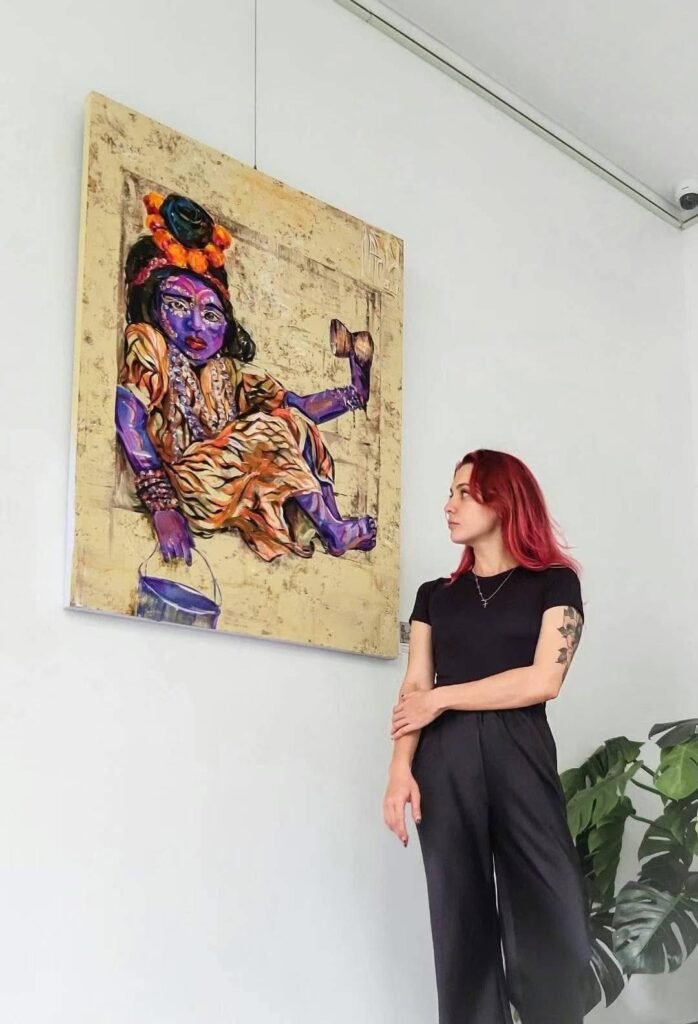
She often mentions Marina Abramović’s comment that for a true artist, art is not a choice, it is a necessity. Lena feels the same way. She does not “choose” art in the same sense that one might choose a job. She creates because not creating would feel like cutting off a part of herself.
Why Cambodia feels like the right place
Lena speaks about Cambodia with a kind of calm affection. She describes life there as vibrant and full of different perspectives. There is cultural diversity, an international community, and a general sense of openness that she finds very nurturing for creativity.
She contrasts this with many large, modern cities that feel disconnected from nature and driven mainly by material values. In such places, artists who lack the “right” connections or financial backing can struggle even to get their work seen. In Southeast Asia, and especially in Cambodia, she feels a different energy: more freedom to create, and more chances to be genuinely seen and heard as an artist.
She also emphasises how warm and welcoming Cambodia is toward foreigners. For her, this openness has made it easier to grow roots, to exchange ideas, and to build a meaningful life and career there.
When painting becomes a way to heal
One of the most powerful moments in Lena’s journey came not from success, but from loss. She has spent time studying psychotherapy and knew about art therapy in theory. Still, it was only after the death of a young person very close to her in Cambodia that she fully understood what it can mean.
In the middle of her grief, she suddenly felt an urge to paint his portrait. There was no plan, no concept, just a strong inner push. She completed the painting in a single day. Looking back, she sees that moment as the beginning of her healing. The pain that had been locked inside became something she could see and relate to from the outside an image that could “quietly look back” at her.
Later, her solo exhibition “apART” at Sra’Art Gallery in Phnom Penh was dedicated to his memory. The show invited others into that space, turning a personal story of loss and recovery into a shared experience.
Exhibitions, series, and tattoos
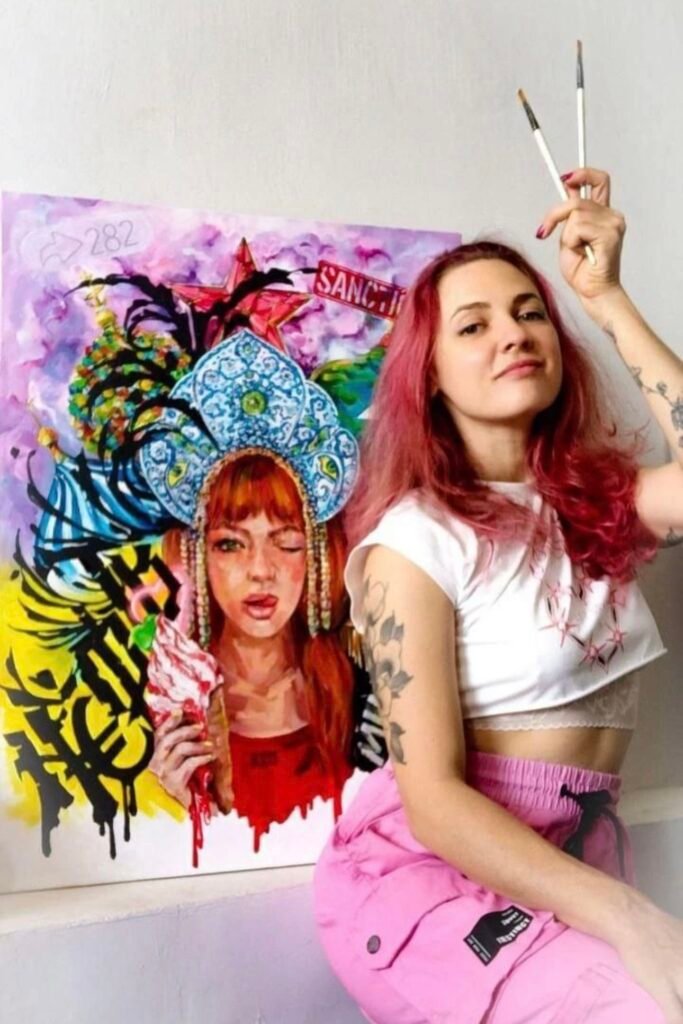
Over the past years, Lena’s work has appeared in several venues in Cambodia. Her exhibition “Resilient” at The Plantation presented her as a Russian artist with strong classical skills in acrylic and watercolor, as well as body art. Other series, like “Spirit of the Wild,” play with texture and light, building up layers of paint so that each surface catches light differently and adds depth to the image.
Outside the gallery space she paints murals and creates custom pieces, bringing her symbolic language into public and commercial spaces. She also works as a tattoo artist under the name “LENA KíNZA – TATTOO Cambodia,” translating her visual ideas into designs that people carry with them on their skin. Across all these forms, her focus stays the same: clear imagery, strong symbolism, and emotional honesty.
Staying real in a market-driven art world
Lena does not hide her worries about the direction the art world is taking. She sees more and more emphasis on “art for the market” works designed primarily to fit into branding, investment portfolios, or quick trends, sometimes at the expense of deeper meaning. She notes the rise of NFTs and the way certain primitive or purely sensational forms are pushed in mass media as signs of this shift.
Faced with this reality, she has made a conscious choice. She wants to remain among those artists who create from inner necessity, driven by the urge to say something real and to contribute to wider social conversations. If people remember her, she hopes it will be as someone who stayed real.
For Lena, the core value is freedom: freedom from lies, from the pressure to be politely insincere, from the need to fit into social frames that do not feel honest, and from the small self-deceptions that slowly erode integrity. She knows that this openness can sometimes make her seem “too direct,” but for her, authenticity is worth that risk. It is a difficult kind of freedom to live by, yet for Lena Kinza, it is the foundation on which both her life and her art are built.