

As Southeast Asian economies actively navigate shifting global trade dynamics, the Regional Comprehensive Economic Partnership (RCEP) has emerged as a stabilizing operational framework. Data from the first half of 2026 highlights this impact quite clearly, particularly along the trade corridor between Cambodia and Vietnam, where regional integration is translating directly into steady, measured growth.
Rather than relying on volatile global markets, both nations are leveraging the world’s largest free trade bloc to build a balanced, highly collaborative economic ecosystem.
The Mid-Year Statistical Reality
Official mid-2026 data from the General Department of Customs and Excise (GDCE) shows a notable upward trajectory in trade volume. Driven heavily by RCEP framework advantages, Cambodia’s total exports to RCEP partners climbed nearly 12% year-on-year to hit $5.63 billion in the first half of the year.
Sitting firmly at the top of that list is Vietnam, maintaining its position as Cambodia’s largest export destination within the trade bloc.
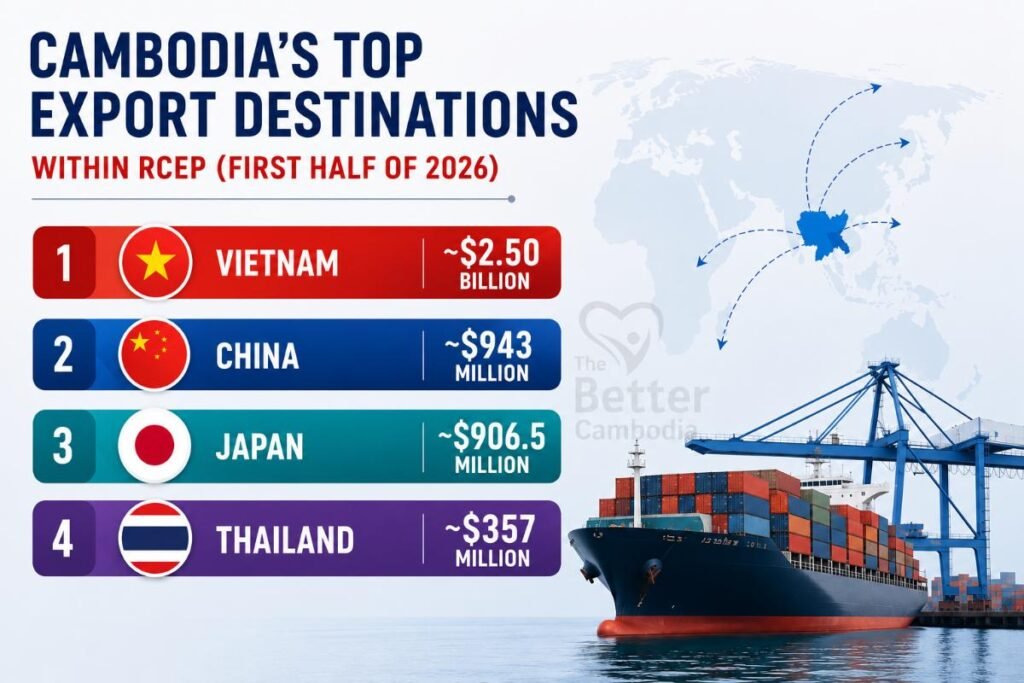
The Mechanics of Growth: Harmonized Rules of Origin
The steady expansion of this trade corridor is not accidental; it is built on specific regulatory mechanisms within the RCEP agreement. The two most critical drivers include:
- Tariff Reductions: Phased elimination of tariffs across agricultural and manufactured goods has dramatically lowered capital friction for cross-border businesses.
- Harmonized Rules of Origin: Historically, differing trade pacts required complex, fractured supply chains. RCEP allows Cambodian and Vietnamese manufacturers to count components sourced from any of the 15 member states as “domestic content”.
This single policy shift has turned Cambodia into an increasingly efficient assembly and light manufacturing hub. Raw materials and machinery components flow seamlessly from Vietnam and other regional partners into Cambodian special economic zones (SEZs), where they are finished and exported back into the bloc with minimal tariff penalties.
A Highly Complementary Trade Flow
The trade data reveals a mature, mutually beneficial exchange of resources rather than an aggressive competition. Cambodia’s primary exports southward consist heavily of raw agricultural goods like rice, rubber, and cashew nuts, which feed into Vietnam’s highly developed agro-processing and packaging sectors.
In return, Vietnam supplies vital industrial inputs—such as processed fuel, construction materials, and specialized machinery—that actively power Cambodia’s ongoing domestic infrastructure boom.
Also Read, Vietnam Earns Nearly $1 Billion from Pepper Exports in H1 2026
By embedding their supply chains deeply within one another, both nations are showing the rest of ASEAN how to successfully mitigate broader global supply chain disruptions. The data confirms that localized, regional cooperation under a unified regulatory framework is creating a reliable model for long-term economic stability.