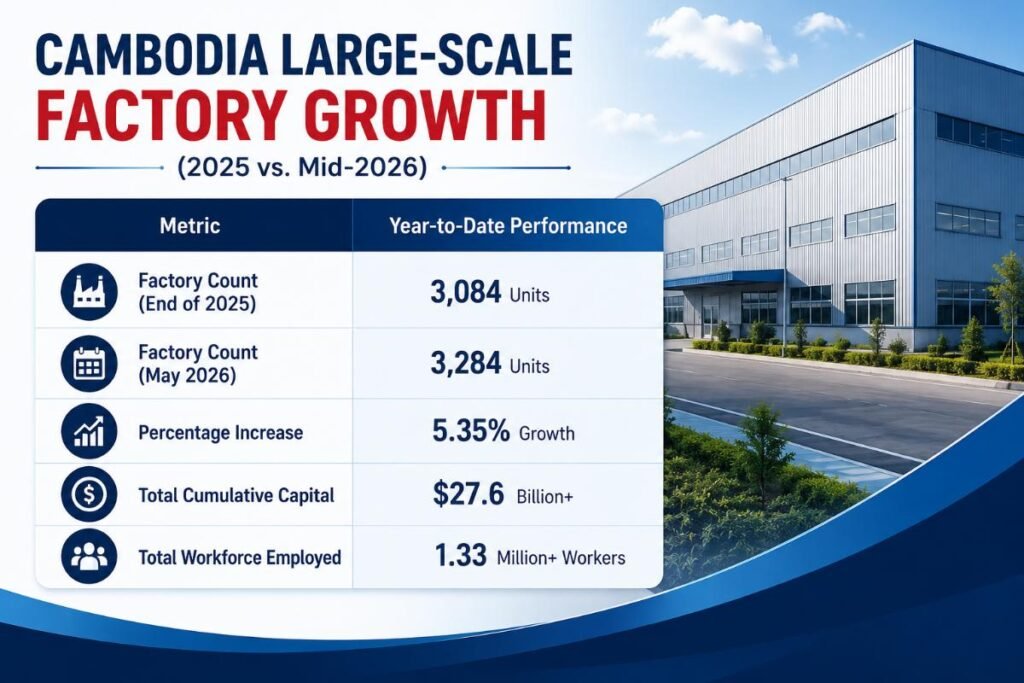
PHNOM PENH — Cambodia’s industrial sector continues to exhibit robust growth momentum, with the total number of operational large-scale factories climbing to 3,284 as of May 2026. This milestone, detailed in a report by the Ministry of Industry, Science, Technology and Innovation (MISTI), reflects steady investment inflows and expanding operations across the country.
The sharp rise highlights sustained international confidence in the Kingdom’s economic stability. Furthermore, it reinforces the industrial manufacturing framework as a foundational pillar supporting national economic development.
Escalating Capital Investment and Employment Capital
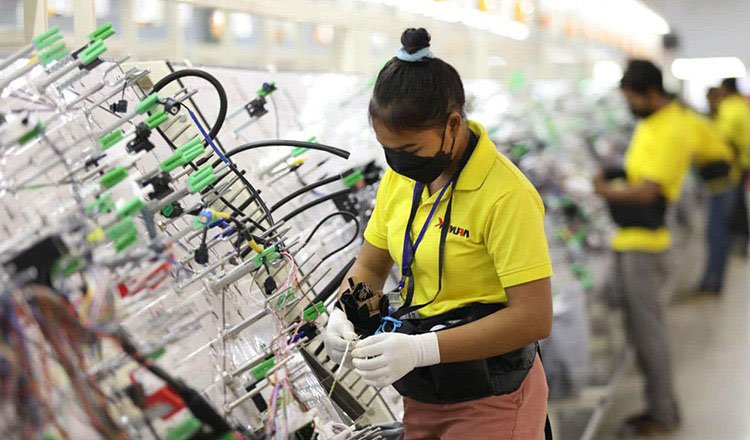
According to MISTI’s statistical data, the 3,284 active large-scale factories represent a cumulative investment capital base exceeding $27.6 billion. This manufacturing ecosystem has evolved into a key employment engine, currently supporting more than 1.33 million jobs nationwide.
Notably, this represents a 5.35 percent net increase in high-capacity factories from the 3,084 manufacturing hubs recorded at the close of 2025.
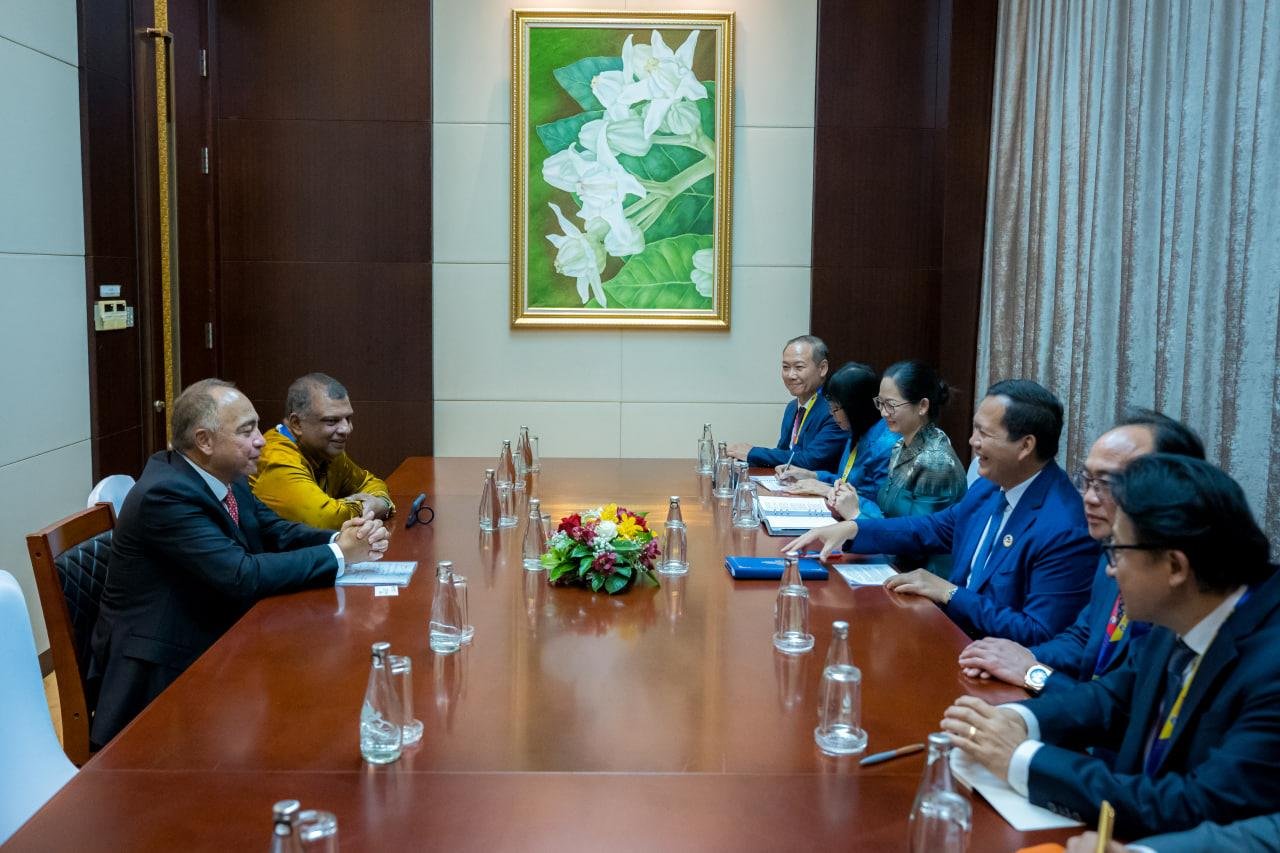
Speaking at the Asia Prestige 50 Under 50 CEO Excellence Award 2026, Minister of Industry, Science, Technology and Innovation Hem Vanndy emphasized that Cambodia remains heavily open to long-term investment partnerships.
“Investor confidence is reflected in the increased investment projects and continued expansion of existing manufacturers,” stated Minister Vanndy. He pointed directly to the successful launch of Toyota’s new locally engineered Hilux Travo assembly line as clear evidence of Cambodia’s expanding production capability.
Moving Toward Higher-Value Industrial Chains
Historically, Cambodia’s export matrix has relied heavily on the Garments, Footwear, and Travel goods (GFT) sectors. While these traditional industries still command a substantial market share, the government is systematically implementing strategic frameworks to diversify manufacturing into medium- and high-tech sectors, such as electronic components and vehicle assembly lines.
Industry specialists note that Cambodia’s growing investment appeal stems from its transition toward higher-value industrial output. The Cambodia Chamber of Commerce also welcomed the positive data. Chamber Vice-President Heng pointed out that the steady surge in new factory openings stands as a direct byproduct of Cambodia’s business-friendly investment laws and competitive tax policies.
Aligning Local SMEs with Global Supply Ecosystems
To support this massive factory expansion, the government actively pushes for deeper integration between major foreign manufacturing anchors and local small-and-medium enterprises (SMEs). Building a reliable tier-one and tier-two domestic supplier base reduces the dependency on imported raw components, ensuring long-term supply chain resilience.
Concurrently, MISTI has reaffirmed its commitment to boosting national industrial competitiveness. Key policy updates focus on tightening industrial safety guidelines, improving risk-management procedures, and promoting cleaner energy practices to meet international corporate governance standards.
Also Read, Cambodia-Vietnam Delegation Explores Agro-Processing and Logistics Hubs at Snoul SEZ