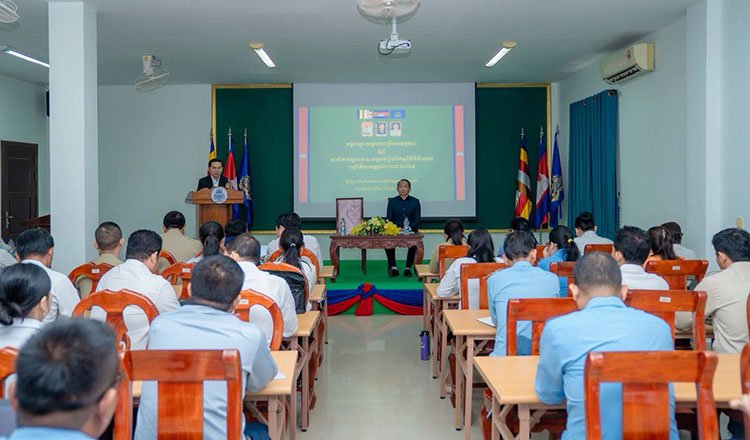
SIEM REAP — The Siem Reap Provincial Administration and the Provincial Department of Planning recently launched a targeted capacity-building training programme for technical officials. The initiative aims to enhance development planning and data analysis for the province’s upcoming three-year rolling investment programme, which spans from 2027 to 2029.
Siem Reap Deputy Governor Sok Thul chaired the training sessions. He emphasized that the program specifically targets the technical skills of local officials. Consequently, this training ensures that future investment programming remains highly effective, evidence-based, and fully aligned with Phase I of the national Pentagonal Strategy.
The Power of Reliable Data in Public Allocation
During the event, Thul explained that thorough situation analysis forms a fundamental pillar of any successful development blueprint. Without comprehensive analysis and reliable data, local investment projects run a high risk of failing to address actual community needs.
Furthermore, accurate data analysis allows authorities to distribute public resources, state budgets, and human capital far more efficiently. As a result, the province can expect much better socio-economic development outcomes across the region.
Overcoming Administrative and Planning Obstacles
The workshop also functioned as an open platform for officials to address systemic obstacles. Specifically, participants identified several recurring challenges that have previously hindered effective investment planning:
- Limited coordination among distinct technical departments.
- High staff turnover rates.
- Insufficient planning experience among newer team members.
- Inconsistencies during project preparation across different communes and districts.
To resolve these pressing issues, the provincial administration introduced immediate corrective measures. Moving forward, the government will expand technical training in SWOT analysis, monitoring and evaluation, and integrated development planning. Therefore, officials will be better equipped to coordinate large-scale infrastructure projects alongside broader development initiatives.
Reviving Tourism and Boosting Economic Indicators
In addition to internal reforms, Siem Reap is actively encouraging small and medium-sized enterprises (SMEs) to formalize their business registrations. This move aims to solidify and strengthen the vital tourism and agriculture sectors.
Despite ongoing global economic challenges and recent tourism disruptions, Siem Reap authorities remain focused on national economic recovery strategies. Specifically, the province continues to implement targeted policies to revive local tourism while improving agricultural and aquaculture productivity to support poverty reduction.
Fortunately, recent data reveals a promising trajectory. According to preliminary situation analysis by the Ministry of Planning, Siem Reap recorded highly positive economic indicators. The data shows that the province’s total trade volume exceeded $2.1 billion, while the average income per capita climbed steadily to $2,191.
What specific sectors do you think will benefit most from Siem Reap’s data-driven investment approach?– Comment below.
Also Read, Cambodia Urges China’s CCECC to Expand High-Value Infrastructure Investments