

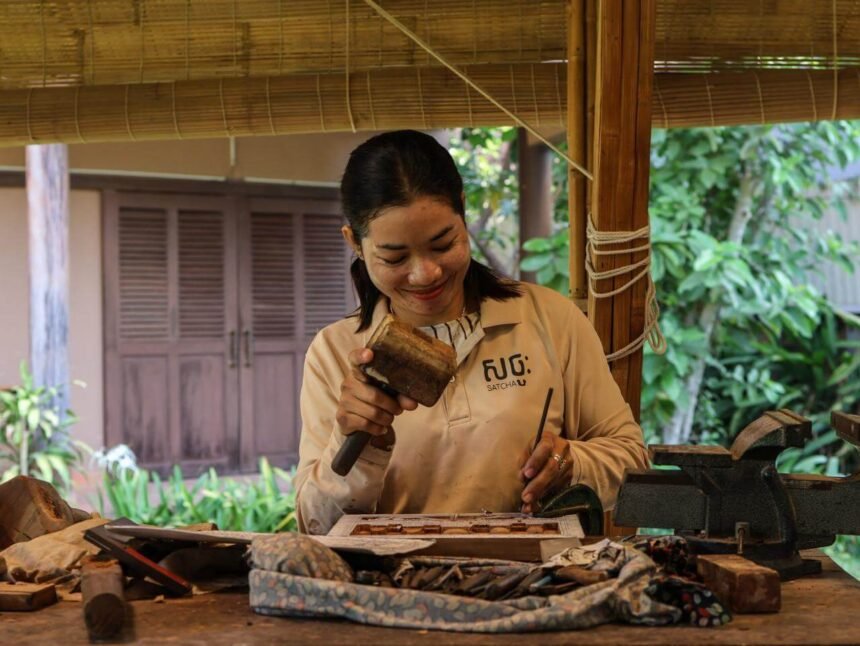
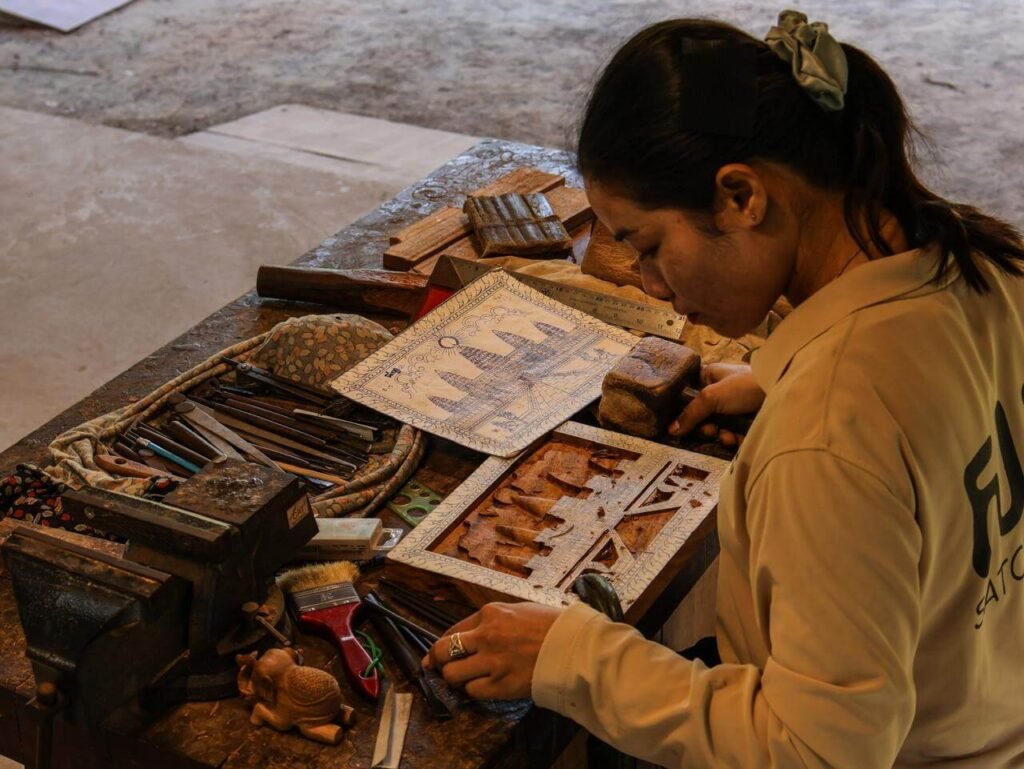
Eyes fixed on her carving of Angkor Wat, Sarin handles her tools with quiet precision. A brief, confident stroke and the wood yields, cut cleanly and evenly. In Cambodia, craftsmanship is carefully studied, preserved, and passed down. It carries the cultural identity of the Kingdom, inherited from its imperial era, with Siem Reap as its capital. After the civil war came a time of reconstruction. Initiatives flourished to safeguard traditional Khmer arts. As both a driving force of the economy and a vessel of history, craftsmanship continues to hold a central place in SiemReap. At its heart, an incubator has set itself the mission of training artisans, offering them pleasant working conditions and comprehensive learning, in an environment set apart from the outside world’s rush defined by tranquility and openness: Satcha.
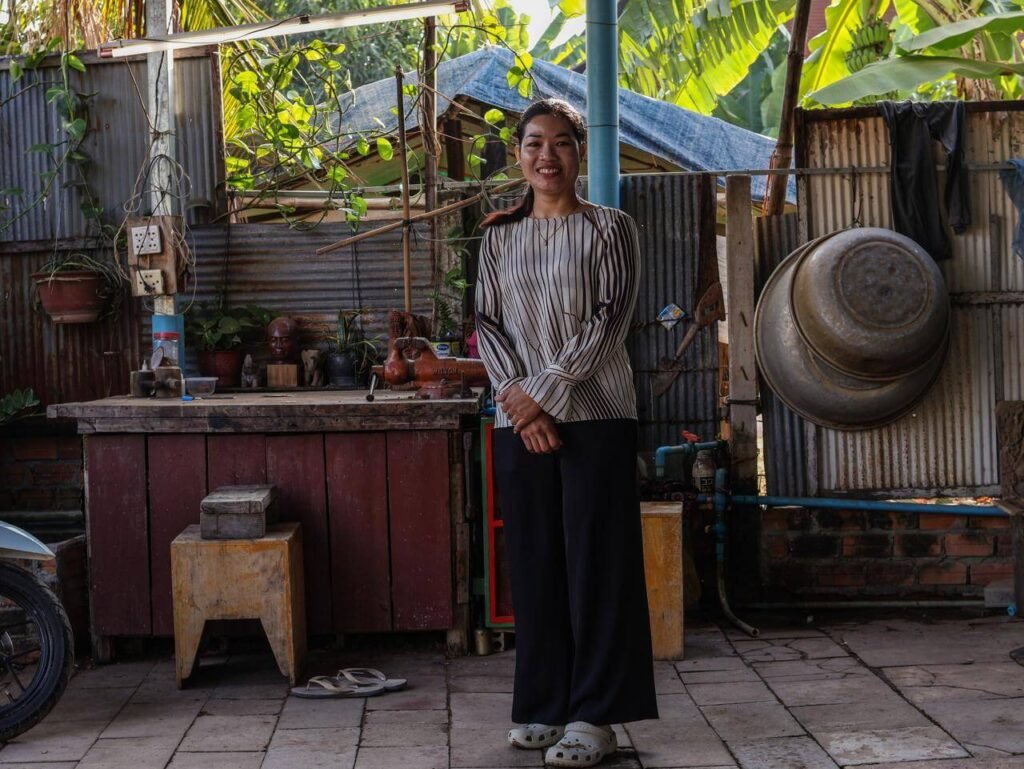
Sarin is 37 years old. She is a wood-carving artisan at Satcha. Her relationship with wood sculpture began early, at the age of 16, and not entirely by choice. Born in a precarious family, her parents could not afford to support her education. She was soon forced to seek paid work in order to meet her own needs. Unsure of the path to take, she nevertheless knew she wanted to contribute to the promotion of Cambodian culture. The loss of her parents rendered financial independence imperative. Still too young to practice professionally, she studied 2 years before obtaining her certificate and was finally able to work as an artisan.
Today, craftsmanship remains at the heart of her family life: her husband also works in wood carving for another company in the city. And she hopes that, when they are older, her children will be able to take part in the creative process. More than a job, wood carving became a true passion, so much so that she set up her own workshop at home. She even brings her tools and creations home, extending her work beyond its confines and into her daily life. Upon entering her house, it is impossible to miss the wooden sculptures displayed on a large shelf, proudly arranged alongside the many certificates lining the walls. Deeply proud of her craft, Sarin readily shares her journey and her training.
Also read, Tonlé to Treeline – From River to Forest: Cambodia’s Living Landscapes
We jump on our scooters and just a few minutes later, we arrive at her workplace. It feels like stepping into a place suspended in time, where the mind settles to the sound of birds and the soft, measured gestures of artisans absorbed in their craft. Surrounded by fluorescent-green rice fields, they work in small bamboo structures that allow them to enjoy the outdoors year-round. For Sarin, this is far more than a workplace. She values the atmosphere, the sense of community among the artisans, and the pleasure of working together. Although wood carving requires great precision and constant attention, it remains an enjoyable practice when shared. It is a passion she is eager to pass on. From time to time, tourists stop by, drawn by the precision of her gestures. They watch in silence, amazed as the pattern slowly emerges from the wood. Sarin meets their gaze with sparkling eyes and a discreet smile. If the language barrier were not so present, she would love to tell them her whole story and pass on everything she knows about this art. Thanks to the company’s support for English learning, Sarin has the opportunity to practice the language and open up further about her craft.
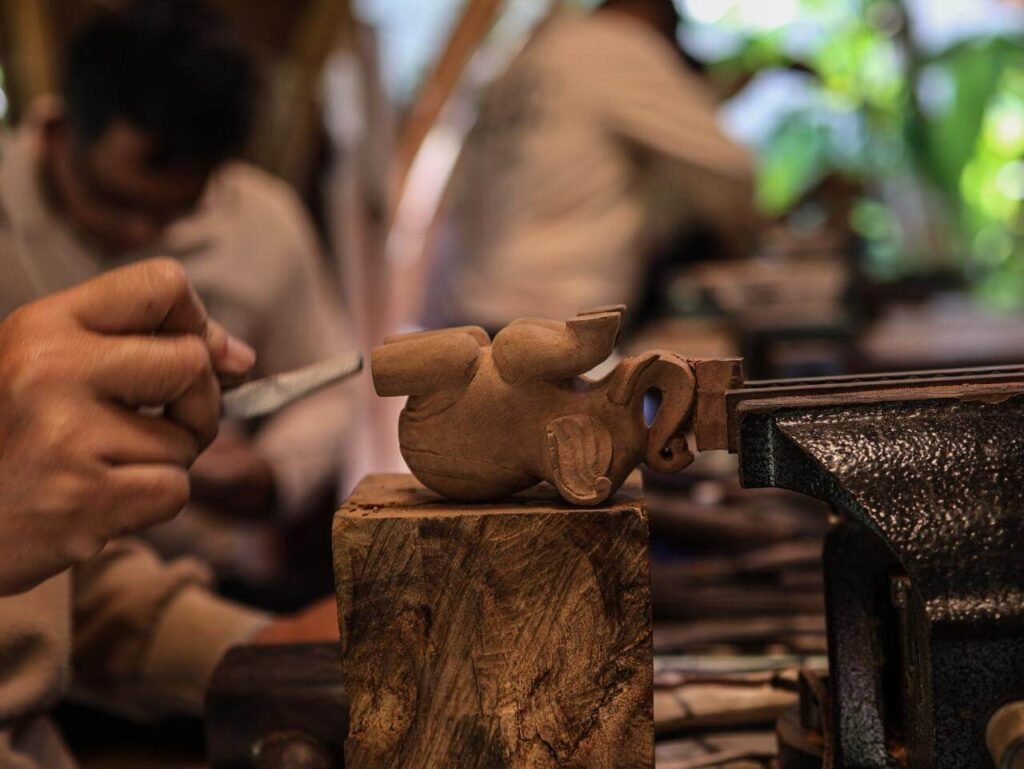
Sarin is drawn to the challenge of her work. She particularly enjoys meticulous, demanding, and highly precise pieces. Those that can take days, sometimes even weeks, to complete. Beneath each sculpture, she engraves her name alongside that of Satcha. What she values most is the daily learning fostered within the workshop. In the past, her role was limited to execution: carving each piece according to strictly transmitted models. Today, Satcha continually introduces new designs and encourages her to create. This shift has allowed her to develop a broader vision and a deeper understanding of wood carving as a whole.
This is why, Sarin produces her own drawings, which she submits to the teams for approval. Decisions are made collectively. She may propose her designs to the design team, who assess and validate them. Or not. When new designs emerge, teams meet together to exchange ideas. This reciprocal dynamic enables artisans to develop their skills across multiple dimensions, creating a collective momentum driven by learning.
Also read, Theam’s Gallery, or the Art of Returning History to Its People
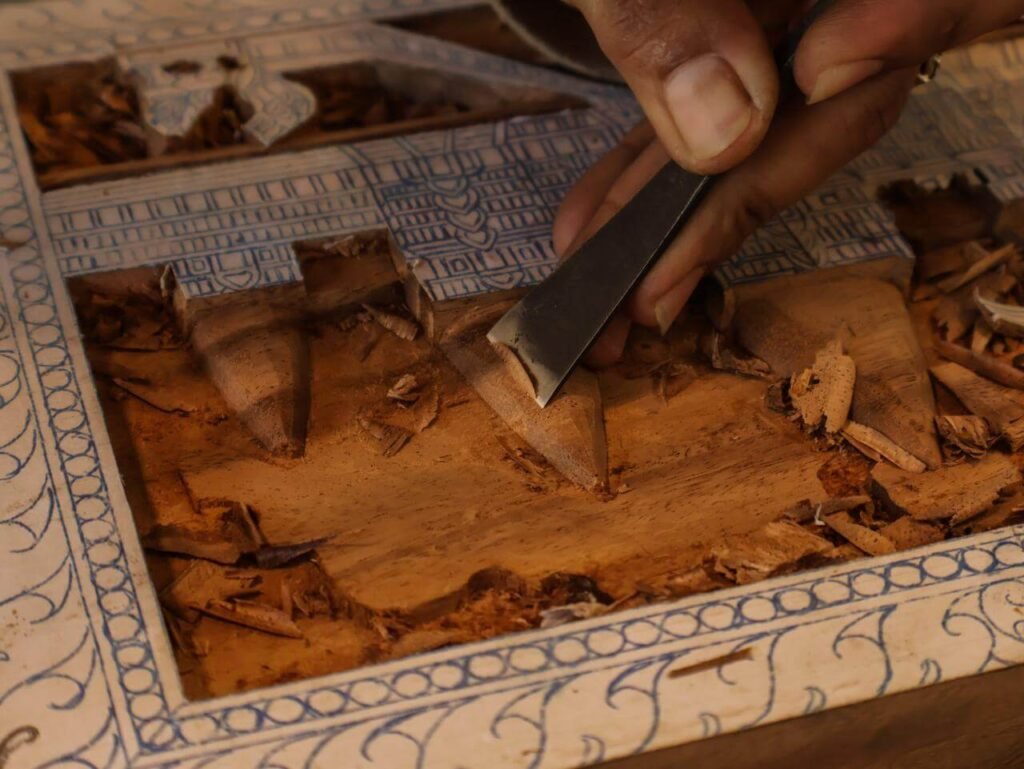
What surprised us is that this craft is not solely based on rigid, methodical techniques. The division of labor remains flexible, encouraging genuine dialogue among employees. Wood carving here is an art that embraces creation, drawing on historical elements to produce something new and contemporary. In doing so, it perpetuates traditional craftsmanship among Cambodians. Indeed they are given the opportunity to rediscover, again and again, the motifs carved into temples such as Angkor Wat, a constant source of inspiration for the surrounding artistic community.
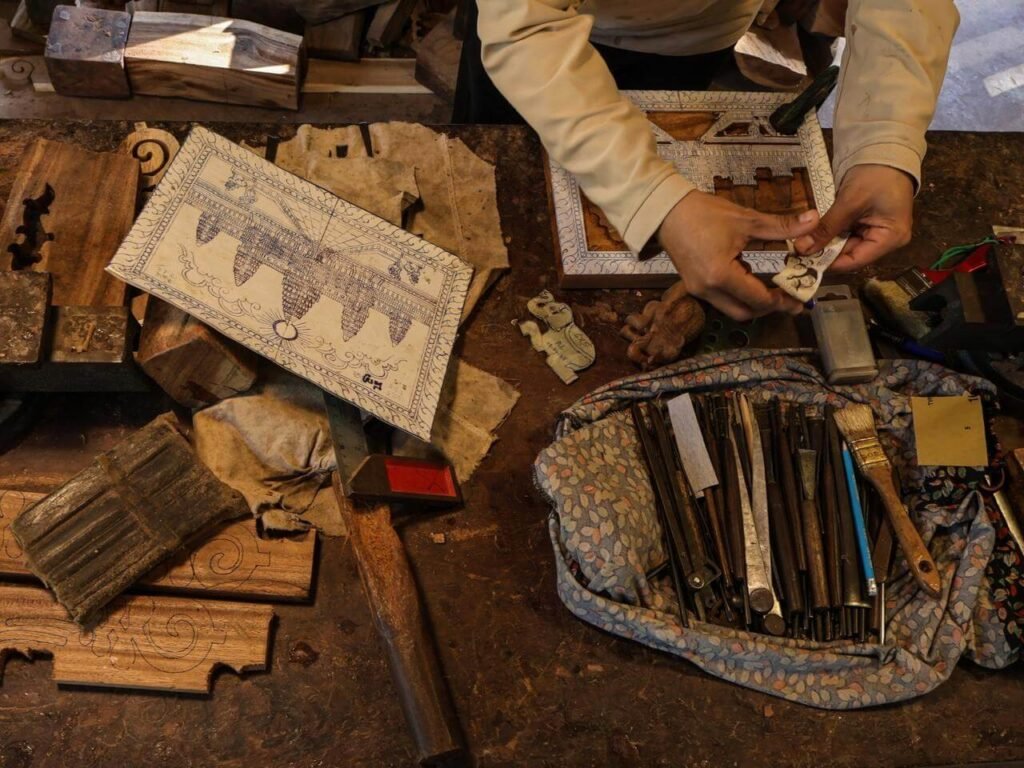
This is what Sarin shared with us throughout our exchanges: a constant desire to learn, to improve, and to keep exploring the echoes of the past. For within what is known, there is always the unknown; within technique, there is always room for creativity; and within sharing, there is always transmission. Our sincere thanks go to Sarin, who offered us a powerful example of meritocracy. Her determination continues to be recognized and rewarded at Satcha, and rightly so.
We also extend our gratitude to the entire Satcha team: Yaya, Soky, and Jon for coordinating our visit, and to all the artisans for their warm welcome. We truly cherished the time spent there.
Also read, Fighting for What Feels Right