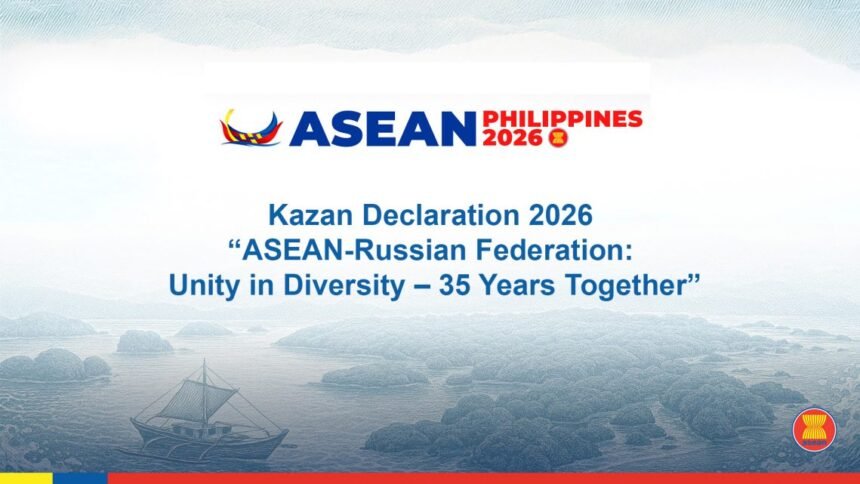
KAZAN, Russian Federation — The Association of Southeast Asian Nations (ASEAN) and the Russian Federation have officially adopted the “Kazan Declaration 2026,” establishing a comprehensive roadmap to navigate shifting global geopolitics and deepen regional cooperation.
- 1. Championing a Multipolar World Order and ASEAN Centrality
- 2. Unveiling New Joint Initiatives on Maritime Security and Biosecurity
- 3. Expanding Trade, AI Cooperation, and Inter-Regional Connectivity
- 4. Driving Youth Empowerment, Scholarships, and Cultural Exchange
- Looking Ahead: Endorsement of the 2026-2030 Strategic Plan
The landmark document, titled “ASEAN-RUSSIAN FEDERATION: UNITY IN DIVERSITY – 35 YEARS TOGETHER,” was formally endorsed on June 18, 2026, during the high-level Kazan Summit in Kazan city, Republic of Tatarstan. The summit marks exactly 35 years since the establishment of relations between ASEAN and Russia in 1991.
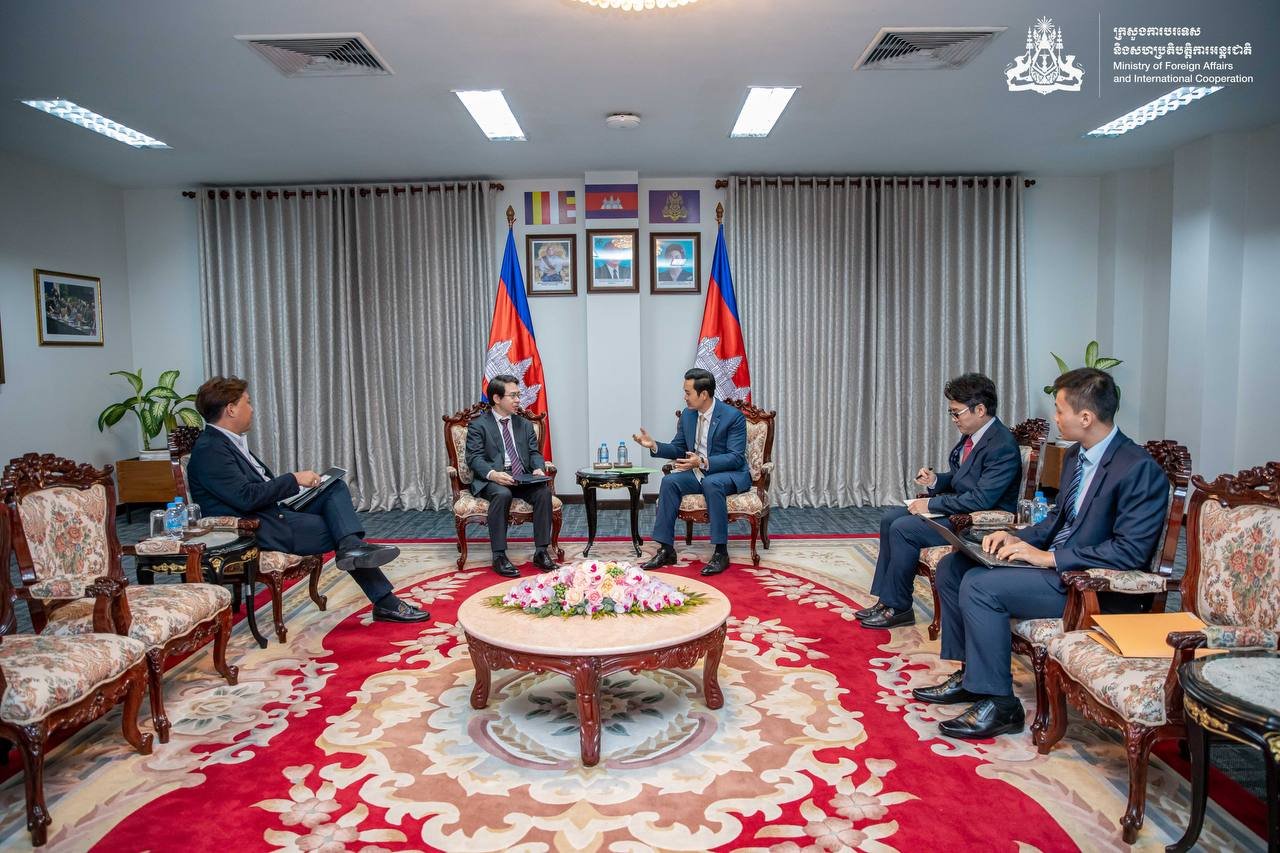
Representing the Kingdom, Cambodian Prime Minister Hun Manet and the Royal Government delegation attended the commemorative summit. Their presence underscores Cambodia’s active role in fostering regional integration, promoting security dialogue, and strengthening economic ties within the ASEAN-Russia framework.
The declaration outlines a shared commitment to a just multipolar world order, ASEAN centrality, and a massive expansion of economic, digital, and security ties through the end of the decade. The official framework for this cooperation is detailed in the official document, “Kazan-Declaration-2026.pdf”.
1. Championing a Multipolar World Order and ASEAN Centrality
Amid increasingly complex global challenges driven by geopolitical and geo-economic shifts, the Kazan Declaration affirms a common aspiration toward a just multipolar world. This vision is explicitly guided by international law and the principles of the United Nations Charter.
Crucially, Russia reaffirmed its continued support for ASEAN Centrality within the region’s open, transparent, and resilient architecture. Both sides pledged to sustain high-level engagements—including regular ASEAN-Russia Summits—while leveraging existing ASEAN-led mechanisms such as the East Asia Summit (EAS), the ASEAN Regional Forum (ARF), and the ASEAN Defence Ministers’ Meeting-Plus (ADMM-Plus).
2. Unveiling New Joint Initiatives on Maritime Security and Biosecurity
The 2026 declaration introduces critical practical initiatives designed to address both traditional and non-traditional security threats across the Asia-Pacific, Indian Ocean, and Eurasia regions.
Key security commitments under the new pact include:
- Maritime Infrastructure Protection: A mutual pledge to ensure freedom of navigation, overflight, and unimpeded commerce under the 1982 United Nations Convention on the Law of the Sea (UNCLOS). Furthermore, both sides will explore a new dialogue mechanism to counter sea piracy and safeguard critical underwater infrastructure (CUI).
- Regional Biological Safety: In response to public health hazards from pandemics, climate change, and potential bioterrorism, ASEAN and Russia will explore a dedicated biosecurity dialogue mechanism to coordinate threat responses.
- Combating Cybercrime: The declaration highlights a mutual interest in strengthening capacity-building and sharing best practices to fight transnational crimes, specifically those utilizing information and communication technologies (ICTs).
3. Expanding Trade, AI Cooperation, and Inter-Regional Connectivity
On the economic front, the Kazan Declaration seeks to intensify trade and investment flows to bring direct economic benefits to both populations. Both parties agreed to deepen cooperation in vital sectors such as energy and food security, transport logistics, and agriculture.
Looking toward the future economy, the agreement places a heavy emphasis on digitalization, science, and technology—specifically citing joint advancements in Artificial Intelligence (AI) and creative industries.
Additionally, the declaration emphasizes the practical value of linking regional infrastructure. This includes fostering practical cooperation across the priority areas of the ASEAN Outlook on the Indo-Pacific (AOIP) and supporting deeper institutional partnerships between ASEAN, the Eurasian Economic Union (EAEU), and the Shanghai Cooperation Organisation (SCO).
4. Driving Youth Empowerment, Scholarships, and Cultural Exchange
To ensure the strategic partnership thrives in future generations, the declaration outlines a robust framework for education and people-to-people connectivity.
The two sides announced plans to expand professional training programs, offer dedicated ASEAN and Russian scholarships, and increase academic, student, and language exchanges. To empower younger populations, officials are actively working toward establishing formal ASEAN-Russia Senior Officials’ Meetings on Youth.
Furthermore, cultural collaboration will be amplified under the framework of their existing 2010 agreement, focusing heavily on traditional culture, eco-tourism, the preservation of cultural heritage, and sports.
Looking Ahead: Endorsement of the 2026-2030 Strategic Plan
The Kazan Summit concluded with the formal endorsement of the Comprehensive Plan of Action to Implement ASEAN-Russian Federation Strategic Partnership (2026-2030).
With the support of regional leaders, including Cambodian Prime Minister Hun Manet, this newly minted five-year roadmap ensures that the multi-faceted, mutually beneficial collaboration between ASEAN and Russia will remain dynamic, highly secure, and economically integrated for years to come.
Also Read, CDC Encourages Australian Businesses to Invest in Cambodia