For decades, textile factories defined Cambodia’s economic narrative. Similarly, the rapid construction of urban centers shaped the country’s growth. However, a profound structural transformation is quietly taking root underneath the surface.
The Royal Government of Cambodia has officially finalized the National Strategy on Startup Development 2026–2030. This strategic policy framework was developed by the Ministry of Economy and Finance. They worked alongside the Digital Economy and Business Committee and the Techo Startup Center. Consequently, the strategy aims to pivot the Kingdom away from a manufacturing-heavy dependency. The new goal focuses on a dynamic, knowledge-based digital economy.
At the absolute center of this paradigm shift is Cambodia’s greatest asset. The country boasts a highly connected, fiercely entrepreneurial, and digitally savvy youth population.
The Vision: Fostering a Robust and Crisis-Resilient Ecosystem
The National Strategy on Startup Development 2026–2030 acts as a core operational component of Prime Minister Hun Manet’s Pentagonal Strategy–Phase I. Therefore, it outlines an intentional path to cultivate sustainable, inclusive, and crisis-resilient development.
Furthermore, the strategy addresses systemic ecosystem bottlenecks by introducing a lighter compliance landscape. For instance, it introduces a proposed three-to-five-year grace period. This period allows early-stage innovators to test, pivot, and scale their concepts safely before they face full administrative burdens.
The core roadmap is structurally built upon five crucial operational pillars:
- Regulatory Support: First, the government will streamline and simplify complex business registration procedures. This step actively reduces bureaucratic friction for tech-driven business models.
- Talent Development: Next, the state is directing heavy national investments toward STEM education. Additionally, schools will focus on specialized digital literacy, practical coding, and entrepreneurial training.
- Capacity Building: Meanwhile, authorities will develop, fund, and scale robust startup incubators. These accelerators and localized innovation hubs will open across both urban and provincial centers.
- Access to Finance: To bridge historical funding gaps, the strategy expands domestic venture capital pools. Moreover, it removes collateral requirements and designs government-backed seed funding pipelines.
- Market Expansion: Finally, the plan formally integrates Cambodian founders into wider ASEAN and global trade networks. As a result, local platforms can achieve cross-border interoperability from day one.
Real Milestones: Tracking the Digital Inflow
Importantly, this strategy is not merely a theoretical exercise. Instead, it lands on an ecosystem that is already demonstrating explosive momentum.
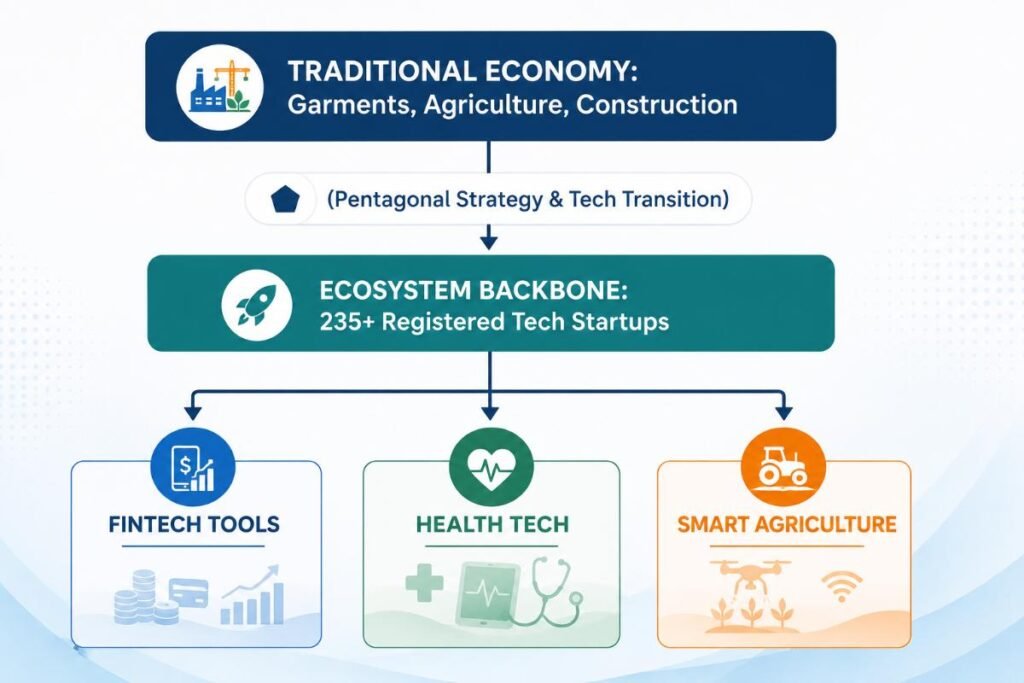
According to the latest tracking data from the Startup Cambodia Insight national program, the number of formally registered tech startups has climbed sharply. Currently, there are 235 active enterprises in the country.
To actively solve the historic bottleneck of capital mobilization, national initiatives are playing a vital matchmaking role. For example, Khmer Enterprise is intentionally connecting brilliant local founders with international angel investor networks. They also provide low-interest, non-collateral credit lines. Thus, the state is effectively lowering the barrier to entry for digital builders.
Why It Matters: High-Value Paths for Cambodia’s Youth
Ultimately, the strategic implications for Cambodia’s upcoming generation are immense. Cambodia no longer wants to be an economy that strictly exports raw materials. It also aims to move past being a destination for basic assembly lines. Instead, the strategy positions youth to build highly complex, proprietary digital solutions tailored to the Global South.
By scaling up homegrown platforms, young innovators can transform fintech, health tech, and smart climate-agriculture. Consequently, these changes are engineering sustainable, high-paying career trajectories.
As the country actively prepares to graduate from its United Nations “Least-Developed Country” (LDC) status by the end of 2029, progress is clear. The Silicon Kingdom approach ensures that Cambodia will enter the next decade with confidence. The country will not just consume global technology; rather, it will actively create it.
Also Read, Cambodia and China Agree on BRI-PS Synergy to Unlock New Economic Opportunities